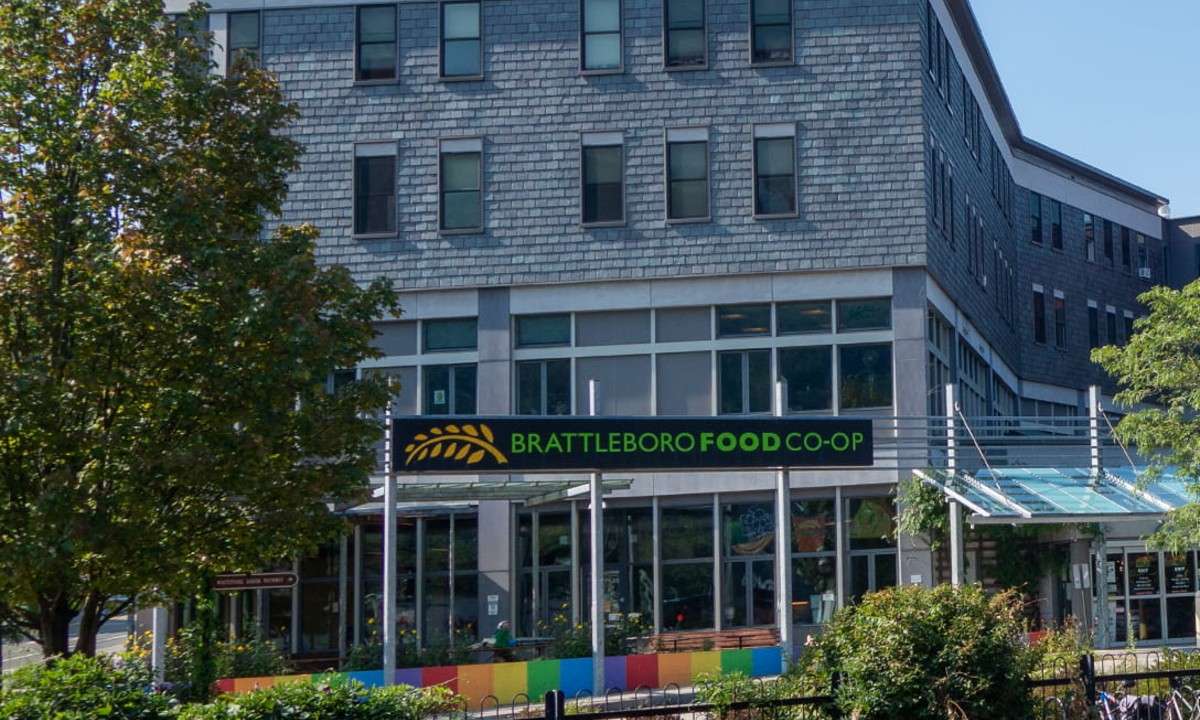
On April 2, the Brattleboro Food Co-op, a 14,000ft2 (1,301m2) Vermont grocery store co-owned by about 9,300 stakeholders, announced on its website that it was awarded a grant of $500,000 (€434,000) from the U.S. Department of Agriculture (USDA)’s Rural Energy for America Program (REAP) program.
REAP helps small rural businesses invest in renewable energy systems and energy-efficiency improvements. “With the help of this funding, we will be replacing our entire refrigeration system to one that – unlike our current system – will have a minimal impact on our climate emissions,” wrote Sarah Brennan, Board Administrator/Sustainability Coordinator for the Co-op. The new equipment will be a transcritical CO2 (R744) refrigeration system.
But then the USDA informed the Co-op that its grant funding was frozen, a consequence of the government-wide spending overhaul by the Trump administration.
The transcritical CO2 project, however, is still on. That’s because earlier this year the Co-op also received employee retention credit funds stemming from its continuing to employ workers during the Covid pandemic period. “A fortuitous circumstance,” said Brennan. “We were really lucky because we got enough money from those credits to do the entire project.”
The Co-op is now mapping out which equipment and systems it will purchase with its contractor, Rutland, Vermont-based Turner Piping and Refrigeration. “We anticipate our contractor purchasing those on our behalf this summer,” Brennan said. But installation will wait till after the winter holiday season, possibly wrapping up by the summer of 2026. The new refrigeration system is estimated to cost about $1.4 million (€$1.2 million), though it may be more “because prices have gone up a bit,” said Brennan.
The Co-op worked with the Ratio Institute, an independent nonprofit focused on promoting sustainability in food retail, on securing the REAP grant. Under the terms of the grant, the Co-op needs to complete the project by March 2027, which is expected, and then receive $500,000 to recoup part of its costs. But whether it will ever receive the now-frozen funds, Brennan acknowledged, is unclear.
In any event, the Co-op needs to replace its R404A-based legacy system, she said, given the ongoing phase-out of HFCs, and the system’s annual leak rate, which exceeds 300%. “In 2024, that amounted to 378lbs [171kg] of R404A drifting up into the atmosphere,” she wrote on the website.
CO2 seen as ‘state of the art’
In deciding what type of refrigeration to invest in, the co-op decided to choose “the state of the art,” said Brennan. To that end, “CO2 seems to be the way to go.” This is in line with one of the Co-op’s four organizational principles: to engage in sustainable and regenerative environmental practices. “We have an aspiration, a North Star, which is to aim towards carbon neutral,” she said.
The system will incorporate adiabatic cooling and heat reclaim. In addition, the Co-op will have some stand-alone units – beverage coolers and prep-table fridges in the cheese and deli departments – that run on propane (R290).
The VEIC (Vermont Energy Investment Corporation) plans to assess the efficiency of the new system and Turner Piping and Refrigeration will be monitoring the system’s performance from its headquarters.
“CO2 seems to be the way to go.”
Sarah Brennan, Sustainability Coordinator for the Brattleboro Food Co-op
The Co-op, on the first floor of a four-story building, operates 154ft (47m) of open medium-temperature multi-deck cases and 61 doors of closed medium-temperature cases, and 37 doors of closed low-temperature cases along with some bunker cases. The building’s second floor includes offices and a commissary kitchen while the top two floors are affordable housing.owned and managed by the Windham and Windsor Housing Trust, a separate nonprofit organization.
In her website post. Brennan acknowledged the difficulty the Co-op was having with the current refrigeration system “Just a few weeks ago, we moved our ice cream from the end of the line (down by the Bulk Department) to the side closer to the Seafood counter, in order to get it closer to the compressor in the back room, because, well, it kept almost melting,” she wrote.
The Co-op generates 30,000kWh of electricity from rooftop solar panels, 3% of the amount it uses annually. It has an agreement with a local solar developer, Norwich Solar, to source the rest of its electricity from a solar array under construction.
Aiming for CO2 retrofit
Another U.S. grocery co-op, Ashland Food Co-op in Ashland, Oregon, is interested in replacing its legacy refrigeration systems with transcritical CO2 refrigeration, possibly as part of a store remodel, according to its sustainability manager, Chris Byrne.
“We are considering our refrigeration and our HVAC systems as end of life,” he said. The Co-op is working on a potential CO2 system replacement with Taper, an energy management B Corp. The project still needs to be approved by the Co-op’s finance committee.
In addition to its store the Co-op runs refrigeration in a storage barn and bakery nearby; the store system is the focus of the replacement project but the barn’s system could be retrofitted as well.
Like the Brattleboro Food Co-op, the Ashland Food Co-op applied for a REAP grant in December and is awaiting word from the USDA on the status of its application. The project is not dependent on getting the grant, said Byrne.
One of the Ashland Food Co-op’s 2030 goals is to “use no persistent chemicals.” Many f-gas refrigerants, including the latest generation, HFOs, fall under the definition of persistent chemicals known as PFAS (per- and polyfluoroalkyl substances). Thus one of the drivers of choosing a CO2 refrigeration system is to avoid using persistent chemicals, said Byrne. In addition, higher maintenance costs and the rising costs of f-gas refrigerants “all make the case for moving to CO2.”
The Ashland Food Co-op is a member of the U.S. Environmental Protection Agency’s GreenChill Program, which helps supermarkets reduce refrigeration leaks and transition to natural refrigerant systems. In 2023 it received the GreenChill award for achieving the lowest leak rate among small, independent grocers.
The Co-op gets credit for solar energy produced in the town of Ashland via virtual net metering and also uses solar panels on its premises, accounting for almost half of its electricity. It is offsetting 100% of its scope 1 and 2 greenhouse gas emissions by purchasing renewable energy credits from the Bonneville Environmental Foundation.