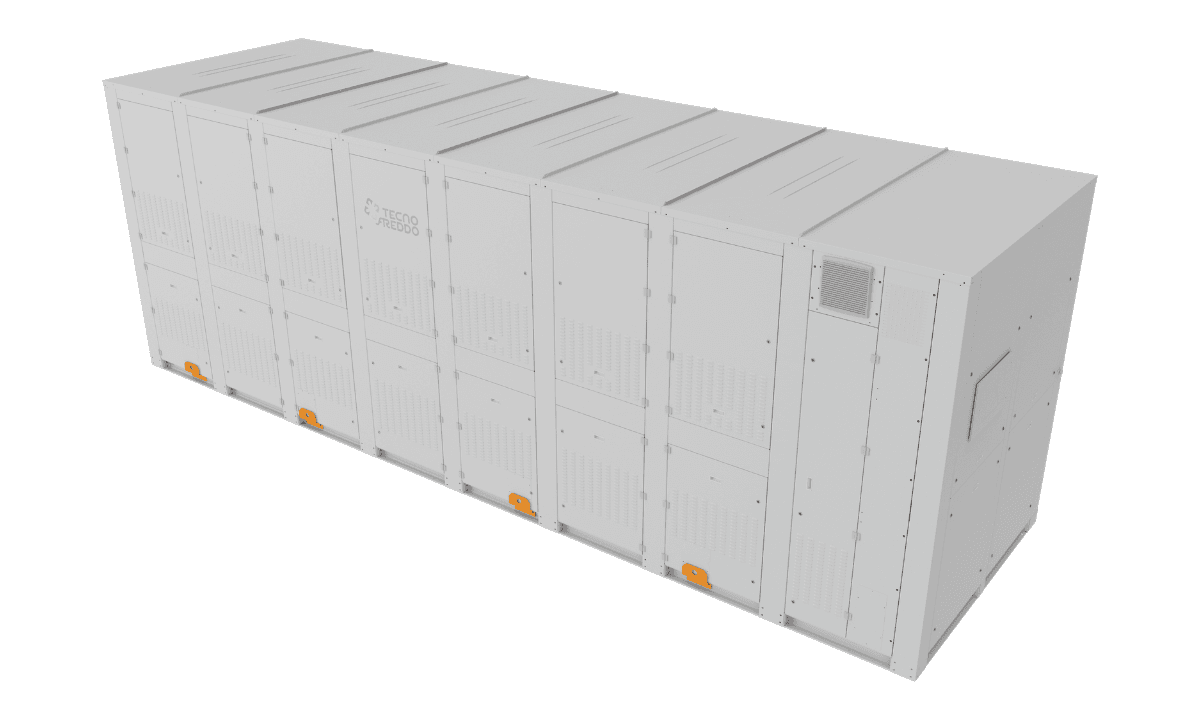
U.S. manufacturer Copeland has announced the launch of an ammonia (R717)-based water-to-water industrial heat pump under its Vilter brand that offers 1 to 5MW (284 to 1,422TR) heating capacity on a single skid for decarbonizing district heating and industrial process heating applications, including food and beverage production.
The announcement came at the Chillventa trade show in Nuremberg, Germany, taking place October 8–10.
The modular unit, model VQ95, can be run in parallel to generate up to 40MW (11,374TR) of heat, noted Grant Kovac, Vilter’s Director – Product Management, during an interview at Copeland’s Chillventa stand at the Exhibition Center Nuremberg. “So it’s perfect for district heating.”
The heat pump is available in both Europe and the U.S., with manufacturing plants in each market.
The heat pump can generate temperatures up to 95°C (203°F), using less than 250kg (551lbs) of ammonia, said Kovac. It employs a single-screw compressor, which enables the system to generate “higher pressures and higher temperatures because of the balanced design of the single screw,” he added. In April, Copeland announced the use of single-screw compressors in the production of its first Vilter-branded industrial CO2 (R744) compressor unit for transcritical or subcritical refrigeration.
This is the first time that Copeland has produced a packaged ammonia heat pump. “In the past, we would sell our compressors to third-party companies who made the heat pump,” Kovac said.
Kovac noted that the water (liquid) source for the VQ95 heat pump could be discharged ammonia from an adjacent refrigeration system. Otherwise the water could be sourced from groundwater, lakes, rivers, waste water or sewage.
The VQ95 does not require super heat because the single-screw compressors “can accept a tolerance of liquid droplets to boost the COP,” said Kovac. He added that the heat pump was designed with a platform to give technicians easy access to critical components.
“It’s perfect for district heating.”
Grant Kovac, Director – Product Management for Vilter
The global industrial heat pump market is forecast to grow exponentially over the next several years, and in energy-intensive industrial processes the electrification of heating systems is widely recognized as a necessary step, noted Copeland. A new report published by McKinsey values the industrial heat pump market at $4 billion in 2023 and is estimated to reach $21 billion by 2030.
Because the heat delivered far exceeds the energy consumed, industrial heat pumps greatly reduce reliance on fossil fuels and expand opportunities to utilize renewable energy sources.