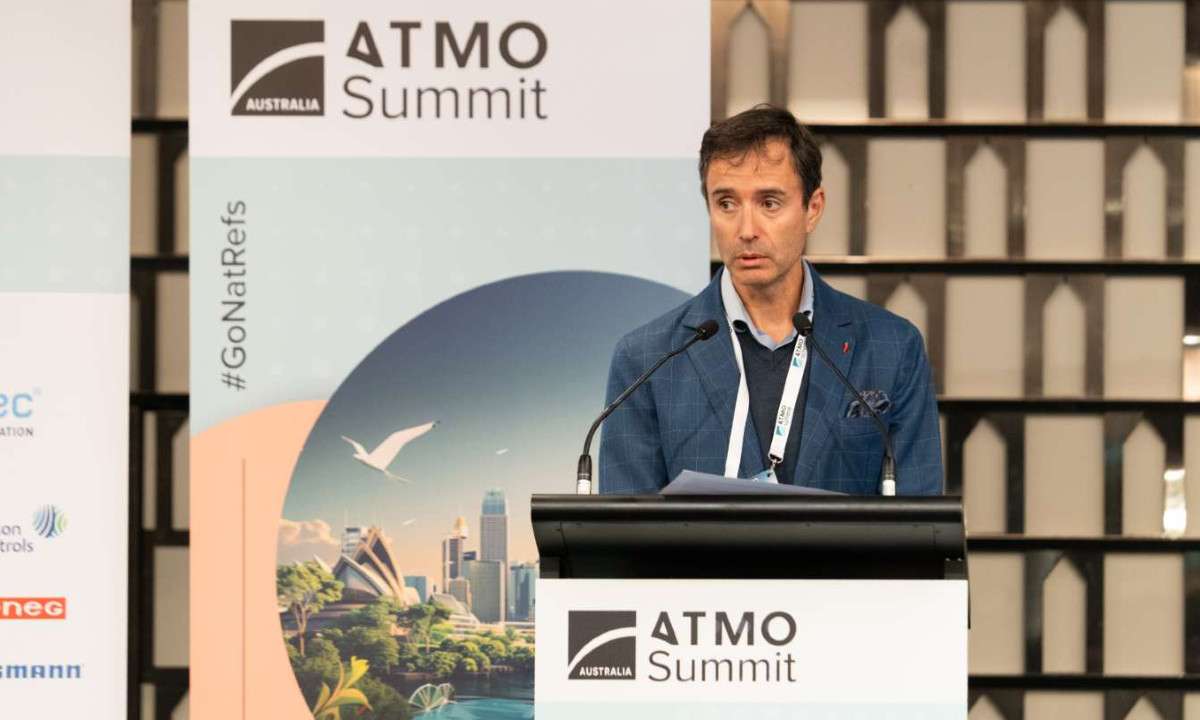
Natural refrigerants are helping Australian retailer Woolworths slash emissions 89% by 2030 compared to 2006 – a drop from 3.7 million metric tons of CO2e to roughly 400,000 metric tons – said Dario Ferlin, National Sustainable Engineering Manager at the company.
In 2006, the chain operated 760 stores and estimates it’ll have around 1,200 by 2030. The CO2e reductions will be achieved through the active use of transcritical CO2 (R744) racks and propane (R290) equipment, heat pumps and ice machines, as well as sourcing solely renewable energy by the end of 2025.
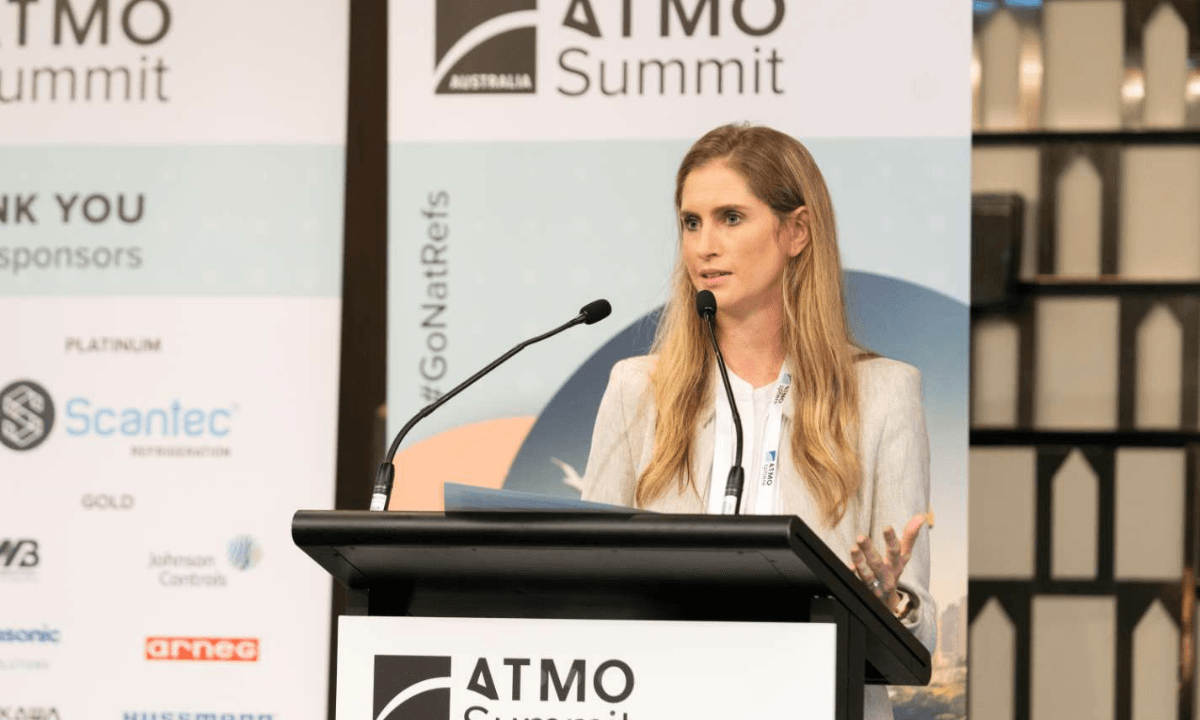
Ferlin, joined by Samantha Bothma, Senior Refrigeration Engineer at Woolworths Group, outlined the retailer’s blueprint to net zero by 2050 in a presentation at ATMO Australia 2025. The event, organized by ATMOsphere, publisher of NaturalRefrigerants.com, was held May 12–13 in Sydney.
“Stationary refrigerants account for 71.6% of our scope 1 emissions,” Bothma said. “In our sustainability drive, we are converting our end-of-life refrigeration equipment in existing stores to natural refrigerants, and new stores generally use transcritical CO2.”
Centralized racks and mechanical heating and cooling systems account for 99% of refrigerant use in a store, Bothma noted. The refrigeration equipment addressed in the presentation included centralized systems, self-contained cases, HVAC chillers and heat pumps, ice machines and bakery proofers.
Making strides: In 2017, Woolworths installed its first transcritical CO2 refrigeration system in a store in Greenway Village, New South Wales. It started integrating HVAC applications in 2018, with direct expansion cooling added in 2023.
- The group celebrated the opening of its 100th CO2 store in March 2024. Of its 1,150 stores, 125 use transcritical CO2 refrigeration systems, according to ATMOsphere’s “Natural Refrigerants: State of the Industry 2024” report.
- “In situations where we are not ready to do a complete store revamp, we do as much as we can to support a full CO2 transition, including installing high-pressure rated coils,” Bothma said.
The group is transitioning its R404A self-contained cases to R290 and its hot water systems from R134a heat pumps to CO2 heat pumps, according to Ferlin.
In progress: To increase store efficiency, Woolworths continues to trial new natural refrigerant technologies.
- “We have trials with [CO2 refrigeration supplying] DX cooling in the main air-handling unit,” Bothma said, adding that the group is considering trying fan coil units in areas of stores that aren’t accessible to the public.
- Woolworths has connected condenser deck mounted evaporators to the medium-temperature (MT) CO2 system in two stores, according to Ferlin. “From a 100kW [28TR] MT [capacity] CO2 refrigeration system, we can recover almost 140kW [40TR] of heat for space heating,” he said.
- R290 ice machine trials are underway. In non-integrated stores, the group is considering R290 chillers for HVAC.
Revamped: Ferlin and Bothma highlighted what a decarbonized Woolworths store’s refrigerant charge and reduced energy consumption look like based on current technology.
- A centralized rack provides refrigeration and store heating and cooling with 720kg of CO2. A heat pump with 2kg of CO2 provides domestic hot water. Self-contained refrigerated cases contain 550g of R290 and the ice machine has an R290 charge of 100g. Only the bakery proofers use a synthetic refrigerant with a 2.2kg charge of R1234yf.
- “In 2013, our 905 stores operated with an average annual power intensity of 2GWh per store,” said Ferlin. “In 2022, our 1,015 stores ‒ a 12% increase ‒ reduced the power consumption by 25%, with an annual average intensity of 1.5GWh per store.”
Quotable: “With some stores built 50 years ago, it’s remarkable that we have dropped the annual store energy consumption across the fleet by 25%,” Ferlin said. “As an engineering team, we’ve focused on continuous iteration and improvement of specifications to optimize the total cost of ownership.”
“In our sustainability drive, we are converting our end-of-life refrigeration equipment in existing stores to natural refrigerants, and new stores generally use transcritical CO2.”
Samantha Bothma, Senior Refrigeration Engineer at Woolworths Group