Combining “intelligent” eight-cylinder CO2 (R744) compressors capable of tracking operating conditions with adjustable ejectors offers a “highly efficient solution” for large-scale refrigeration projects, according to Alessandro Silva, Senior Application Engineer at Bitzer.
Scott Ercole, Vice President of Technical Sales at CoolSys, joined Silva in a presentation at ATMO America 2025 to share modeled data from a warehouse built in 2021 and equipped with a CO2 refrigeration system offering 1,328TR (4.67MW) of cooling capacity. The event, organized by ATMOsphere, publisher of NaturalRefrigerants.com, was held June 11‒12 in Atlanta, Georgia.
“As the adoption of CO2 refrigeration rises, OEMs continue to make investments into different technologies,” Ercole said. “As such, we decided to revisit a grocery distribution center we built in western Maryland to determine the impact of the larger compressors and ejectors on operational expenses and upfront costs.”

In the simulation, using the eight-cylinder CO2 compressors and the ejectors halved the number of required compressors for the facility and increased the COP in full load conditions by roughly 17%.
The existing system
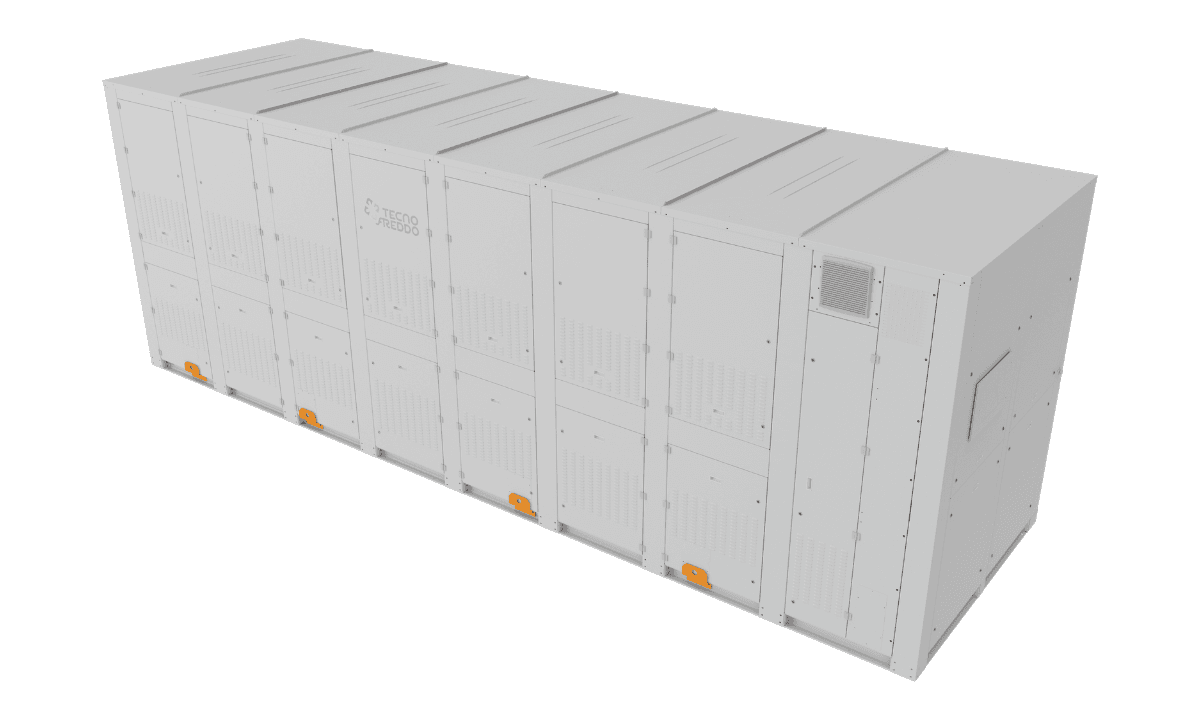
The facility uses 57 four- and six-cylinder CO2 compressors mounted on five racks ‒ manufactured by Zero Zone ‒ to refrigerate 350,000ft2 (33,166m2) of storage space. They provide 227.5TR (800kW) of low-temperature (LT) capacity at −21°F (−29.4°C) SST and 1,100.5 TR (3.59MW) of medium-temperature (MT) capacity at 21°F (−6.2°C) SST.
Two racks provide LT/MT output, and three racks provide MT output. In 2021, the available technology restricted the compressor choices for LT loads, according to Ercole. “Rather than optimizing the LT compressors, we had to use transcritical models,” he said.
Parallel compression manages the flash gas in high ambient conditions, with two dedicated compressors per rack. An adiabatic gas cooler supports each rack, with an 85°F (29.4°C) outlet temperature. The system also employs an LT air-cooled desuperheater.
The modeled system
The modeled system keeps the basic five rack design of the existing facility. However, it replaces the roughly 12 compressors per rack with six compressors: two eight-cylinder compressors, three six-cylinder compressors and one four-cylinder compressor. The high-pressure control valves have been swapped with variable geometry ejectors – three per rack – to help manage flash gas. For the LT/MT racks, the modeling used optimized LT compressors instead of transcritical models.
“Since we reduce the number of compressors per rack from 12 to six, we shrink the rack footprint by 25%,” Ercole said, adding that the eight-cylinder compressor provides almost three times more displacement than the six-cylinder model.
For the comparison, the modeling included the five adiabatic gas coolers and the LT air-cooled desuperheater. One of the eight-cylinder compressors on each rack provides parallel compression. Bitzer’s CO2 system software and its newly released Fender software, which won the ATMO America 2025 Innovation of the Year award, were used in the simulation. Both programs gave basically the same results, according to Silva.
Improved COP: The comparison highlighted the COPs at three ambient temperatures, representing full, 85% and 75% load conditions. “Ejectors, especially at full load, played a pivotal role in moving most of the refrigerant mass flow between the MT evaporators and the parallel compressor,” Silva said.
- At full load with an ambient temperature of 91.4°F (33°C), the simulated system demonstrated a 16.95% COP improvement over the existing system.
- At 85% load with an ambient temperature of 77°F (25°C), the simulated system improved the COP by 10.34%.
- At 75% load with an ambient temperature of 59°F (15°C), the simulation improved the COP by 5.44%.
Less current: “The big difference is the amperage requirement between the two systems,” Ercole noted, with the simulated system requiring roughly 20% less amperage than the operating one.
- The existing facility requires a total of 885.9RLA, but the simulation only needs 710.6RLA.
- The optimized LT compressors account for the majority of the difference, with the simulation using 169.9RLA and the facility 372.5RLA.
Quotable: “With more cold storage facilities being built next to big cities, the eight-cylinder CO2 compressor may be a good fit,” Silva said, citing ammonia’s [R717] safety compliance issues, even in low-charge applications. “When used with the adjustable ejectors, the benefits of the large CO2 compressors include lower energy use, reduced footprint, safer operation and operating cost savings.”
“When used with the adjustable ejectors, the benefits of the large CO2 compressors include lower energy use, reduced footprint, safer operation and operating cost savings.”
Alessandro Silva, Senior Application Engineer at Bitzer