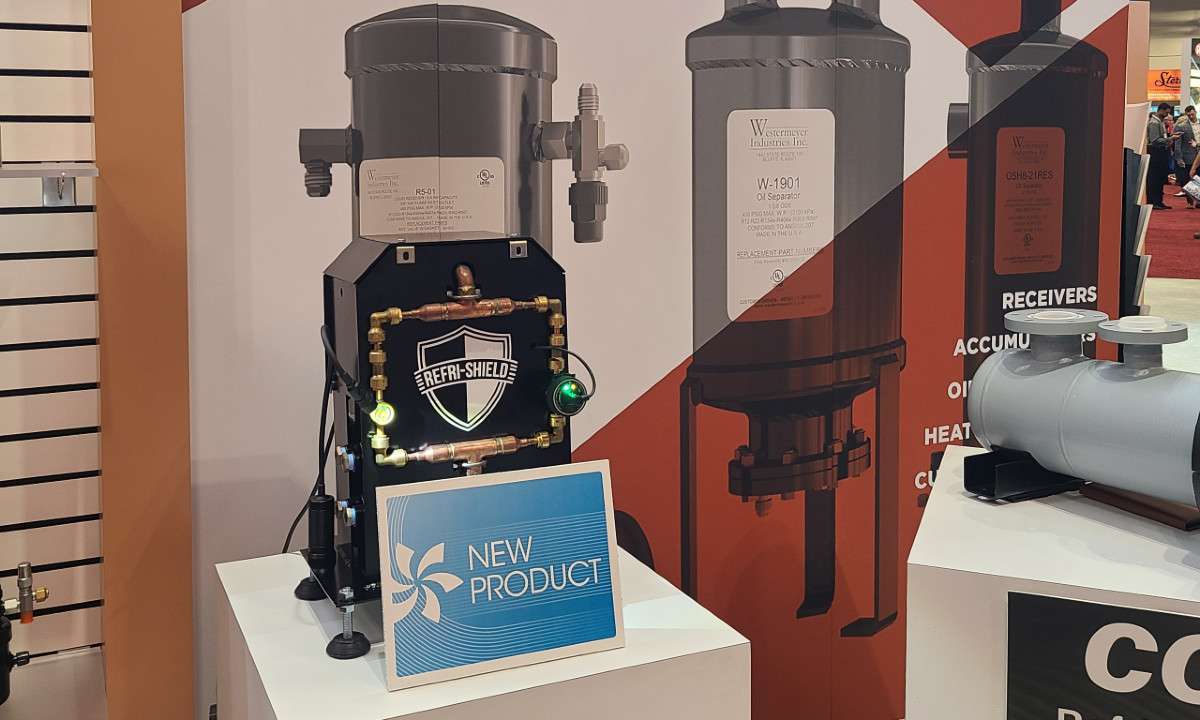
Westermeyer Industries, a U.S.-based manufacturer of HVAC&R components, is showcasing three new products for CO2 (R744) refrigeration systems at the 2025 AHR Expo: an electronic sight glass, a no-calibration liquid level probe and an extended liquid level switch.
Adam Chapman, Sales Manager at Westermeyer Industries, told NaturalRefrigerants.com that the new products are a response to the increased demand for CO2 refrigeration in the U.S. The 2025 AHR Expo is being held in Orlando, Florida, from February 10-12.
Electronic sight glass
The patent-pending sight glass uses an RGB [red, green and blue light] sensor to detect moisture and relay the information to a system controller, negating the need for on-site technician readings. Westermeyer is working on reversing the engineering of the original unit, which was developed for HFO refrigerants, to use with CO2. Chapman said the company aims to release the sight glass by the end of the year.
“This sight glass is unlike anything else on the market,” said Chapman. “The interest in CO2 is very high, and I see it being very successful.”
The company is seeking industry feedback concerning the displayed output range of the device and the programming for the controllers from AHR attendees.
“This product will be our most popular conversation piece at the show,” Chapman added.
Liquid level probe
Westermeyer has applied time domain reflectometry (TDR) technology to its new liquid level probe. According to Chapman, the company is not the first to apply TDR to refrigeration. However, its new probe, rated at 1,350psi (93bar), is more compact and reduces the technology’s inherited dead zones with algorithms in its software.
As a non-refrigerant-specific component, the probe does not require switch-out calibration. “Instead of having a probe for R22, R448A or CO2, it’s interchangeable, allowing OEMs to consolidate parts,” Chapman said, adding that the unit will be available early this summer.
Extended switch
The high-temperature operations of CO2 cause problems for the electronics in liquid-level switches. To combat this issue, Westermeyer added an extension device that shields the switch from the fluid, allowing an operation range from −40 to 300°F (−40 to 149°C).
The extension allows Westermeyer to use its “proven” switch by shooting light through a prism, which hits a glass cone in the device to detect the liquid. “Whether it’s a hot or cold liquid, we are shielding the electronics,” Chapman said.
“This sight glass is unlike anything else on the market. The interest in CO2 is very high, and I see it being very successful.”
Adam Chapman, Sales Manager at Westermeyer Industries