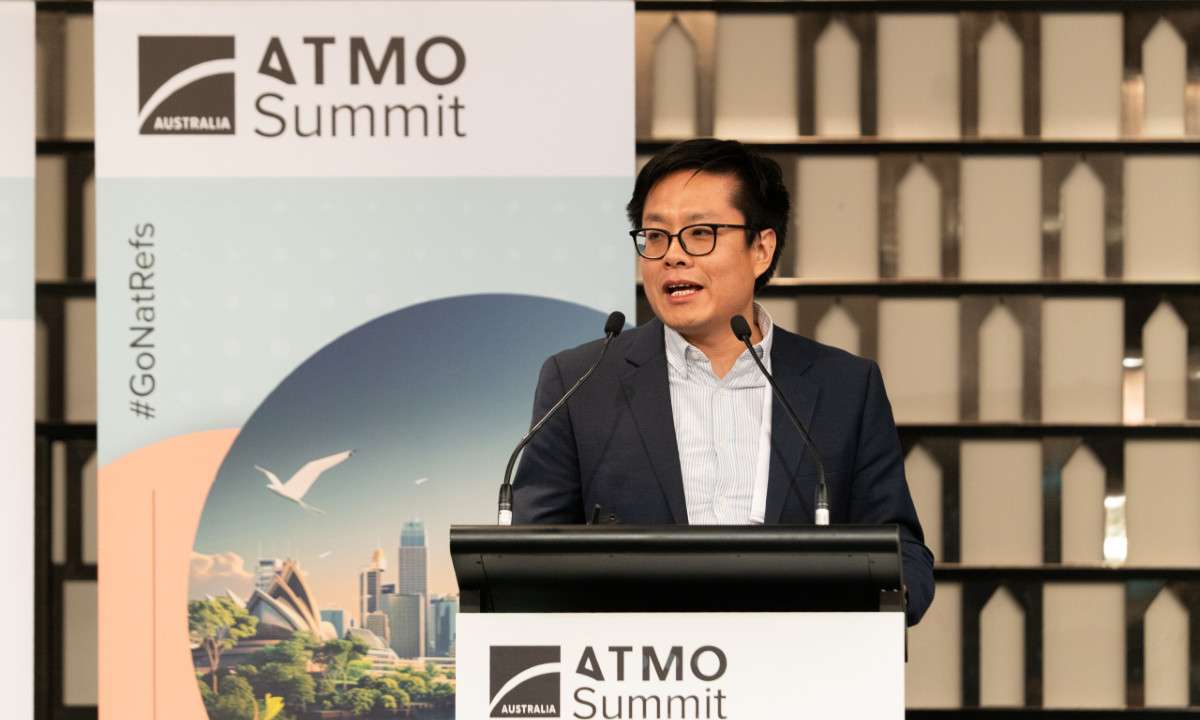
The Ingka Group, the largest IKEA franchise operator, is prioritizing natural refrigerant HVAC&R solutions for its 574 stores and more than 40 distribution centers around the globe, according to Jason Zhang, Cluster Engineer — Real Estate, Asia Pacific Cluster at the company.
Ingka Group accounts for 90% of all IKEA sales and operates 400 of the brand’s 484 stores worldwide as well as smaller-format IKEA stores and IKEA Planning Studios. Zhang outlined the group’s use of natural refrigerants, primarily CO2 (R744), in its retrofit and new construction projects in a presentation at ATMO Australia 2025. The event, organized by ATMOsphere, publisher of NaturalRefrigerants.com, was held May 12–13 in Sydney.
In its path to net zero, the retail group aims to cut its absolute greenhouse gas emissions across the entire IKEA value chain 50% by 2030 compared to a 2016 baseline. Moreover, in its “own operations category,” the company is targeting an emissions reduction of 85%, going from 652,600 metric tons of CO2e in 2016 to 98,000 by 2030.
“Tackling our carbon footprint is our fundamental priority,” Zhang said. “Optimization of refrigeration gas management and selection plays a critical role.”
In the Asia Pacific region, Ingka Group operates 10 IKEA stores and one distribution center in both Australia and Japan, five stores in Korea and one store and one distribution center in New Zealand.
Typical loads: IKEA stores require cooling, heating and refrigeration for the in-store restaurant kitchens.
- Depending on the store size, cooling capacity ranges from 2,500 to 3,500kW (710.9 to 995.2TR), with heating loads around 40‒80% of cooling capacity.
- A store’s refrigeration load is between 300 and 400kW (85.3 and 113.7TR).
Projects: Last fall, the Ingka Group announced a €1.5 billion (US$1.58 billion) investment in its “renewable energy transformation,” partly earmarked for sustainable heating and cooling technology. Zhang did not detail the portion of that investment earmarked for natural refrigerant-based solutions but did outline the group’s mindset in relation to its refrigerant strategy.
- “In our global kitchen cooling project, we are replacing old HFC equipment with new equipment using natural refrigerants, primarily CO2,” Zhang said. “We leverage CO2’s better performance for the application, especially in low-temperature, and integrate heat recovery options.”
- EU f-gas regulations are the minimum standard for retrofitting Ingka Group’s existing buildings. “[The company] always prioritizes the evaluation of natural refrigerants as a first option,” Zhang said.
- “New construction projects provide the best opportunity to implement a low-carbon HVAC design,” Zhang said, adding that Ingka Group strongly prefers natural refrigerants whenever it is technically sound and commercially feasible. In 2022, the group installed a CO2 heat pump, produced by Danish manufacturer Fenagy, in a northern Denmark store to provide space cooling in the summer and heating in the winter.
Propane potential: According to Zhang, the group sees propane (R290) as an “attractive” natural refrigerant with its better thermodynamic performance and the ability to provide high-temperature hot water.
- However, the high flammability is causing issues, with the company’s insurance policy requiring a 10m (32.8ft) distance between the R290 equipment and the main building.
- Other Asian-Pacific retailers, including Coles and Kmart, have installed R290 chiller-based HVAC systems.
- “We are working externally with partners to find an R290 solution and internally with our insurance partner to modify the policy to allow us to transition to the refrigerant,” Zhang said.
Quotable: “I believe reducing emissions is an ongoing journey instead of a final destination, with the landscape constantly shifting,” Zhang said. “That is why we are attending [ATMO Australia]. We are keen to learn from and collaborate with partners across the industry, mainly those sitting here today.”
“Optimization of refrigeration gas management and selection plays a critical role in tackling our carbon footprint.”
Jason Zhang, Asia and Pacific Cluster Engineer at Ingka Group