The U.S. Environmental Protection Agency (EPA)’s GreenChill initiative, a voluntary partnership with the U.S. food retail industry, outlined upcoming changes in its store certification program during a training webinar on November 19.
Launched in 2008, a year after the founding of GreenChill, the certification program recognizes individual supermarkets that meet strict criteria for refrigerant charge and emissions, or use low-GWP refrigerants such as natural refrigerants. The certification program is open to any U.S. supermarket, in contrast to the GreenChill partnership program, which is designed for food retail companies that pledge to reduce their refrigerant emissions in a transparent manner chain-wide. In the 2024 reporting year, there were over 900 GreenChill certified supermarket stores and more than 13,500 supermarket stores in the GreenChill partnership.
GreenChill decided it was time to update the criteria given the changes in federal and state regulations and technology, explained Chris Orvin, Environmental Protection Specialist at the EPA’s Stratospheric Protection Division. He noted the “technology and refrigerant advancements over the past decade” and “the increase in stores using stand-alone equipment.”
“This is several years ahead of when it will be required [under the AIM Act]. But GreenChill stores are ahead of the curve.”
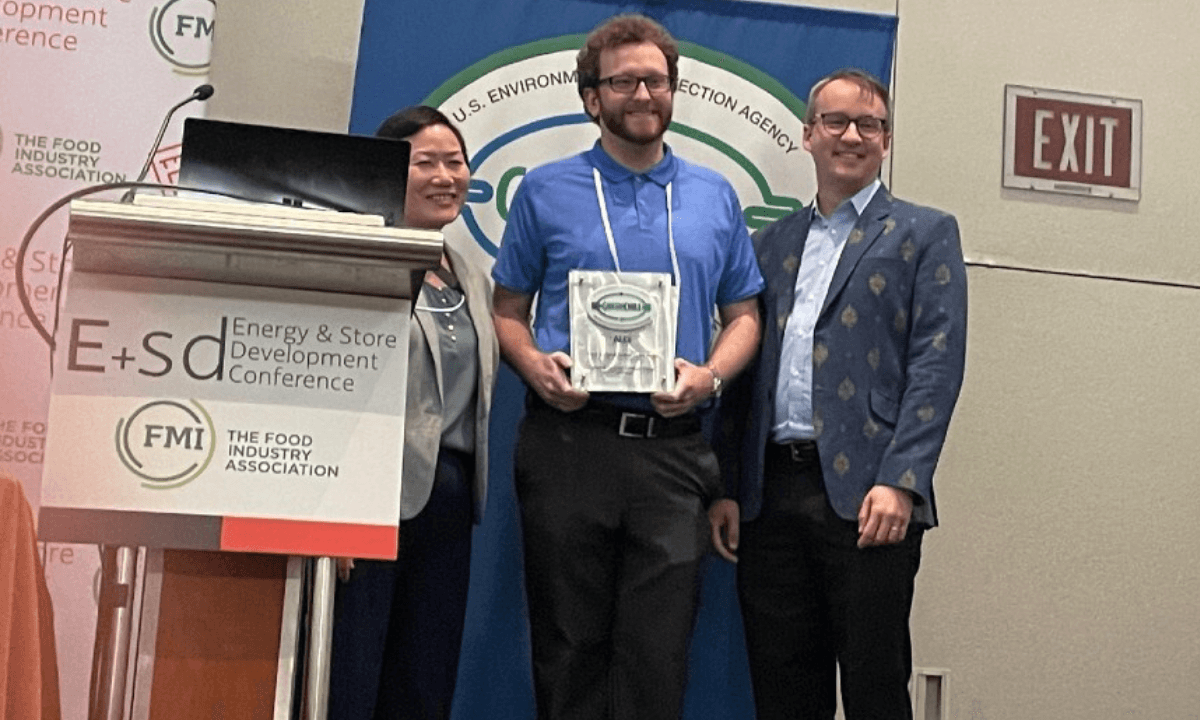
Chris Orvin Environmental Protection Specialist, EPA
Spot stand-alone cases are not included in the certification evaluation but stand-alone cases that are used as the primary refrigeration units do qualify, as do condensing units for walk-in rooms. Primarily centralized refrigeration systems are evaluated.
The original criteria evaluated stores at three levels: platinum (highest), gold and silver. Under the new criteria, stores in Category 1, which use equipment that was installed before January 1, 2025, will continue to be evaluated at these levels, but the criteria will be “20% more stringent,” said Orvin.
New equipment installed starting on January 1, 2025, will fall under Category 2; stores with equipment that meet this criteria will be declared simply GreenChill certified, Category 2.
Whereas the annual certification period previously covered July 1 through June 30 of the following year, the new certification program will follow the calendar year beginning in 2025, which matches the reporting cycle for partners in the GreenChill program.
GreenChill is still finalizing the forms for Category 2 equipment, but Orvin said “the intent” is for the new certification program to start on January 1, 2025. “There may be a slight lag time for the newer stores until the final forms are finalized.”
GWP-weighted measures in Category 1
Under the original criteria, stores were evaluated based on their average HFC refrigerant charge per MBTU/hr load and their annual HFC leak rate. Silver and gold ratings required less than a 15% leak rate; platinum, less than 5%. Charge levels for silver, gold and platinum went from less than 1.75 (lbs/MBTU/hr) to less than 1.25, to less than 0.5, respectively. Platinum could alternatively be achieved if all refrigerant in a store’s commercial refrigeration equipment has a GWP under 150.
In the last cycle, ALDI US certified 611 stores, more than any other U.S. supermarket chain, all at the platinum level by installing mostly transcritical CO2 (R744) systems and some propane (R290)-only cases; for this it was given GreenChill’s the Store Certification Excellence award for the sixth consecutive year.
The new criteria for Category 1 equipment “encourages older stores to make voluntary shifts to lower-GWP refrigerant that aren’t required by regulations,” said Orvin. “That’s something we would want to recognize.”
Unlike the original criteria, the new criteria applies a refrigerant’s GWP to the existing charge-to-load ratio and emissions criteria. Thus a refrigerant’s GWP is multiplied by the charge/load to produce a GWP-weighted charge in lbs/MBTU/hr. Silver is awarded to equipment that ranges between greater than 2,000 to 2,400; gold from 1,600 to 2,000; and platinum below 1,600.
For emissions, a refrigerant’s GWP is multiplied by its annual emissions/load; this is divided by 2,204.623 (the weight in pounds of 1 metric ton of CO2) to produce a GWP-weighted emissions measured in MTCO2e/MBTU/Hr). Silver is earned by GWP-weighted emissions of greater than 0.08 to 0.13; gold for 0.03 to 0.08; and platinum for less than 0.03.
If a system earns different levels for charge and emissions, the lower level determines the final rating.
As in the past, stores using natural refrigerants like CO2 would tend to earn platinum status because of their extremely low GWP.
Category 2 requirements
To be GreenChill certified under Category 2, stores with equipment installed after January 1, 2025 must:
- Use refrigerants with a GWP under 150 in the primary refrigeration system. “This is several years ahead of when it will be required [under the AIM Act],” said Orvin. ”But GreenChill stores are ahead of the curve.”
- Have a GWP-weighted charge-to-load ratio equivalent to or better than platinum level for Category 1 equipment.
- Have a GWP-weighted emissions rate equivalent to or better than platinum level for Category 1 equipment.
Even for stores using low-GWP refrigerants, “we didn’t want leaky stores or heavy charge sizes to get certified,” said Orvin.
In addition, Level 2 certified stores must use two of the following five:
- A refrigerant with a GWP under 10 in the primary refrigeration system
- A refrigerant with a GWP under 400 in HVAC (heating, ventilation, and air-conditioning). “There are not many options for this now but we see this as aspirational target,” said Orvin.
- Advanced refrigeration technology
- A technician training program
- Reclaimed refrigerant
For advanced technology, a store must employ at least one of thellowing in the primary refrigeration system:
- Mechanical subcooling
- Thermal energy storage
- Predictive analytics software
- Automatic leak detection. When this becomes required under the AIM Act, it will be removed from the list.
- Condensing units with a GWP of less than 10
Orvin acknowledged that the list of advanced technology will evolve over time.
For technician training, a store must implement a technician training program that educates internal or in-house refrigeration technicians on proper equipment installation, service, repair, maintenance and disposal practices, as well as emerging technologies and refrigerants so as to reduce refrigerant leaks and ensure efficient operation.
To meet the reclaimed refrigerant criterion, applicants must send recovered refrigerants for reclamation to an EPA-certified reclaimer and/or use reclaimed refrigerants for service and/or initial charge of equipment, with proper documentation.
Refrigerant that is recovered from one refrigeration system and used in another system without being reclaimed to AHRI (Air-Conditioning, Heating, and Refrigeration Institute) purity standards by an EPA-certified reclaimer does not meet this criterion.