On November 18, 2018, industrial designer John O’Connor went to Massachusetts General Hospital in Boston to discuss CoolSculpting (the brand name for cryolipolysis), a fat-freezing method to reduce fat thickness in treated areas. He was invited by former colleague Ellen Sheets, a medical doctor.
He found the CoolSculpting process to be “pretty clever,” he said in an interview with NaturalRefrigerants.com. However, the machine used for freezing was less impressive, more like a “Rube Goldberg” contraption. “I went home that night and thought, ‘There’s got to be a better way.’”
By the next day, O’Connor came up with a refrigeration machine that – unlike any conventional vapor-compression system – uses vacuum-driven water evaporation to deliver cooling. “This does not use compression,” said O’Connor, a PhD physicist whose varied career spans semiconductor and medical-device design as well as aviation and border security. “It goes in the other direction using a vacuum” to reduce pressure.
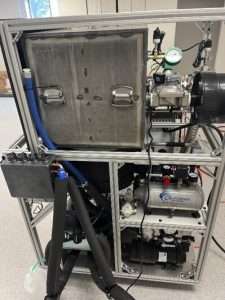
In support of his idea, in 2023 O’Connor and Sheets launched a Woburn, Massachusetts-based startup, CleanCold Technologies, for which O’Connor is CTO and Sheets is CEO. Last year the company built a small-scale (2.5ft × 3.5ft × 5.0ft/0.76m × 1.1m × 1.5m) operational refrigeration prototype. They are now seeking to partner with a manufacturer to bring the concept to market.
The original design was meant for CoolSculpting, but since then O’Connor has developed a patented closed-loop system that he said can be applied to everything from supermarkets and cold storage facilities to data centers, commercial air-conditioning and water-treatment facilities. “Supermarkets are perfect [for this],” said O’Connor. “We’ve actually been talking to a lot of supermarkets.”
Skid-based refrigeration units could each deliver up to about 75TR (264kW) of cooling, he said. For industrial AC, single skid subassemblies could produce up to about 300TR (1,055kW), while for water treatment facilities, depending upon the configuration, units in the tens of megawatts (around 2,800TR) are possible.
As a natural refrigerant, water (R718) has many advantages. It has a high heat of vaporization (2,260J/g), is nontoxic, nonflammable and not an asphyxiant, and it presents no safety or environmental issues (zero GWP and ozone depletion potential and no PFAS). Furthermore, O’Connor emphasized, it is fully retrofittable to existing installations without changing the piping to the evaporators. In addition, as a closed-loop system, it does not waste water.

How it works
According to CleanCold Technologies’ website, the system relies on “the cooling power of vacuum-driven water evaporation.” It begins by atomizing water droplets into an aluminum cylinder housed in a chamber that undergoes vacuum-induced vaporization, driving the cylinder’s cooling. The cooled cylinder sits within a water (or glycol)-based cooling circuit that transfers cooling or freezing to any desired space such as a commercial refrigerator or cold room. The cycle repeats every 30 to 60 seconds until the targeted cold storage temperature is achieved. An air- or water-cooled condenser is used to condense the evaporated water. The temperature of the cylinder and cold storage area is monitored to provide feedback to the control system.
The temperature delivered by the system depends on the pressure in the vacuum chamber. When the pressure is lowered to around 7mbar (0.1psi), the vaporization temperature of water is 2°C (35.6°F), typical refrigeration temperature. At 2mbar (0.03psi), vaporization occurs at the typical freezer temperature of −18°C (−0.4°F). At atmospheric pressure (1.01bar/14.7psi), water vaporizes (boils) at 100°C/212°F.
Using “off-the-shelf” vacuum pumps, O’Connor calculated the COP of his system would be 1.3 to 1.5 but could be higher if the system were optimized. The COP of CO2 (R744) systems, he said, were around 1.5. The cost of the water-based system is about 2–3% less than that of a CO2 system, he said.
Other water systems
Other companies have developed systems using water as the primary refrigerant with somewhat different technologies. One of the early developers was Efficient Energy, which invented a low-capacity water-based centrifugal chiller. However, in 2023, the company’s technology was acquired by Vertiv, a data center services provider based in India.
Malvern, Pennsylvania-based OxiCool has developed a home air-conditioning system based on a vacuum-driven water evaporation process. It also employs a sodium-impregnated molecular sieve. The company did not respond to a request for comment on the market status of the system.
Alpinov X, a French manufacturer of cooling systems for data centers and district cooling, has devised a water-based system that uses a vacuum pumps and a turbo-compressor. The company did not respond to a request for comment on the market status of the system.
“I went home that night and thought, ‘There’s got to be a better way.’”
John O’Connor, CTO, CleanColdTechnologies