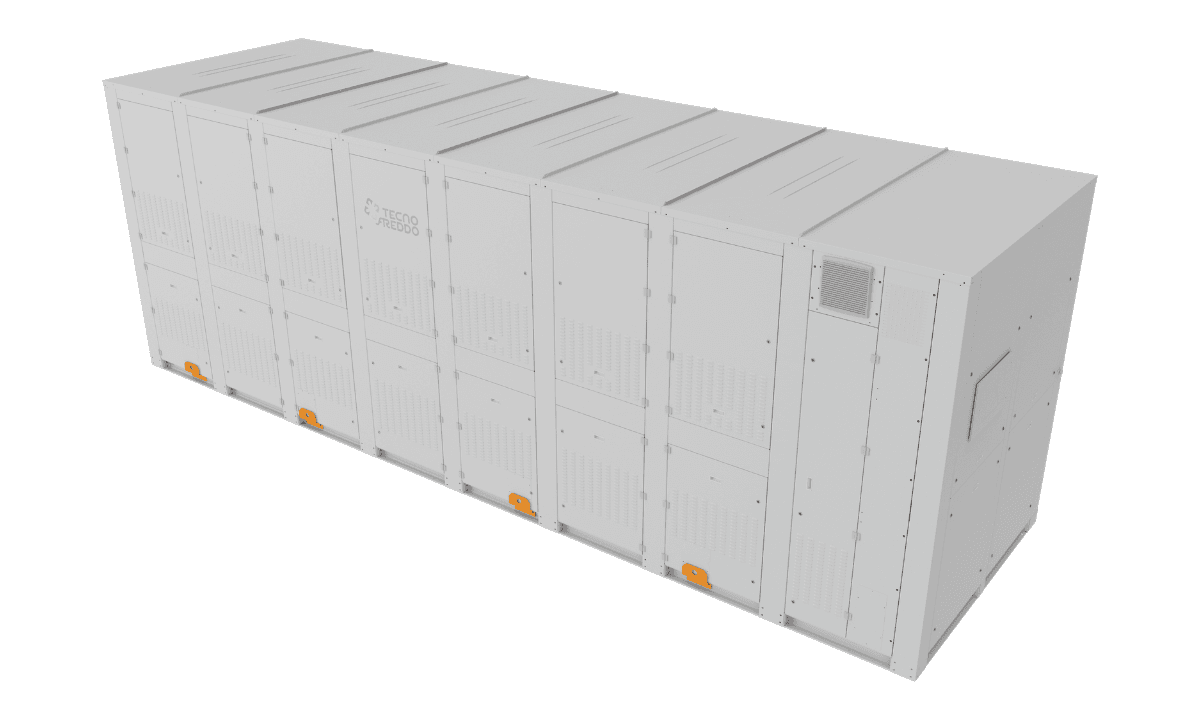
In collaboration with CERN, Swedish-based manufacturer SWEP is supplying brazed plate heat exchangers (BPHE) for the laboratory’s new CO2 (R744)-based cooling system, which includes its Q185H model developed specifically for the project.
CERN is updating its ATLAS and CMS sites at the Large Hadron Collider (LHC), located on the France–Switzerland border, in preparation for its fourth operational run, scheduled to begin in 2030. The renovation includes the installation of two new CO2 systems capable of cooling the refrigerant down to −53°C (−63.4°F).
To regulate the temperature of the particle detectors in CERN’s new High-Luminosity LHC program, SWEP engineers adapted the company’s B185 BPHE to include a Q-pipe. The newly created Q185H heat exchanger will act as a CO2 evaporator to absorb and remove the increased thermal load resulting from higher radiation levels, according to SWEP.
“The entire installation was dimensioned and built specifically to incorporate [our] robust units,” SWEP said. Both its B185 and Q185H BPHEs will “play critical roles” in the cooling system, acting as CO2 superheaters ‒ preventing liquid droplets from entering and damaging compressors ‒ and as CO2 cascades, building a thermal bridge between stages, the company added.
The previous refrigeration systems at the ATLAS and CMS sites used synthetic high-GWP-based refrigerants. The new CO2 system is expected to reduce the facility’s greenhouse gas emissions by 40,000 metric tons of CO2e per year, according to CERN.
CO2 system details: The combined 1.3MW (370TR) cooling system features 18 modules, seven installed at ATLAS and 11 at CMS, each supplying 70kW (20TR) of capacity.
- Due to the lack of space around the detectors, the cooling system, positioned on the surface, will pipe the −53°C CO2 refrigerant 90m (295ft) underground to the heat exchangers.
- “The unique properties of CO2 enable the use of small pipes ‒ a significant advantage where space is limited,” SWEP said.
- The cooling systems represent a novel combination of subcritical and transcritical CO2 technologies, said Dirk Leuteritz, Head of Sales at Compact Kältetechnik ‒ the German company that helped develop the solution.
CO2 evaporator: With a vertical tube for rising vapor and a separate tube for descending condensate, the Q185H heat exchanger will maintain the temperature of the detectors below −25°C (−13°F), as required.
- The design passively transfers heat, with high temperatures from the radiation detector boiling a two–phase liquid fluid, like helium or nitrogen.
- The resulting vapor rises through the Q-pipe to the upper end of the BPHE, where the −53°C CO2 refrigerant rejects the heat.
- Gravity pulls the condensed liquid back into contact with the heat from the detector, restarting the evaporation cycle.
Moving the market: In 2005 SWEP developed its first high-pressure CO2 heat exchanger for CERN’s LHC beauty, or bottom quark, experiment using CO2 cooling.
- As a result of the collaboration, SWEP introduced its reinforced B16DW CO2 heat exchanger to the refrigeration market.
Quotable: “We [have] pushed the boundaries of what can be achieved with CO2 natural refrigerant,“ said Yann Herpin, Cooling Engineer at CERN. “We are proud to say that this new system is paving the way for further developments in CO2 refrigeration technology, which will lead to reduced emissions in many other industrial applications.”
“We are proud to say that this new system is paving the way for further developments in CO2 refrigeration technology.”Yann Herpin, Cooling Engineer at CERN