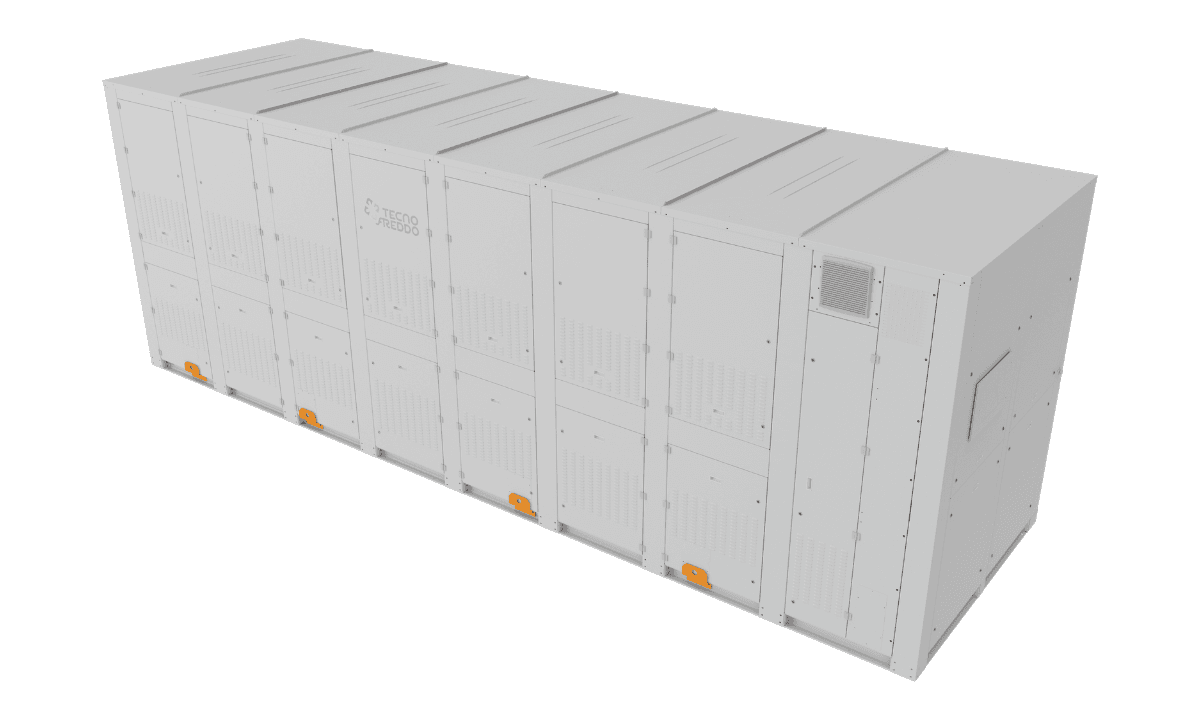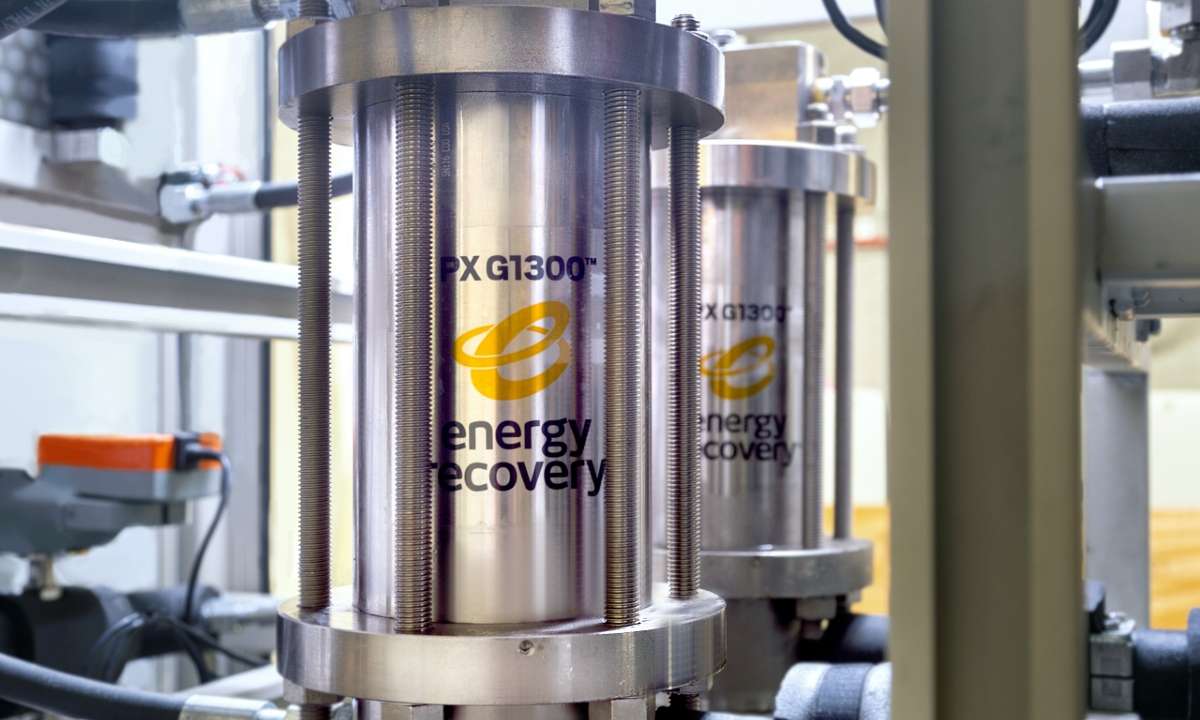
Energy Recovery, a San Leandro, California-based component manufacturer, on October 29 released recent operational data from transcritical CO2 (R744) refrigeration installations in North American and European supermarkets showing that its pressure exchanger device can help these systems perform more efficiently in hot climates and reduce water consumption.
According to Energy Recovery, the device , the PX G1300, provided up to 15% in annual energy savings, up to a 22% lift in coefficient of performance (COP) and up to 460,000gal (1,741,289L) in an annual water savings.
The installation sites represent varied geographies, climates and system architectures, including systems with adiabatic gas coolers, parallel compression and heat reclaim. Results are based on side-by-side testing at multiple sites, comparing system performance with and without the PX G1300 under similar weather and load conditions.
“The PX G1300 gives operators an edge, cutting energy and water use while helping systems perform through demanding heat wave events,” said Ricardo Freitas, Vice President of CO₂ at Energy Recovery.
Energy Recovery marketed its pressure exchanger device for more than 30 years in the desalination industry before introducing it to the supermarket industry for use in transcritical CO2 systems in 2021. In the U.S., the first supermarket to install the device was Vallarta Supermarkets, a California chain. The PX G1300 has now been installed and is running in dozens of sites across three continents, according to Energy Recovery.
Seven-store study
With its announcement, Energy Recovery published a white paper detailing the results of its efficiency study. The study encompassed three stores in California and one each in Canada, Spain, Hungary and Belgium.
Data collected over the various time periods showed the Canadian store achieved an average daily COP lift of approximately 10%, while the store in Barcelona, Spain, saw up to 16% COP lift, reducing estimated annual energy consumption by over 40MWh, Energy Recovery said, adding that a site in Budapest saw a 22% COP lift during the summer months.
“The results over the testing period showed that the PX G1300 reduces compressor workload and power spikes, translating into annualized energy savings that grow with rising ambient temperatures,” said Energy Recovery. “The technology also enhances resilience during heat waves by increasing cooling capacity and preventing temperature spikes that could jeopardize food safety.”
“The PX G1300 gives operators an edge, cutting energy and water use while helping systems perform through demanding heat wave events.”
Ricardo Freitas, Energy Recovery
The pressure exchanger device is also designed to help operators avoid recurring costs related to water use, treatment, and maintenance in evaporative or adiabatic gas coolers. “Eliminating sprayed water during heat waves, a common practice in the EU, helps prevent mineral deposits and scaling on the heat exchange surfaces and pumping circuits,” said Energy Recovery. “This, in turn, extends equipment life, reduces service interventions, and lowers overall operating costs.”
At a grocery store that uses an adiabatic gas cooler in the Sonoran Desert region of California, the PX G1300 saved an estimated around 460,000gal or 46% of water annually, said Energy Recovery. Another California store did not need to turn on its adiabatic system over a period of 18 months while reducing the CO2 rack’s annual energy consumption by 19MWh.
Energy Recovery touted the pressure exchanger’s ability to “increase the capacity of the refrigeration system” during heat waves by enabling compressors to “deliver more cooling at their maximum operating point. The device thus “can eliminate the need for standby or supplementary compressors that would otherwise only be utilized for a few weeks per year.”
At the ATMOsphere (ATMO) America conference in June, Energy Recovery and OEM Hillphoenix showed that the PX G1300 pressure exchanger in a transcritical CO2 rack could improve COP by up to 15% in 95°F (35°C) ambient temperatures. ATMO America was organized by ATMOsphere, publisher of NaturalRefrigerants.com.
Michael Garry is the U.S-based Editor-at-Large for ATMOsphere, where he was previously Editor-in-Chief of the NaturalRefrigerants.com website. He has worked at ATMOsphere since 2014 and has covered natural refrigerants since 2006.