Europe’s commercial and industrial transcritical CO2 (R744) refrigeration system installations reached 111,650 sites in 2025, according to “Refrigeration: Commercial and Industrial Refrigeration with Natural Refrigerants,” a new report from ATMOsphere, publisher of NaturalRefrigerants.com.
The report estimates that there were 106,000 food retail outlets using transcritical CO2 refrigeration systems: 88,000 equipped with racks and 18,000 with condensing units. Year-over-year, the number of racks grew by 15% (76,200 in 2024) and the number of condensing units by 24% (14,500 in 2024). In addition, the number of self-contained hydrocarbon cabinets, primarily using propane (R290), installed in food retail stores rose to 19.7 million units, marking a 15% increase from 17 million in December 2024.
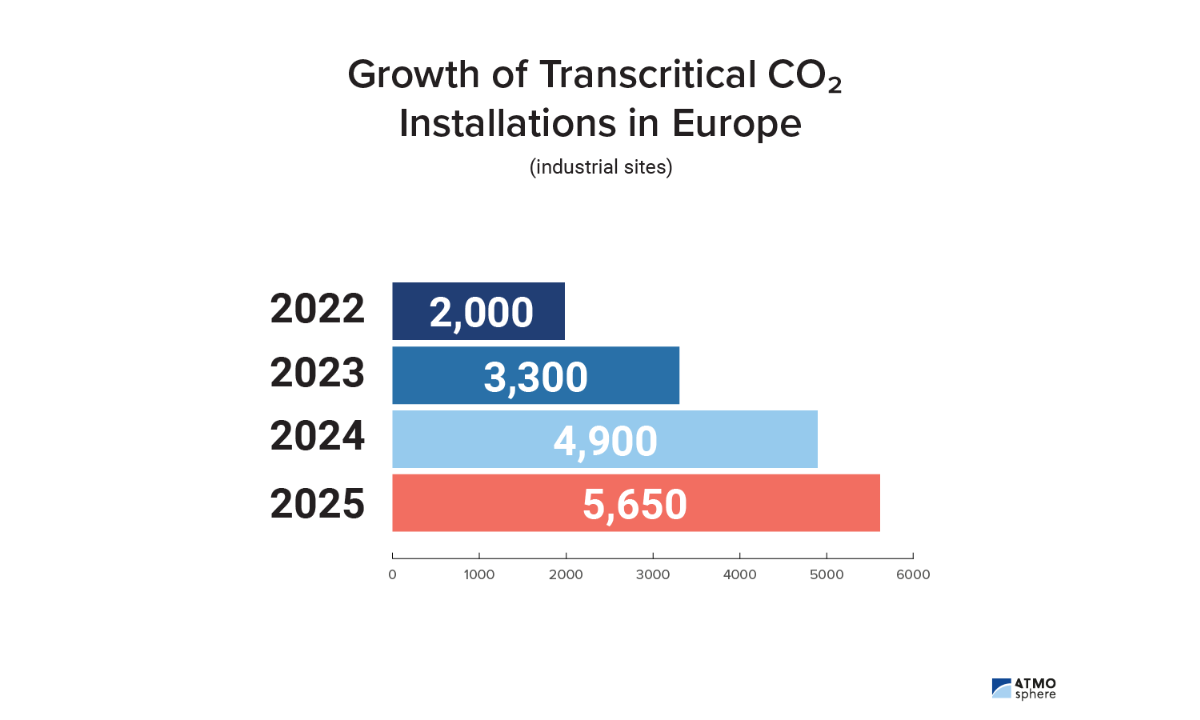
In the industrial sector, the number of sites using transcritical CO2 reached 5,650 in 2025, up 15% from 4,900 the previous year. The overall growth of transcritical CO2 in both industrial facilities and food retail stores in 2025 was 16%. Meanwhile, sites using low-charge ammonia (R717) grew to 4,100, representing a 14% increase from 3,600 sites in 2024.
The report surveyed systems manufacturers, end users and leading contractors. It defines Europe as the EU, the U.K., Norway, Switzerland, Iceland, non-EU Balkan states, Ukraine, Belarus, Moldova and the European part of Russia.
The complete report can be downloaded for free via this link.
Commercial refrigeration
In 2025, Europe had approximately 305,000 food retail outlets, of which 34% used transcritical CO2 refrigeration. METRO and the Schwarz Group are two notable retailers embracing natural refrigerants.
International food wholesaler METRO is investing an estimated €1.1 billion ($1.3 billion) to remove synthetic refrigerants from its operations by 2040. As of early October 2025, 59% of METRO’s 658 stores and distribution centers used exclusively natural refrigerants in their refrigeration systems. In 2026, the company plans to upgrade stores in Serbia, the Czech Republic, Austria and Portugal with natural refrigerants.
The Schwarz group, operator of 14,200 stores between its brands Lidl and Kaufland, operates 4,635 stores that use either CO2 or propane chillers. In addition, the company’s 2024 sustainability report states that there were 4,818 buildings “across the Schwarz Group equipped with corresponding cooling technology.”
Along with sales, ATMOsphere also surveyed manufacturers about their CO2 refrigeration systems installed in new builds and retrofits. The data show that in 2025, the split for the transcritical CO2 racks was 51%–49%, while for condensing units it was 53%–47%. In 2024 those figures were 54%–46% and 51%–49%, respectively.
ATMOsphere also asked manufacturers about cooling capacity. For racks, 42% of respondents said their units were <100kW (28.4TR), while 50% said they were between 100 and 300kW (28.4–85.3TR). For condensing units, the majority (71%) offered between 11 and 20kW (3.1–5.6TR) of cooling capacity, with 10% offering <5kW (1.4TR), 9% offering between 5 and 10kW (1.4–2.8TR) and 6% offering more than 50kW (14.2TR).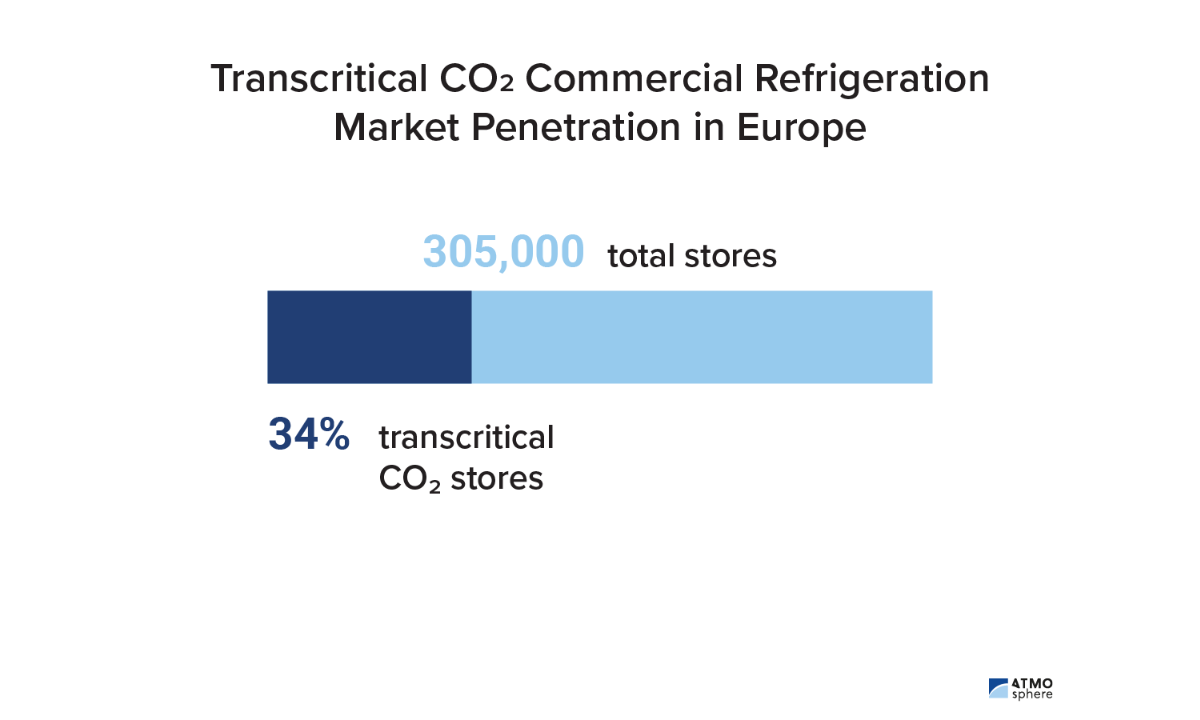
Industrial refrigeration
The 5,650 European industrial sites using transcritical CO2 represented 5% of the total 111,650 sites. The number of industrial sites with transcritical CO2 refrigeration systems has doubled since 2022. Of the 4,100 sites using low-charge ammonia, 69% used centralized systems and 31% packaged.
Leading industrial end users that continued to adopt CO2 included Maersk. In June 2025 the Danish shipping giant opened a new 35,000m2 (375,740ft2) distribution center in Rotterdam, the Netherlands, equipped with six SteelXL CO2 racks from Advansor. The racks provide a 5.5MW total capacity, with 2.4MW (682TR) of cooling, 700kW (199TR) of freezing and 2.4MW of heating. Advansor updated the SteelXL’s capacity in January 2025.
With regard to low-charge ammonia, Star Refrigeration completed a notable expansion project in July 2025. It doubled the frozen storage capacity of a NewCold high-bay automated warehouse in Corby, the U.K., installing a 2.75MW (782TR) ammonia expansion system. The installation added 75,000 pallet positions, bringing the total capacity of the facility to 150,000 pallet positions, kept at a storage temperature of −22°C (−7.6°F).
In terms of the split between new builds and retrofits, for transcritical CO2 it was 50%–50% and for low-charge ammonia it was 66%–34%. No data on new builds vs. retrofits were gathered for the 2024 report.
Manufacturers were also asked about the cooling capacities of their units. For transcritical CO2, the majority of respondents (55%) said their units were between 100 and 500kW (28.4–142TR), while 34% reported units between 500kW and 1MW (142–284TR). A total of 8% of units were under 100kW in cooling capacity, while just 3% were 1–5MW (284–1,421TR) in size.
For low-charge ammonia, 23% of the manufacturers reported selling units offering 100–300kW (28.4–85.3TR) of cooling capacity, 24% sold units with capacities between 500kW–1MW, and an additional 24% sold units with more than 1MW of cooling capacity. The remaining 13% were for units with under 100kW of capacity.