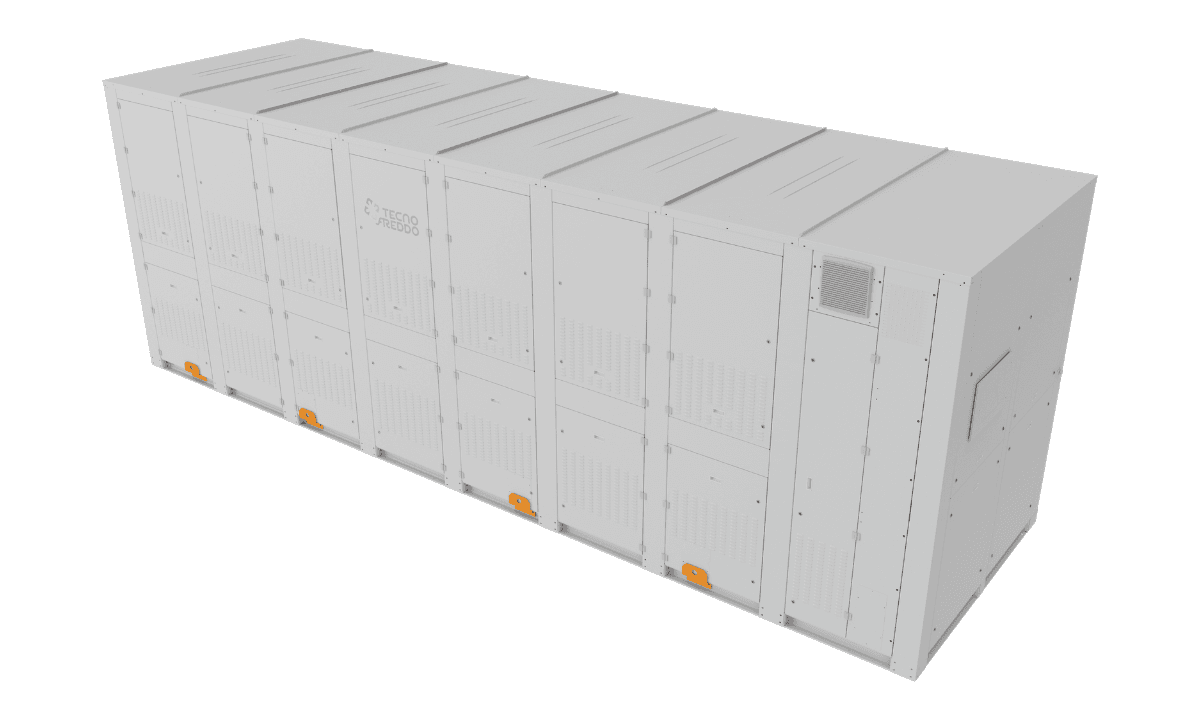
Controller-equipped Güntner air coolers and gas coolers support a 3.5MW (995TR) CO2 (R744) refrigeration system at a new logistics center in Montalto Uffugo, Italy, according to Stefano Vidal, the company’s Italy Division Manager of Heat Exchanger Sales.
Working together, Italian manufacturer Arneg and German-based Güntner developed energy-efficient solutions for the CO2 refrigeration system serving the 49,000m2 (527,400ft2) facility in southern Italy. The center achieves a specific energy consumption (SEC) of 13kWh per cubic meter per year, measured by Arneg, despite summer temperatures reaching 42°C (108°F). For comparison, the SEC benchmark for the location is 45 kWh per cubic meter per year, according to Güntner.
“Several design decisions contribute to the system’s efficiency performance,” Vidal told NaturalRefrigerants.com. “Güntner’s VARIO technology enables variable-speed fan control, while the aicore controller continuously optimizes system operation across all zones. The heat recovery circuit maximizes what’s extracted from every unit of energy that the refrigeration system handles.”
The facility: The 3.5MW CO2 system serves three refrigeration zones: a 23,537m3 (831,200ft3) fruit and vegetable storage section operating at a suction temperature of 4.4°C (40°F); a 44,769m3 (1,581,000ft3) dairy section at 0°C (32°F); and a 27,644m3 (976,200ft3) meat and fish section at −4.5°C (24°F).
- Vidal outlined the transcritical CO2 booster system configuration, which includes seven compressors, three booster racks, parallel compression, three Güntner V-Shape VARIO gas coolers equipped with EC fans and 58 Güntner air coolers serving the refrigerated spaces. The facility’s design also incorporates 150mm (5.9in) insulated wall panels and a door-management system to reduce cooling loads.
- The system does not include adiabatic gas cooling, according to Vidal. “Peak summer performance is managed through the aicore controller, which maintains system efficiency by reducing water consumption – even under extreme ambient conditions,” he said.
- The logistics provider selected a CO2 refrigeration system to provide regulatory certainty amid tightening f-gas regulations in Europe and globally, Vidal explained.
The benefits: Along with the optimization measures that improve cooling efficiency, the system captures and redirects waste heat for hot glycol defrost, domestic hot water production and space heating.
- Compared to electric resistance heaters, Arneg estimates that the “virtually energy-free” hot glycol defrost system reduces the facility’s electrical use by 102,000kWh per year, saving the facility €20,000 ($22,800) annually.
- By reusing waste heat from the CO2 refrigeration system, the facility avoids emitting roughly 26.1 metric tons of CO2e carbon emissions per year.
Sustainability aims: Güntner supports initiatives and technologies that promote the adoption of natural refrigerants, including a purpose-built defrost laboratory.
- The company earned the 2026 ATMOsphere Label for the fifth consecutive year. The label recognizes best-in-class manufacturers of natural refrigerant equipment. ATMOsphere is the publisher of NaturalRefrigerants.com.
- As one of the seven founding members of the Coalition of PFAS Free Cooling and Heating, Güntner supports efforts to regulate refrigerants containing per- and polyfluoroalkyl substances (PFAS) in Europe.
- As a subsidiary of the technology group A-HEAT, Güntner aims to have 100% of its product portfolio compatible with natural refrigerants by 2030. The company is already close to achieving that goal, according to A-HEAT’s 2024 sustainability report.
Quotable: “By successfully implementing natural refrigerants in a high-temperature environment, we have demonstrated that environmental responsibility and high performance can go hand in hand,” said Enrico Zambotto, Technical Engineering Director of Refrigeration Systems at Arneg. “This is a meaningful contribution to the global transition towards greener, more energy-efficient technologies.”
“By successfully implementing natural refrigerants in a high-temperature environment, we have demonstrated that environmental responsibility and high performance can go hand in hand.”
Enrico Zambotto, Technical Engineering Director of Refrigeration Systems at Arneg.