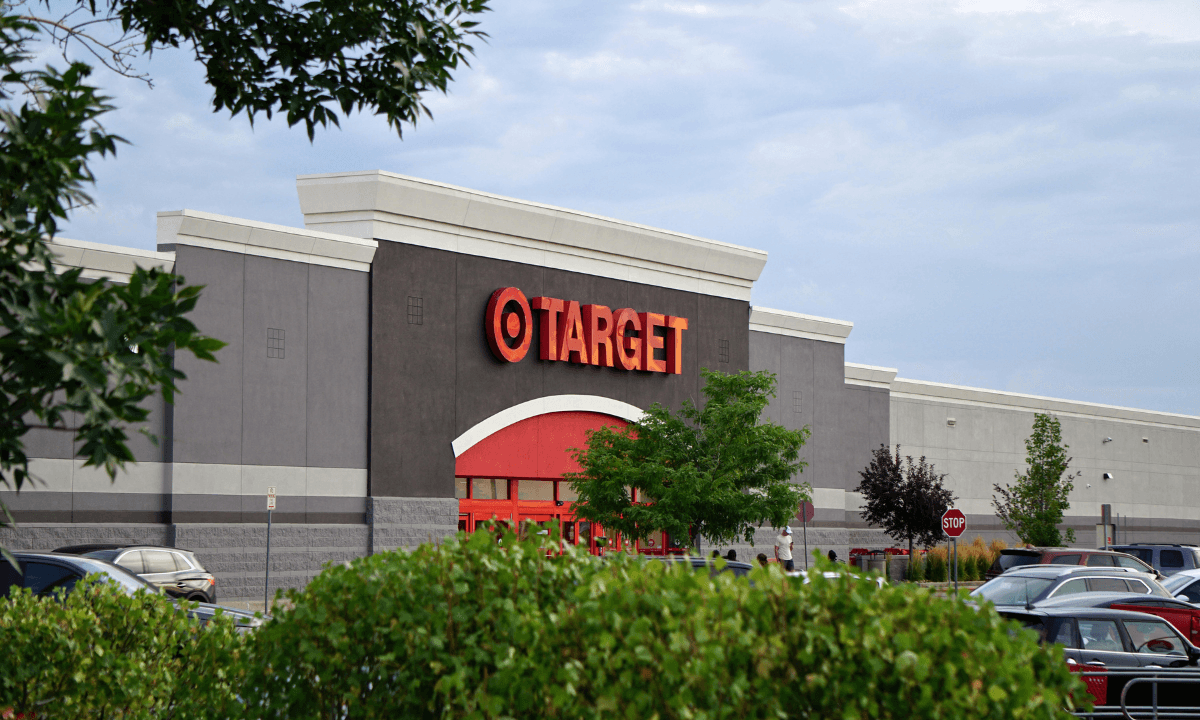
American retailer Target is prioritizing the use of Skycool’s reflective heat rejection panels to subcool and precool its refrigeration systems, including those using CO2 (R744), according to the group’s Director of Refrigeration Shawn Holzschuh.
The roof-mounted panels, coated with an optical film, emit solar heat into space as infrared radiation, according to Eli Goldstein, Co-Founder and CTO of the California-based Skycool Systems. An array provides “passive cooling” to the refrigeration system via a heat exchanger through a closed water or glycol loop circulated by a 1HP pump. An automated valve switches where the CO2 refrigeration system is cooled based on the ambient conditions.
The panels can either subcool CO2 on the high–pressure side of the refrigeration system or precool it on the low-pressure side. In ambient temperatures between 60 and 85°F (15 and 30°C), subcooling reduces flash gas formation to increase cooling capacity and COP. In ambient temperatures over 85°F, precooling stabilizes system operation by reducing the refrigerant discharge temperature and compressor workload.
Target started testing the technology in 2021 and now has more than 600 Skycool panels installed on 21 stores. “We’ve tested the panels in California, Florida, Indiana, Kansas, Nevada and Texas,” Holzschuh said. “Last summer, our CO2 site in Texas did not go supercritical once.”
“Last summer, our CO2 site in Texas did not go supercritical once.”Shawn Holzschuh, Director of Refrigeration at Target
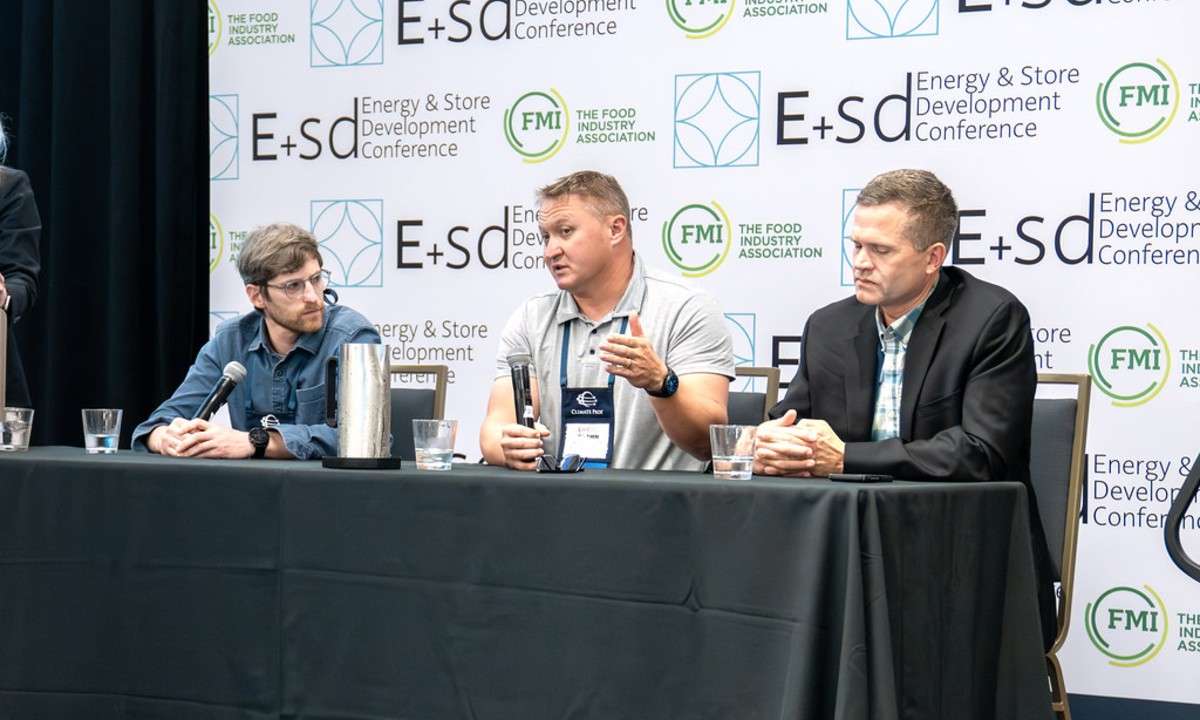
Holzschuh and Goldstein, joined by KC Kolstad, Target’s Lead Mechanical Engineer, detailed the technology, performance and refrigeration retrofit benefits in a presentation at the 2025 FMI Energy and Store Development Conference. The event was held October 6–9 at the Town and Country Resort in San Diego, California.
“Hot water, heated by the refrigerant system, enters the panel array and returns to the heat exchanger at a temperature roughly 10°F (5.6°C) lower than the ambient air temperature,” Goldstein said.
Panel performance: It takes 1,000ft2 (93m2) of roof space to install 20 panels, which can reject 60–80MBH (17.6–23.4kW/5–6.7TR) of heat when used for pre-cooling with the outlet water temperature close to 10°F below the ambient air temperature. Alternatively, the system can reject 20–30 MBH (5.9–8.8kW/1.7–2.5TR) when used for subcooling with an outlet water temperature close to the ambient air temperature, Goldstein noted.
- The cooling panels use the same mounting brackets as solar panels but face north instead of south. The system’s modularity allows for installation in stages.
- Thus far, the only maintenance required for the system is cleaning the panels twice a year, according to Holzschuh, with frequency depending on location.
- All of the components of the panel system have a 25-year life expectancy, except for the replaceable PFAS (per- and polyfluoroalkyl substances)-free film, degrade over 10–15 years, Goldstein explained.
Going CO2: As part of its climate initiative, Target plans to convert all of its stores to CO2 refrigeration by 2040. As of early 2025, Target operated 1,989 stores across the U.S., ranging in size from small–format stores covering several thousand square feet to large stores spanning 200,000ft2 (18,580m2).
- The panel pilot studies conducted by Target focused on reducing transcritical CO2 operation in conjunction with adiabatic gas coolers. “We’ve tested the panels throughout the U.S., and we are seeing positive results in all locations,” Holzschuh said.
- At the 2024 FMI Store and Energy Development event, Goldstein reported that the panels improved system efficiency by 15–20% compared to mechanical subcooling and reduced hours spent in transcritical operation by 50–100%, depending on the conditions.
Retrofit planning: With the closed thermal loop, Skycool’s panels support any refrigeration system, regardless of the refrigerant. When updating a store to CO2 refrigeration, the panels, previously installed to support an aging system, integrate into the new setup by replacing the heat exchanger.
- “The panels save us from putting out capital for end-of-life [synthetic] condensers when we plan to remodel the store in the near future anyway,” Kolstad said. “We can reuse the panels with the new transcritical CO2 rack. It’s a win–win.”
- Today the panel system costs 10–20% more than a traditional air-cooled condenser replacement, Holzschuh said. However, he thinks it will become cost-neutral as manufacturing scales up.
- “In Southern California, the panels allow us to maintain operation in the peak of summer without using sprinklers on the coils,” Holzschuh said. “In 2026 we plan to put enough panels on the roof to remove the air-cooled condenser from the system.”
- “We reduced water usage by 40% in a Nevada store by using the panels to desuperheat an evaporative condenser,” Goldstein said.
Quotable: “As a passive heat rejection system, the panels can be used in any application,” said Holzschuh. “It seems like a perfect opportunity to pair Skycool panels with a water-cooled propane [R290] system to create a more efficient process.”
“In Southern California, the panels allow us to maintain operation in the peak of summer without using sprinklers on the coils.”
Shawn Holzschuh, Director of Refrigeration at Target