When Dr. Tim Lau and his team at the University of South Australia (UNISA) set out to design a more energy-efficient CO2 (R744) refrigeration system, they looked to the air-conditioning industry for inspiration.
UNISA is located in Adelaide, which is home to air-conditioning manufacturer Seeley. Its product range includes residential and commercial air conditioners that use indirect evaporative cooling with water (R718) as a cooling medium.
To Lau and his team, the idea was simple: why not see if the “dew point coolers” used in Seeley’s air conditioners could be used in CO2 refrigeration?
“We didn’t design this system from scratch,” Lau told NaturalRefigerants.com. “We knew dew point coolers worked and thought, ‘Why don’t we use them to pre-cool the air and reduce the time we operate in transcritical mode?’”
Lau said a “lab scale” dew point CO2 (DP-CO2) system was built about five years ago, with the research team working in collaboration with local HVAC&R contractor Glaciem Cooling Technologies. In 2023, Australian supermarket chain Coles, which has experience with CO2 refrigeration, decided to test the DP-CO2 system at a new supermarket in Adelaide.
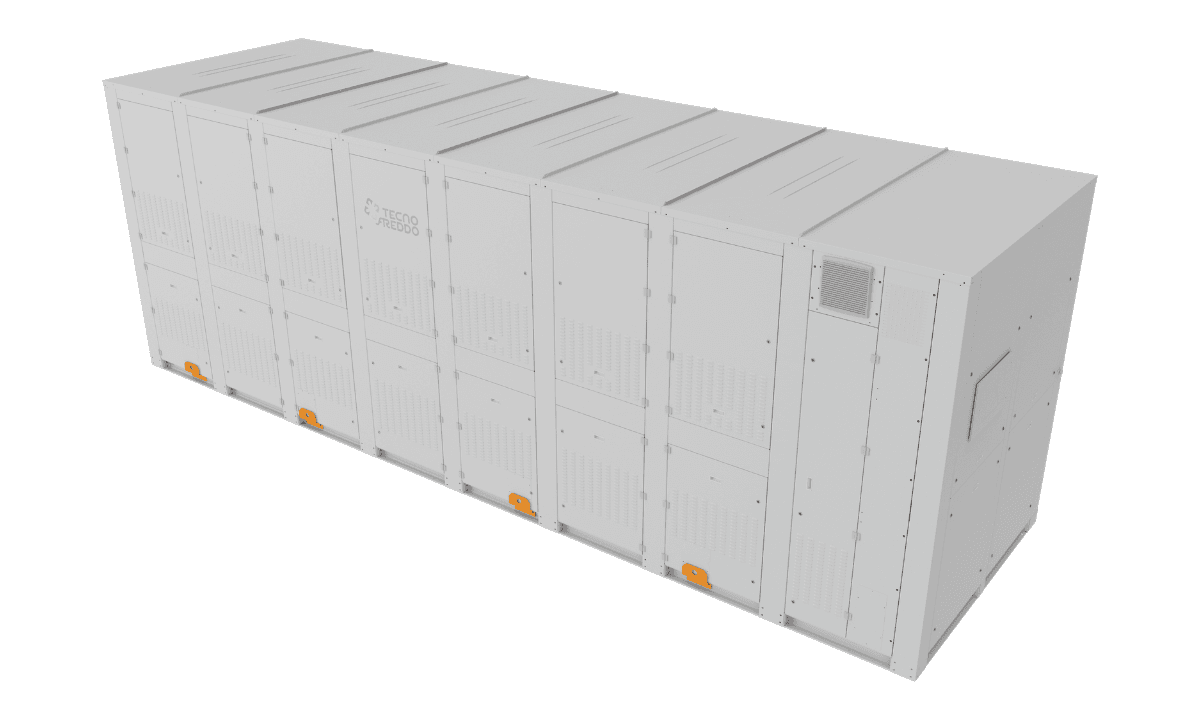
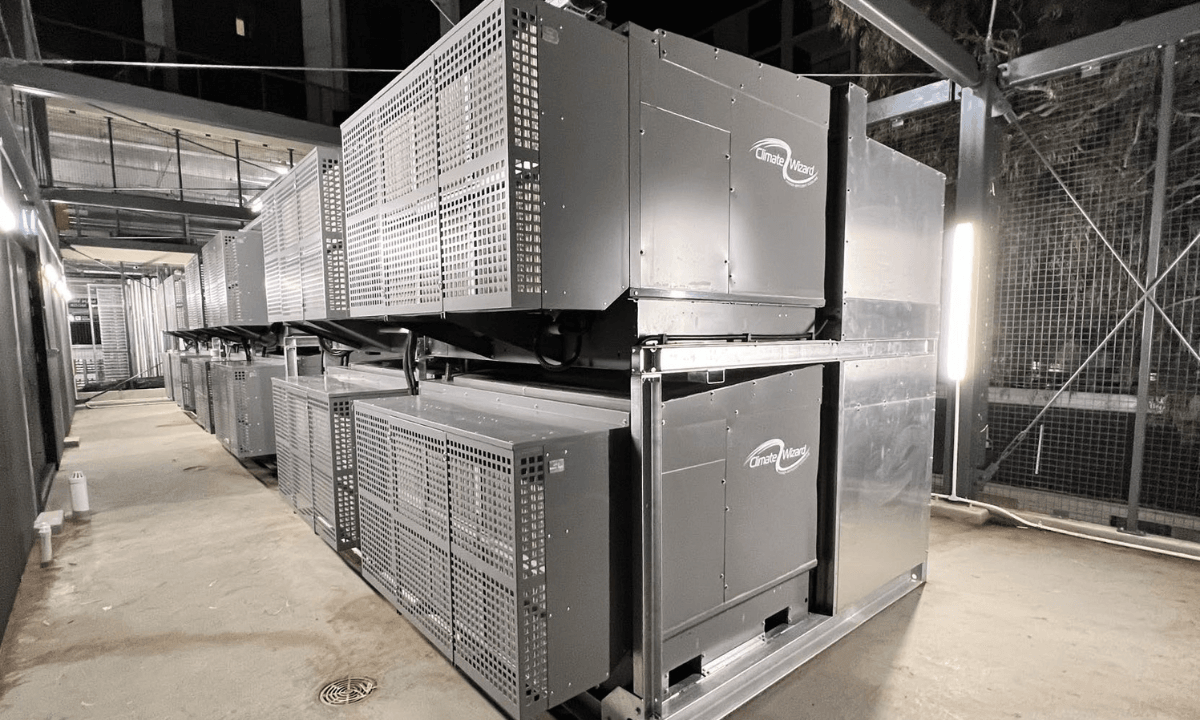
Lau said that, aside from the gas coolers, which feature 12 Seeley International CW-15S dew point coolers, the “CO2 side” of the system was left relatively untouched.
Specs of the CO2 system, provided by Coles:
- 34kW (9.6TR) low temperature
- 185kW (52.6TR) medium temperature
- 250kW (71TR) air-conditioning
- 60kW heat recovery
- Rack: SCM Frigo
- Compressors: Bitzer
- Gas cooler: Glaciem
- Evaporators: Güntner
- Case: Hussmann
- Controls: Danfoss
Data collection
The performance of the DP-CO2 system was monitored between July 2023 and February 2024, and the findings were published in a recently published report. Perhaps the biggest is that, over the eight-month period, the air temperature supplied to the gas cooler stayed below 20°C (68°F) 98.4% of the time. This enabled the system to operate in subcritical mode nearly the entire time despite ambient temperatures occasionally exceeding 40°C (104°F).
“To our knowledge, this is the first time [the DP-CO2 system]’s been employed anywhere around the world, certainly in Australia,” said Lau.
When asked about its plans to implement this technology in additional stores, Coles Media Manager Jessica Tancred told NaturalRefrigerants.com the initial results are “in review” and that “further deployment of this technology will be based on PIR [post-implementation review] outcome.”
In addition to the in-store findings, the performance of the DP-CO2 system was modeled against a similar system using an adiabatic gas cooler. The researchers found that their design had an annual energy consumption 19.6% lower than a similar system equipped with an adiabatic gas cooler. The modeled data was found to match the monitored Coles data within 7%.
NaturalRefrigerants.com spoke with Dr. Lau to learn more about how the DP-CO2 system works, his team’s findings and what’s next for this project.
This interview has been edited for length and clarity.
What is the benefit of employing dew point coolers in a CO2 refrigeration system?
Tim Lau: Dew point coolers use indirect evaporative cooling, which means they cool the air without changing its humidity. We employ dew point coolers as a pre-cooling system, with the outlet basically blowing over the gas cooler coils. Therefore the gas coolers “see” an ambient temperature or temperature that’s closer to the dew point temperature than it is to the actual ambient dry bulb temperature.
On a very hot summer day, you might get 35°C [95°F] here and a dew point of 10°C [50°F]. You might cool that 35°C to something like 20°C in the indirect component. At the outlet of the indirect air, which is also still dry, we can then pass that air through evaporative pads again, further cooling that air while increasing its humidity. That temperature then cools down to 12–13°C [53.6–55.4°F] close to the dew point temperature.
Your research found that the DP-CO2 system was more efficient than a CO2 system with an adiabatic gas cooler. What gave it the edge?
TL: We had measurements for the DP-CO2 system, but we didn’t have a like-for-like adiabatic system onsite running under the same conditions. We had to make a range of assumptions as to the efficiency and the effectiveness of how much cooling can be done by typical evaporated pads. We came to 19.6%, which is the difference between the two systems.
We can get lower temperatures with the dew point cooler system because it can cool to the dew point temperature, not the wet bulb temperature. Because of how the pads are set up and the heat transfer rates, we assumed a higher efficiency for our system compared to standard conventional spray type adiabatic systems.
The DPCO2 system had the same efficiency, in modeled performance, as an R134a system located in a hospital kitchen cool room Brisbane, Australia. What factors affected this?
TL: It’s slightly more humid in Brisbane than in South Australia, so the effectiveness of the dew point cooling system drops because you can’t cool as much if the ambient conditions become too humid.
With a dew point cooling system, there’s also an additional amount of fan energy because the fans have to drive the air through the pre-cooling pads, the indirect pads and the direct evaporated pads. There is a pressure drop across those pads, so the fans have to work harder to push the air through.
In general, R134a systems tend to have higher COPs than the CO2 systems. So if you factor all those into account across the whole year, we found that they break about even.
Would it be possible to turn the fans off in the cooler months?
TL: In theory you could, but our system has built the gas coolers into the dew point coolers, so the gas cooler coils are inside the dew point cooler system. So if you turn off the fans, the gas coolers are sitting in there, and they don’t have enough air blowing over them.
We could design a system where the coils would be swapped. So there’d be coils inside the system where the pre-cooled air can be blown over during hot summer days, and when it’s cool outside you’d actually have the coils sitting in ambient air with wind blowing over them. That could possibly work, but our design doesn’t allow for that.
Can dew point coolers be retrofitted to existing CO2 gas coolers or do they need to be built into new systems?
TL: We were quite lucky because Coles were building a new supermarket, so it was quite straightforward for us to purpose-build a gas cooler system with the dew point cooling system as a pre-cooler. The CO2 side was what Coles would use as standard. Whether the system could be retrofitted: technically yes. Whether it’s worthwhile to be retrofitted in terms of the savings involved versus the capital costs: I don’t know.
Has your team gathered any cost data?
TL: We don’t model any finances for two reasons. First of all, the price of electricity in Australia is quite volatile, so we don’t actually know what the dollar savings is in terms of your energy costs for any given time. More critically, the system built for this project is a first of its kind. I think it would be slightly unfair to use the capital cost of the current system as a benchmark for what it would be if this was more commonly used.
What are the next steps for this project?
TL: When we wrote the report, we only had eight months of data and some holes in it as well. What we really want is at least 12 months or even 18–24 months of data to be able to get a bit more confidence in the numbers.
The project was focused on broad strokes, such as annual energy consumption, but we want to understand the system better and optimize it. We still think we can optimize the control system to eke out a few more percentage points in terms of efficiency, for example.
We also want to compare the system more reliably and accurately to other existing systems. We get asked a lot about how our system compares to ammonia-based systems, so that’s something we might look at. We’re also looking at how the system performs under different weather and operating conditions.