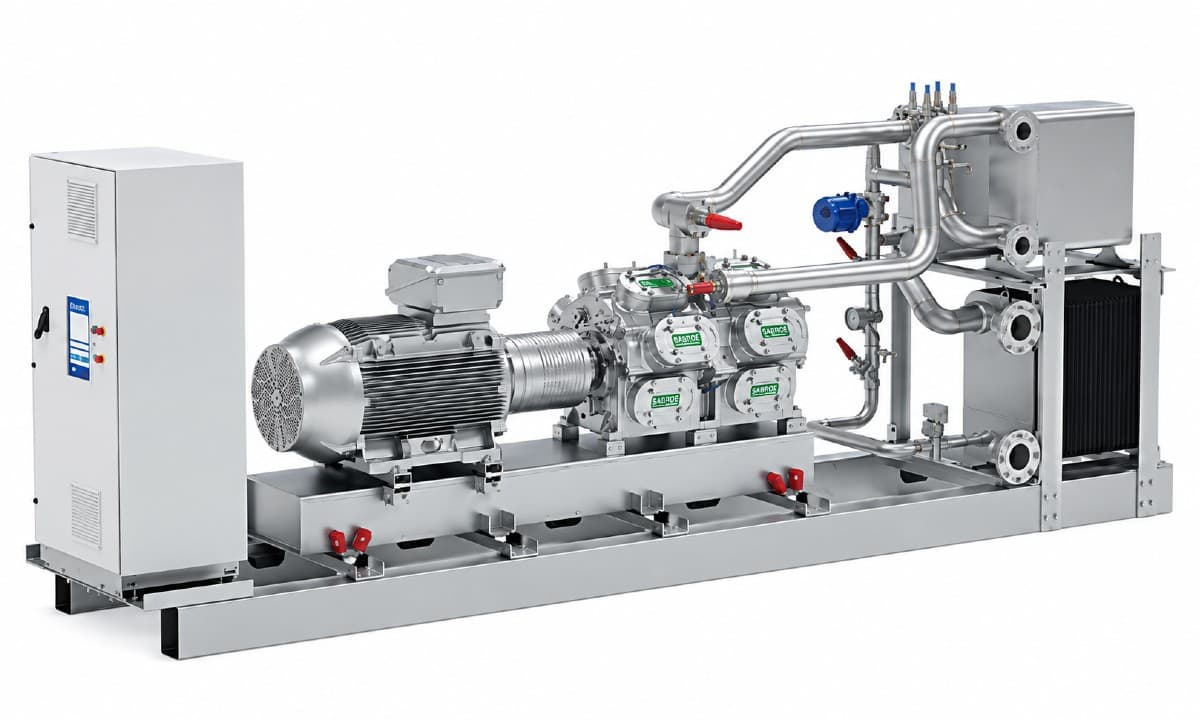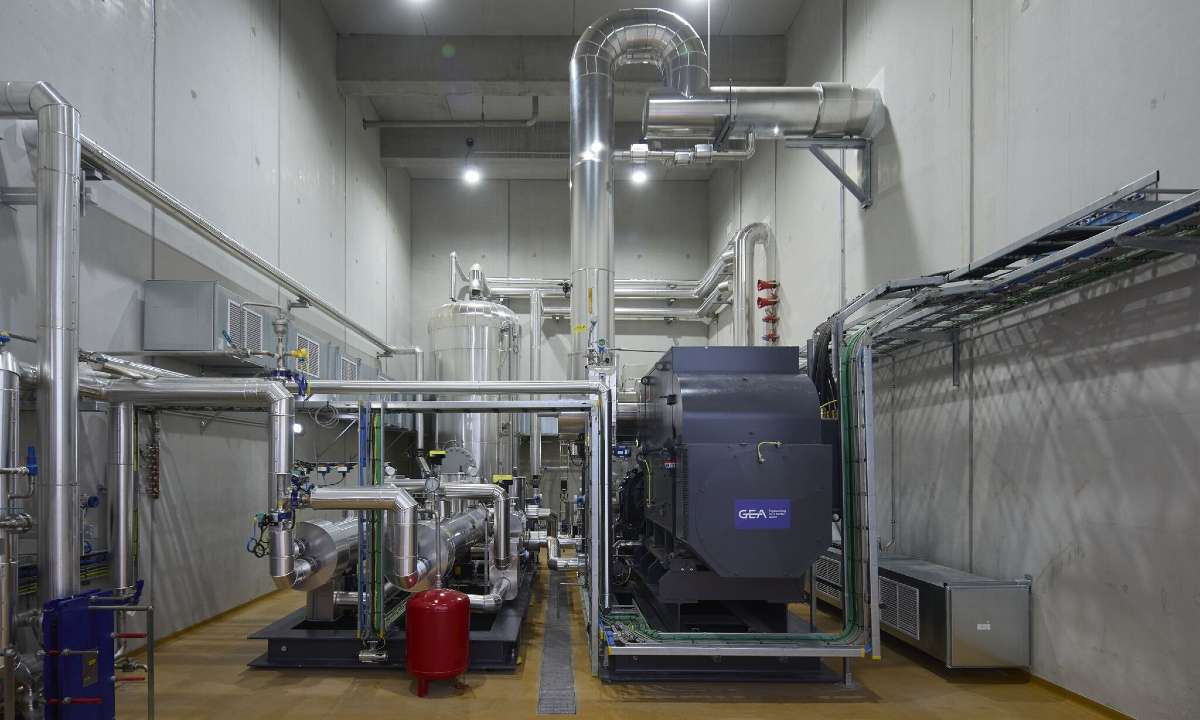
A first-of-its-kind 4MW (1,137TR) high-temperature heat pump – using natural refrigerant pentane (R601) – has been installed at one of Belgian sugar producer Tiense Suiker’s production facilities, according to GEA.
The new heat pump recovers waste heat from the factory’s evaporation plant at 75–92°C (167–197.6°F) and generates steam at temperatures of 135–160°C (275–320°F) for the sugar refining process, the German manufacturer explained in a press release.
Tiense Suiker produces its sugar from sugar beets, which are grated and soaked in warm water to create a sugar-rich liquid. After impurities are removed, the liquid is heated to evaporate water, forming a thick syrup. Further heating creates sugar crystals, which are refined through multiple rounds of cooking and spinning.
Generally, fossil fuel-based boilers are used to generate the steam required for these processes.
Industrial heat pumps with capacities of 500kW–10MW (142–2,843TR) have traditionally been limited to output temperatures of around 95°C (203°F), GEA added, noting that high-temperature heat pumps are an “important building block for decarbonization.”
Decarbonizing sugar production
Around 5% of the factory’s process heat needs will be delivered by the pentane heat pump, reducing Tiense Suiker’s reliance on fossil fuel-based steam boilers and cutting its greenhouse gas emissions by 3,000–3,500 metric tons of CO2 per year.
“The installation of this heat pump marks a significant milestone in our journey toward zero CO2 emissions by 2050,” Ingels Jan, Director of Factories at Tiense Suiker – a subsidiary of Südzucker Group – in a LinkedIn post. “It demonstrates our commitment to a greener future and reinforces Tiense Suiker’s pioneering role in driving sustainability within the food sector.”
GEA’s heat pump has a COP of 3–5 and uses screw compressors, shell-and-tube heat exchangers, stainless-steel piping and leak-detection sensors to ensure efficient, reliable and safe operation, the manufacturer stated.
In total, the project took three years to implement, with the official opening of the plant taking place in February 2025. The project will now begin a 2,000-hour testing phase to assess system performance, reliability and cost savings. The project team hopes to develop a blueprint to support future adoption of industrial heat pumps.
“The installation of this heat pump marks a significant milestone in our journey toward zero CO2 emissions by 2050.”
Ingels Jan, Director of Factories at Tiense Suiker
Industry-wide collaboration
The Tiense Suiker installation is one of three demonstration projects under the SPIRIT program, an EU-funded initiative aiming to promote the use of industrial heat pumps across Europe.
“By increasing the use of industrial heat pumps that treat and use surplus heat, companies can not only reduce their operating costs but also reduce their environmental footprint and contribute to achieving the EU’s climate targets,” GEA said.
Project partners include the Danish Technological Institute, the Netherlands Organization for Applied Scientific Research, the European Heat Pump Association and German software provider TLK Energy.
Another of the program’s demonstration projects is an ammonia (R717)-pentane cascade heat pump from Japanese manufacturer Mayekawa, installed at a Stella Polaris prawn processing facility in Norway. The heat pump recovers waste heat from the site’s cooling system to generate steam at 145°C (293°F) for cooking prawns. The cooling system is then used to freeze the cooked prawns. Previously, waste heat from this process was discharged into seawater.
The third demonstration project is a steam compression system from Spilling Technologies at a paper and pulp production plant in the Czech Republic. The heat pump will optimize the use of steam in the facility’s drying process, which currently uses a gas-fired boiler.
Natural refrigerant-based high-temperature heat pumps are becoming increasingly common across European industry. Examples of recent installations include a 400kW (113.7TR) helium (R704) heat pump providing temperatures of 150–250°C (302–482°F) for a fish-oil production facility in Norway, an isobutane (R600a) heat pump at a binder and adhesive plant in Finland and a butane (R600) and water (R718) heat pump at an Austrian pharmaceutical manufacturing site that can reach temperatures of 200–260°C (392–500°F).
“By increasing the use of industrial heat pumps that treat and use surplus heat, companies can not only reduce their operating costs but also reduce their environmental footprint and contribute to achieving the EU’s climate targets.”
GEA