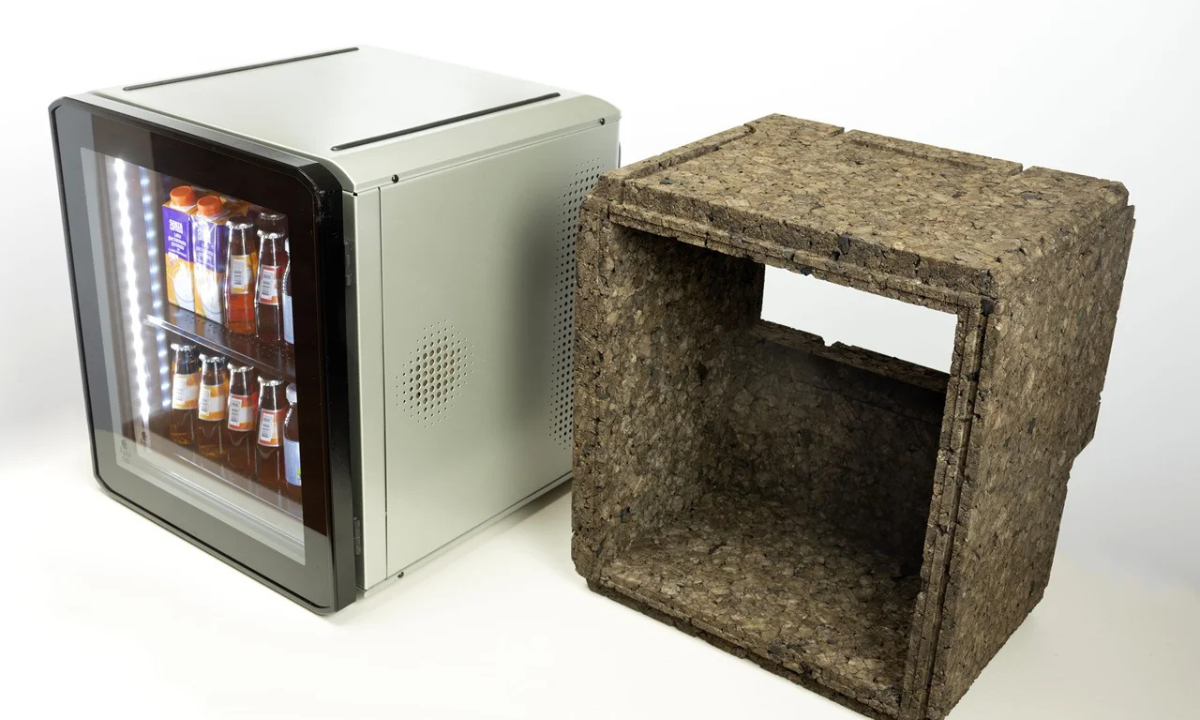
Epta recently announced the launch of UNIT, a counter beverage cooler it calls “the manifesto for circular refrigeration.” In its pages you’ll find isobutane (R600a) refrigerant, recycled plastic, biodegradable cork insulation and a components designed to be multifunctional.
The company says UNIT is up to 80% recyclable, and one of the people most closely involved in its development, Norman Sarabelli, Iarp Product Marketing Manager at Epta, told NaturalRefrigerants.com, “Elements of UNIT’s design approach are already being explored for integration into Epta’s larger refrigerated cabinets.”
NaturalRefrigerants.com recently spoke to Sarabelli about UNIT’s design and how it’s evolved since it was first introduced as a concept in 2023 along with how it compares to more traditionally designed counter beverage coolers.
This interview has been edited for length and clarity.
When UNIT debuted in 2023 it was 95% recyclable and didn’t use a refrigerant. What has changed since then?

Norman Sarabelli: The main difference lies primarily in the transition from concept to production and the integration of the model into Epta’s full product portfolio. The 2023 version was a prototype born out of an experimental university thesis. In contrast, the newly launched UNIT is the first refrigerated display cabinet to be industrialized according to circular economy principles.
Several key technical modifications were made. Most notably, the original Peltier thermoelectric cooling system, which proved to be highly energy intensive and lacked sufficient cooling capacity for commercial applications, was replaced with a small charge of isobutane. This not only improved energy consumption but also significantly enhanced refrigeration performance. The new UNIT now achieves energy class B.
The industrialised version of UNIT incorporates several additional components that significantly enhance cooling efficiency and product preservation. These have led to a recalibration of the recyclability rate, now measured at up to 80%, highlighting Epta’s pragmatic and transparent approach to sustainability: to prioritize measurable results over claims and deliver solutions that are both environmentally responsible and operationally effective. Epta is committed to a progressive circular strategy, with the clear ambition of reaching 100% recyclability.
Does Epta handle the recycling process?
NS: The recycling process is managed by authorized operators, but Epta plays an active role in enabling responsible end-of-life management. Customers receive clear, detailed documentation that includes a dedicated end-of-life manual to guide correct disassembly and recycling of components. However, recycling is just one part of Epta’s broader circular vision.
Through EptaService, the Group provides continuous support, promoting preventive maintenance and refurbishment programs aimed at extending the product’s useful life and delaying its end-of-life phase. Epta not only facilitates recycling but actively works to reduce the need for it.
Is UNIT as efficient as similar products designed more traditionally?
NS: UNIT delivers energy efficiency in line with the high standards of Epta’s Iarp-branded ranges already on the market. One of the key challenges during industrialization was the replacement of conventional polyurethane foam with cork. This required a slightly thicker insulation layer but resulted in no loss of thermal performance. On the contrary, cork’s natural insulating properties contribute to both energy efficiency and a reduction in the model’s carbon footprint. UNIT proves that sustainability can drive, not hinder, efficiency.
Is UNIT currently on the market?
NS: The first units have already been produced, marking the initial phase of a go-to-market strategy designed to align with customer demand and market potential. Epta is fully equipped to scale up production and respond flexibly with larger sales batches, based on commercial feedback and partner needs. While specific sales forecasts are evolving, the early market response confirms strong interest.
Does the circular nature of UNIT’s design mean it has a higher price?
NS: While the initial investment in UNIT may be slightly higher than that of a traditional counter, its circular design delivers clear economic advantages over the medium-to-long term. UNIT has been engineered to reduce the need for replacement and waste management, resulting in a significantly lower total cost of ownership. In this sense, the circular approach is not only environmentally responsible but also a strategic and cost-effective choice for forward-thinking retailers.
Does Epta have plans to bring aspects of UNIT’s design to its larger refrigerated cases?
NS: Absolutely. With UNIT, Epta has achieved a significant milestone in developing solutions that fully embrace the principles of the circular economy. However, this is not an isolated innovation. What started with UNIT is now inspiring a full-scale evolution of the whole product portfolio. The journey is well underway and will be a central theme at EuroShop 2026 where Epta will unveil the next chapter in its circular economy strategy.
“The circular approach is not only environmentally responsible but also a strategic and cost-effective choice for forward-thinking retailers.”
Norman Sarabelli, Iarp Product Marketing Manager at Epta