The Expert Opinion provides a platform on NaturalRefrigerants.com for experts to share their views on technology, market trends, policy developments and more. Contributors are not paid, and NaturalRefrigerants.com maintains full editorial control over each submission. If you’re interested in contributing to The Expert Opinion, please reach out to michael.hines@shecco.com.
This Expert Opinion column has been authored by Sean Osborne, Vice President of the ITB Group, a specialized consulting firm with strategy, data and insight for automotive energy storage, powertrain, thermal management, body and cabin evolution.
Future vehicle thermal system architectures are the focus of ITB’s latest research report, published in January 2025. The assessment helps companies plan their thermal system transition path by examining sources of value, supply chain dynamics and production volumes for a shift to natural refrigerants across global regions. Below is a high-level summary of ITB’s findings.

Automotive OEMs are making their choices for natural refrigerant thermal systems
Natural refrigerant solutions are becoming common for non-automotive uses and are being developed for automotive applications. For automotive use, this means either R744 (CO2) or R290 (propane), which are expected to replace fluorinated refrigerants for certain automotive applications over the next 10–15 years.
Refrigerant circuits must be combined with coolant (glycol/water) circuits to thermally manage internal combustion components, electric drive units, batteries and the passenger cabin. Automotive OEMs in Europe have commercialized R744-based thermal systems. OEMs in Asia, Europe and North America are also developing R290 systems for commercialization in the next five years.
Both R744 and R290 will grow at high rates, but R290 is expected to take the lead after 2030
ITB expects a marked shift in refrigerant usage around 2030, primarily due to changing regulations in Europe, particularly the proposed universal PFAS (per- and polyfluoroalkyl substances) restrictions and the low-GWP gas transition in China. ITB projects high growth for global automotive natural refrigerant thermal systems, particularly as R290 designs start to be commercialized, from 2026 to 2034. The estimated CAGR (compound annual growth rate) of light-duty vehicle thermal systems using R744 will be nearly 50% and over 100% CAGR for R290.
This does not mean fluorinated refrigerants go away. The share of light vehicles using fluorinated refrigerants in 2034 is projected to remain over 45%.
“ITB projects high growth for global automotive natural refrigerant thermal systems, particularly as R290 designs start to be commercialized, from 2026 to 2034.”
Sean Osborne, Vice President of the ITB Group
Companies are setting their natural refrigerant system vehicle transition strategies
The shift toward natural refrigerants is well under way behind the scenes but will take more than a decade. Natural refrigerant usage depends on regulations in different regions, different powertrain thermal system designs and OEM choices.
Automakers must determine how to smoothly transition to natural refrigerants for different vehicle types and markets while remaining flexible, given the uncertainties in regulations, development and approvals.
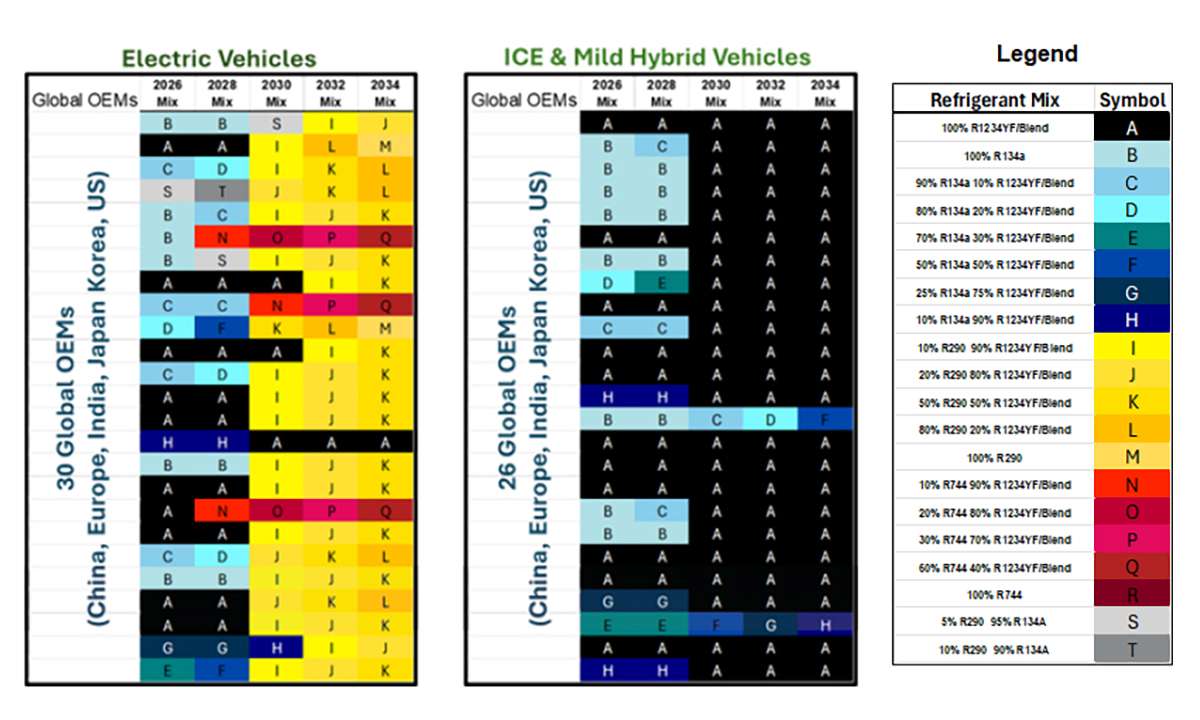
Secondary loop R290 thermal system architectures present new challenges but offer the possibility of low-cost systems and compatibility with existing and future supply chains. As the images show, refrigerant usage can vary greatly across OEMs, powertrain types and over time.
Supply chains are developing to provide natural refrigerant solutions
Components for R744 refrigerant systems have been developed, and the supply base is expanding. Even though R290 components, modules and systems are not being commercialized yet, there are more companies developing them than similar products for R744 systems. This makes both segments competitive.
Both pathways are seeing improvements in performance aspects – and, more importantly, to reduce cost. Compact fluid modules are a key area of development, and 55 suppliers compete in this highly competitive area.
Tightening global warming and PFAS regulations are not the only drivers for natural refrigerant systems
Cost/mass reduction and thermal system performance, as well as regulations, provide incentives for developing natural refrigerant thermal systems for vehicles. Refrigerant regulations are becoming tighter in Europe, China and possibly in the U.S. via state environmental protection agencies. In parallel, the EV market is becoming highly competitive, leading companies to develop new solutions to reduce costs.
Both R744- and R290-based thermal systems offer improved heating performance for heat pump thermal systems. R290-based thermal systems offer potential to reduce thermal system cost by shifting functionality from the refrigerant circuit to the coolant circuit.
Natural refrigerant thermal system value varies by vehicle powertrain type and thermal system function
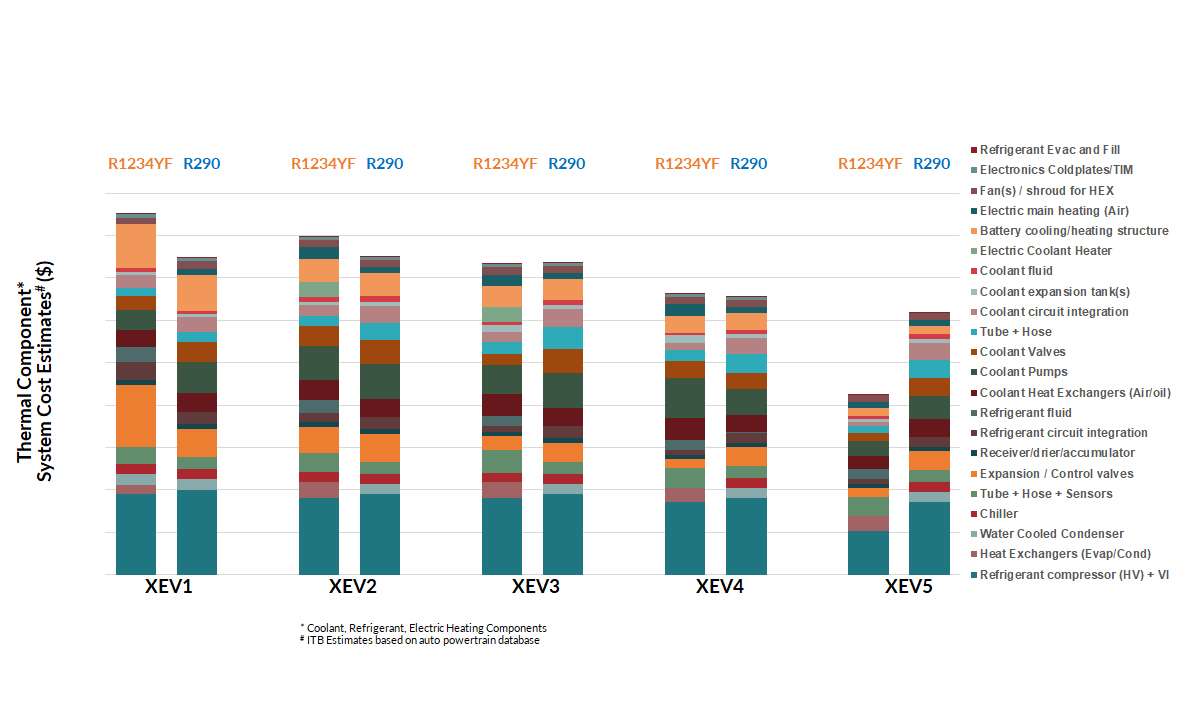
The chart below shows cost breakdowns for five electrified vehicle thermal systems and conventional-versus-natural refrigerant architectures. Propane secondary loop thermal systems have potential to offer a total thermal system cost reduction. For some EVs, natural refrigerant system designs offer an opportunity to lower thermal system cost, improve heating performance and be more environmentally friendly.
Thermal system design includes not just refrigerant circuits but also coolant circuits, electric heating components and thermal control logic. New designs, especially for complex heat pumps, will be simpler. Functions can be combined into compact fluid modules to reduce cost and mass while improving thermal system performance.
R744- and R290-based systems need design improvements to make them more competitive in terms of cost and performance. OEMs and suppliers must mitigate the safety risks of R290 refrigerant circuits to make such designs a viable option.
Visit ITB’s website to learn more about the latest research report underpinning this article.