This is an excerpt from an article featured in ATMOsphere’s “Clean Cooling for Data Centers 2025” report, which can be downloaded here. ATMOsphere is the publisher of NaturalRefrigerants.com.
Carel is a global manufacturer of HVAC&R industry controllers, sensors and humidifiers as well as components, including inverters and electronic expansion valves. The company was founded in 1973 in Padua, Italy, originally as a manufacturer of electric cabinets for the air-conditioning industry.
Enrico Boscaro, Group Marketing Manager for HVAC Industrial, said the data center industry is in the “DNA of Carel.” In addition to his work at Carel, Boscaro is also the chairman of the IT cooling task force at Eurovent, a European HVAC&R industry association made up of more than 1,000 companies, which are represented directly and indirectly through national membership associations.
“Carel has been working in the data center industry since 1973,” Boscaro said. “We started providing technology to OEMs manufacturing computer room air conditioners [CRACs] to control temperature and humidity,” Boscaro said.
Three flavors
Boscaro organized the company’s offerings for data centers into three product groups: CRAC and computer room air handlers (CRAHs), free cooling and liquid cooling. For CRACs and CRAHs, Carel offers controllers, sensors, electronic expansion valves and variable-speed compressor drives. Carel also provides controllers for chillers. Boscaro said Eurovent data shows that more than 60% of CRAC units use inverters.
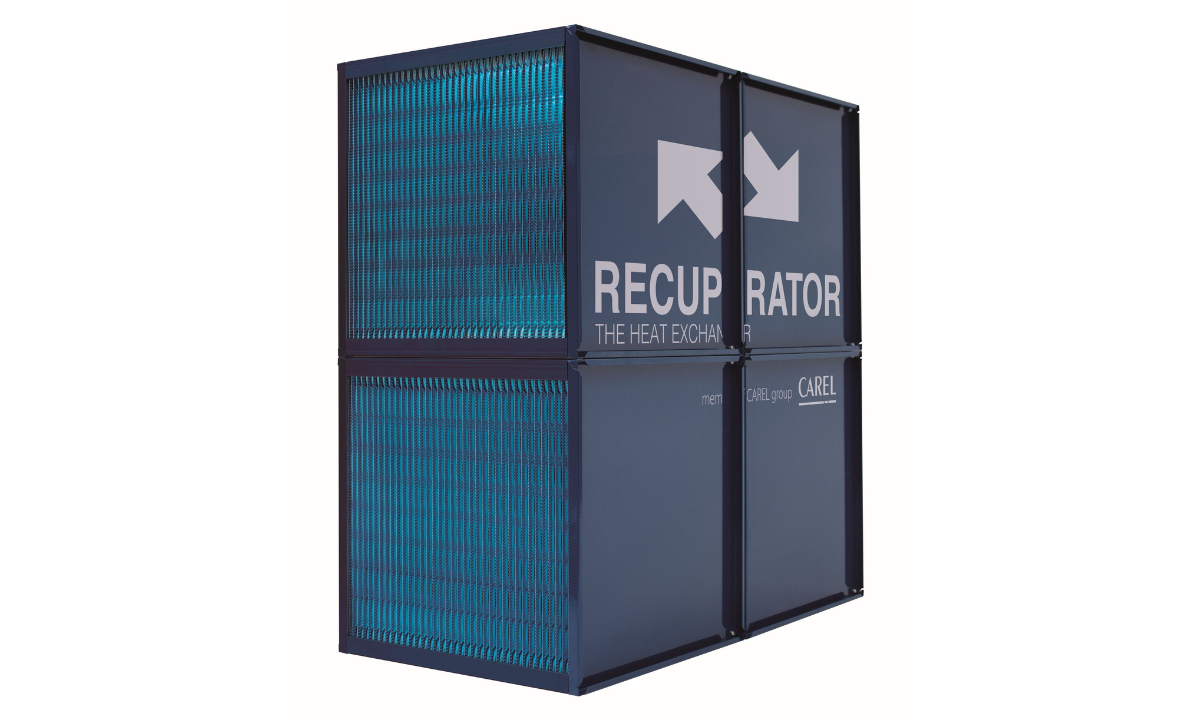
“The industry started [using inverters] much, much earlier compared to others,” he said. On the free-cooling front, Carel is developing “special dampers” for data center air-handling units, which Boscaro said are designed to avoid thermal loss and preserve air quality. Indirect free-cooling solutions are available via Recuperator and Klingenburg, two companies acquired by Carel in recent years that manufacture rotary and plate air-to-air heat exchangers.
While CRACs and free cooling are a big part of Carel’s data center business, the growth in new products is coming from liquid cooling, which encompasses both coolant distribution units (CDUs) and immersion cooling. Carel is developing controls and sensors for CDUs and immersion cooling systems.
In May 2025 Carel announced that its data center controllers were compatible with the Redfish protocol. Redfish enables the managing and monitoring of data center infrastructure, including cooling equipment. “The Redfish protocol is very useful in liquid cooling as it enables the collection of data from both servers and cooling solutions to optimize control and minimize energy consumption,” Boscaro said. “We worked in advance [on Redfish integration], and now all over the world requests are appearing for this feature.”
Boscaro said most of the development in liquid cooling has been on direct-to-chip technology, which places cold plates with microchannels filled with a water–glycol mix or a dielectric fluid on top of chips to remove heat. Immersion cooling, while promising, still isn’t available at scale and requires a setup that is starkly different from what many data center designers are familiar with, according to Boscaro.
Liquid cooling
“Direct-to-chip cooling is much more similar to the traditional deployment,” Boscaro said. “It’s racks and servers. With immersion you need a tank. It’s horizontal, not vertical, and you don’t have the same racks or connections. There are also big concerns about PFAS [per- and polyfluoroalkyl substances].”
In two-phase, a fluorocarbon-based dielectric fluid absorbs heat and evaporates, with the vapor changing back into a liquid after contacting a condensing coil in the tank. The two-phase immersion cooling industry received a shock in 2023 when 3M – which supplied coolant for two-phase immersion systems used by Microsoft – announced it would cease PFAS manufacturing by the end of 2025. There are two types of immersion cooling: single-phase and two-phase. In single-phase, servers are submerged in a dielectric fluid – a synthetic oil or hydrocarbon-based fluid – that is pumped to a heat exchanger and doesn’t change state.
Future growth
“Countless” was how Boscaro described the number of projects Carel has worked on in the data center sector. Regarding its future prospects, Boscaro said the data center industry is forecasted for double-digit growth, “which is why we keep investing into this sector.”
“We can say that we’re supporting most of the most important players around the world with one product or another,” Boscaro said.
Information from quarterly earnings calls provides further insight into Carel’s presence in the data center sector. Carel has seen “sustained demand” from data centers in North America in 2025, with its HVAC segment, which includes data centers, growing 15% from the first to second quarters. During a Q&A on Carel’s Q2 earnings call, CEO Francesco Nalini said data centers were the biggest contributors to the HVAC segment’s growth “in absolute terms.” He added that “smaller competitors and complementary technologies” were targets of acquisition in the space.
“We can say that we’re supporting most of the most important players around the world with one product or another.”
Enrico Boscaro,
Group Marketing Manager for HVAC Industrial at Carel