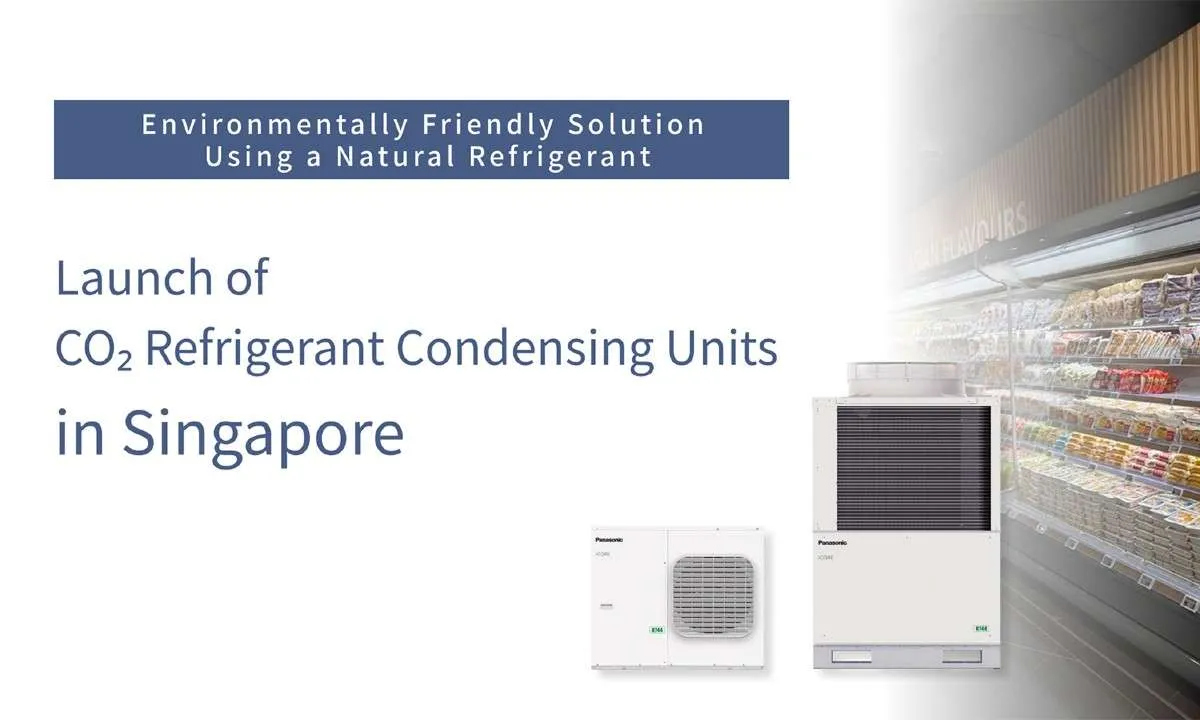
Panasonic HVAC & CC, part of the Japan-based Panasonic group, has launched its CO2 (R744) outdoor condensing units (OCUs) in Singapore, with the first installation operating at the Sheng Siong Rivervale Mall store in Sengkang.
The Singapore lineup comprises six factory-assembled models from 2 to 20HP, with an ambient operating range of −20 to 45°C (−4 to 113°F) and low- and medium-temperature (LT/MT) options. The OCUs allow configurations based on store size and refrigeration load while reducing design workload and simplifying on-site installation compared with conventional CO2 racks, according to the manufacturer.
“Today, the [CO2 OCU] product is sold in Japan, Europe and Oceania, with cumulative shipments exceeding 39,000 units worldwide as of June 2026,” the company said. “Through the introduction in Singapore, Panasonic HVAC & CC will expand its commercial refrigeration business across Southeast Asia.”
The configurations: The modular units come in side-flow and top-flow discharge direction models, both housed in salt-corrosion-resistant packaging.
- The side-flow units include a 2HP combined LT/MT model in a 930 × 900 × 437mm (37 × 35 × 17in) package and a 4HP MT or combined LT/MT model in a 948 × 1,143 × 609mm (37 × 45 × 24in) package.
- The top-flow units include a 10HP MT or combined LT/MT model in a 1,941 × 890 × 890mm (76 × 35 × 35in) package and a 20HP combined LT/MT model in a 1,941 × 1,190 × 890mm (76 × 47 × 35in) package.
- The units, featuring a proprietary compressor for high-pressure operation, are designed to perform reliably in Singapore’s consistently hot and humid climate, with limited seasonal fluctuations, Panasonic HVAC & CC told NaturalRefrigerants.com.
Initial installation: The 2,053m2 (22,100ft2) Sheng Siong store opened on August 20, equipped with Panasonic CO2 OCUs.
- The store installed four 20HP CO2 OCUs alongside 24 Panasonic remote-refrigerated cases as part of an integrated solution.
Regulatory landscape: In May Singapore’s National Environment Agency (NEA) announced that new centralized commercial refrigeration systems must use refrigerants with a GWP of 150 or lower from July 2027, supporting the country’s goals of reducing emissions by 2030 and achieving net-zero emissions by 2050.
- As of 2025 Singapore had 718 supermarkets. Since the requirements apply only to newly installed equipment, the impact of the regulation will highly depend on the rate of new construction and equipment replacement. Sheng Siong, one of Singapore’s largest supermarket chains, expects to open three new supermarkets per year over the next 10 to 15 years.
- The policy presents a market opportunity for natural refrigerant-system suppliers and manufacturers, especially given the low number of natural refrigerant installations in Southeast Asia.
- As of December 2025 the region had 35 food retail and industrial sites using transcritical CO2, according to the ATMOsphere report “Refrigeration: Commercial and Industrial Refrigeration with Natural Refrigerants.” ATMOsphere is the publisher of NaturalRefrigerants.com. Most of these installations are in Malaysia and Indonesia.
Quotable: “This project marks an important milestone for Panasonic Cold Chain business in Southeast Asia,” the company told NaturalRefrigerants.com. “It meets Singapore’s environmental initiatives and supports retailers facing increasing demand for efficient use of store space, energy efficiency and streamlined installation processes.”