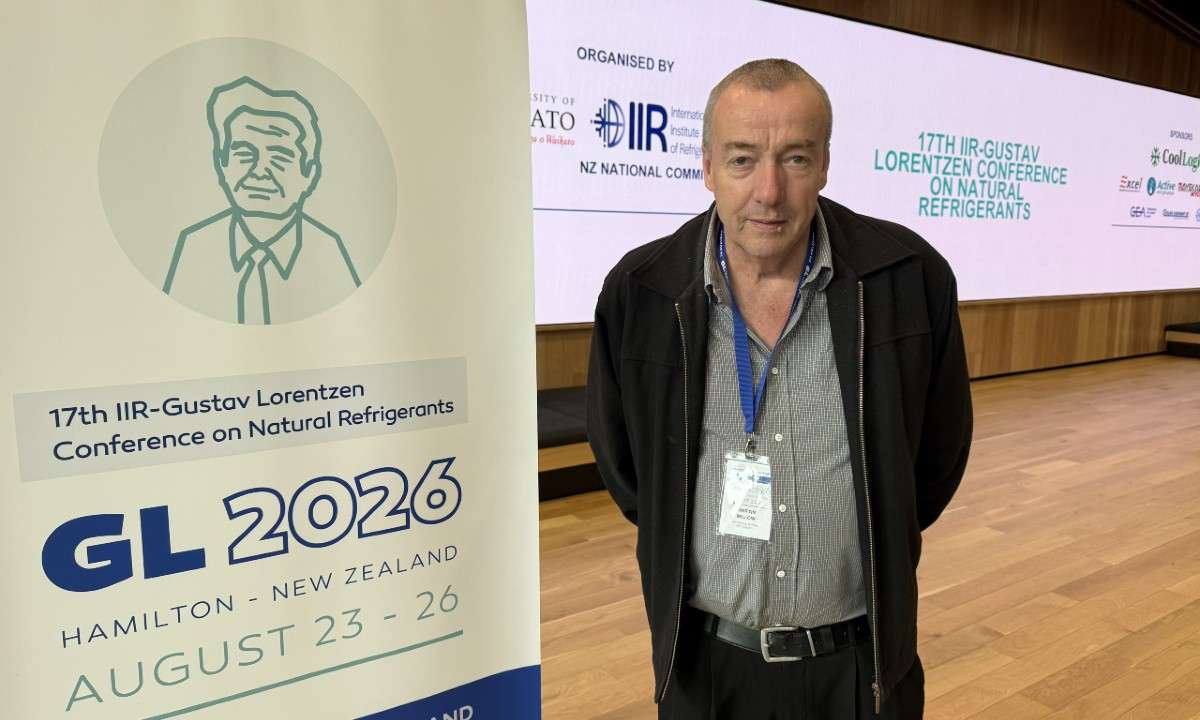
Martin Millow, Mayekawa Australia’s General Manager NZ, discussed the growing use of natural refrigerants and adoption of ammonia (R717) heat pumps in New Zealand’s industrial sector in an interview with ATMOsphere’s Co-Founder and COO Jan Dusek.
ATMOsphere is the publisher of NaturalRefrigerants.com. In the interview, Millow outlined how the country’s decarbonization incentives are driving a new industrial configuration, highlighted future market opportunities for natural refrigerants and detailed a recent CO2 (R744)–ammonia project at a meat-processing plant.
“As the only industrial compressor manufacturer actually producing packages in New Zealand, we work closely with contractors to come up with optimal solutions for end users,” Millow said, adding that the company produces 20‒30 ammonia packages annually. “With the government ending oil and gas exploration and providing decarbonization incentives, heat pumps will be a big part of our business going forward,” he added.
Assembling compressor packages in New Zealand allows Mayekawa to offer shorter lead times than importing turnkey systems, according to Millow. He also noted that the country’s AS/NZS 1200 pressure-equipment standard includes seismic design provisions, which can create compliance challenges for overseas suppliers. For individual projects, the determining factors for choosing a system ultimately come down to equipment availability, suitability and cost, Millow said.
Optimal design: A new configuration for decarbonizing large-scale food processing plants in New Zealand combines subcritical CO2 for low-temperature (LT) freezing, an ammonia intermediate-pressure (IP) system for CO2 condensing and glycol loads and ammonia heat pumps that recover refrigeration waste heat for hot water processing, according to Millow.
- To reduce energy consumption, Auckland Meat Processors recently upgraded its plant to this configuration, which was designed by local contractor Active Refrigeration.
- “With the meat plant operating its carton freezer around −50°C [−58°F], the CO2 side optimizes LT efficiency,” Millow said, adding that the ammonia heat pump eliminates fossil fuel boilers while delivering processing water at 65 and 90°C [149 and 194°F].
- “If you consider the megawatts of refrigeration heat that we reject through condensers – it’s just energy going up into the sky,” Millow said. “With the heat pumps, we can utilize that waste heat to make useful heat.”
Potential growth: New Zealand’s agriculture-based economy and significant refrigeration demand create an opportunity to enhance heat pump technology, with potential for hundreds of industrial installations, Millow said.
- With end users taking advantage of government decarbonization incentives, Mayekawa has already installed 25 to 28 heat pump units in New Zealand.
- As the company continues to develop its heat pump technology and add higher pressure compressors to its range, Millow expects heat pumps to account for half of Mayekawa NZ’s annual production.
- “We have the range of compressors and the technology to support many different industries,” Millow said, adding that this includes data-center cooling and other industrial air-conditioning applications.
Looking forward: Mayekawa’s priorities include reducing ammonia charges to minimize potential hazards, developing high-temperature heat pumps (HTHPs) and bringing natural refrigerant solutions to smaller NZ food-processing and cold-storage facilities still dominated by synthetic refrigerants.
- The company’s European segment is working on an ammonia–hydrocarbon cascade HTHP capable of producing temperatures beyond 150°C (302°F), according to Millow. Once the design is developed, Mayekawa NZ will build the units locally, unlocking new business opportunities in New Zealand.
- The company focuses on 0.5MW (142.2TR) and larger systems. However, Millow sees clear potential for transcritical CO2 solutions in smaller applications, noting that access to compact CO2 systems would allow Mayekawa to compete more effectively in that market.
- Mayekawa also has a few air-source CO2 hot water heat pumps installed in New Zealand. However, Millow noted that high return temperatures in closed-loop CO2 systems can reduce COPs, limiting the range of applications where they can operate efficiently.
Quotable: “We continue to promote natural refrigerants and decarbonization,” Millow said. “There’s no reason to use a synthetic refrigerant because the technology is there to use natural refrigerants in all sectors,” he added.
“We have the range of compressors and the technology to support many different industries. There’s no reason to use a synthetic refrigerant because the technology is there to use natural refrigerants in all sectors.”
Martin Millow, Mayekawa Australia’s General Manager NZ