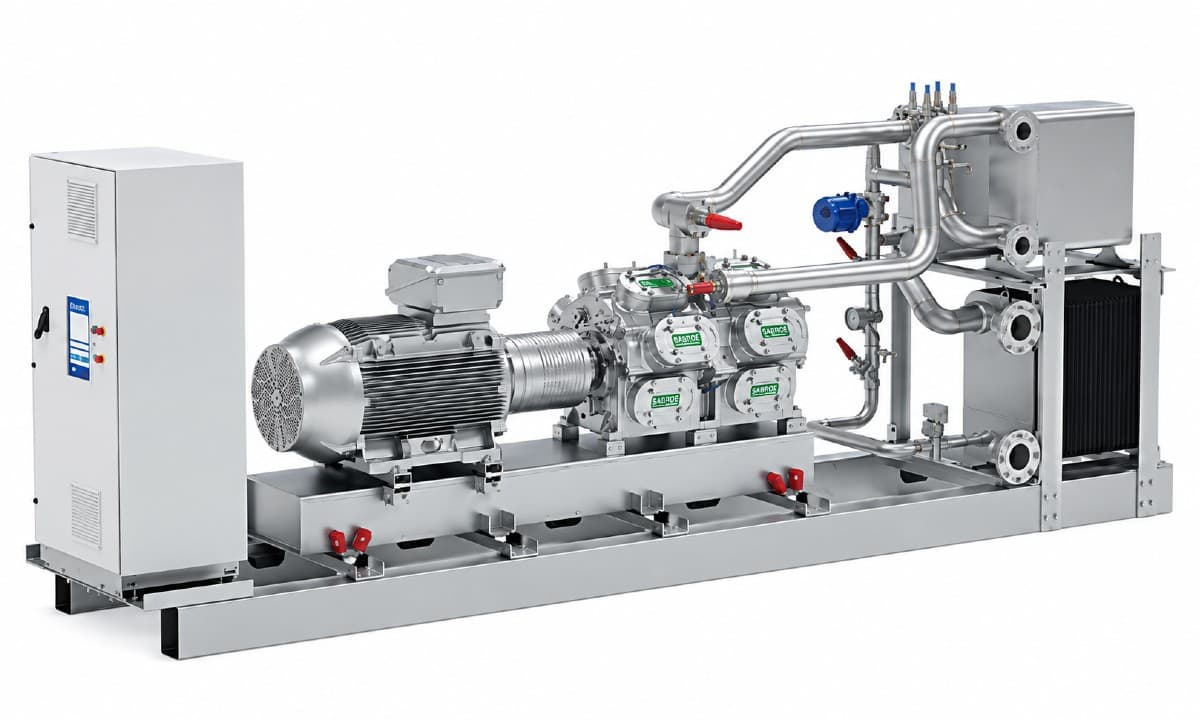
Japanese manufacturer Mayekawa has announced the development of a desiccant dehumidifier that incorporates a CO2 (R744) heat pump.
Kazuhiro Hattori, General Manager, Research and Development division for Mayekawa, described the system at the 10th International Institute of Refrigeration (IIR) conference, held in Ohrid, North Macedonia, April 27–29.
“Designed to combat condensation in wet surfaces, the new system overcomes the limitations of traditional dehumidifiers by providing dehumidification in low-temperature environments without the risk of freezing,” said Hattori.
Traditional dehumidifiers, he added, rely on a cooling dehumidification/reheating process and have proven insufficient due to the frequent defrosting required in low-temperature environments.
In addition to tackling condensation, the CO2 system also offers a significantly more energy-efficient solution, reducing the reliance on traditional heat sources such as boilers and electric heaters, he said.
“Mayekawa’s CO2 desiccant dehumidifier reduces the electric power consumption by 75.5% compared with traditional dehumidifiers using the electric heater,” Hattori stated.
In recent years, industry has become interested in desiccant dehumidifiers. These devices utilize adsorption dehumidification, dehumidifying without generating condensate, thereby circumventing the freezing issues. The regeneration of adsorbent in these dehumidifiers requires a heat source, which, until now, has increased energy consumption. To overcome this issue, a CO2 heat pump desiccant dehumidifier was developed.
The CO2 heat pump desiccant unit measures 4.31m by 2.25m by 2.80m (14.14ft by 7.38ft by 9.18ft) and weighs 5,100kg (11,244lbs). It is crafted from roll-formed stainless steel and features outer panels made from galvanized steel plates. The unit houses a desiccant rotor and a CO2 heat pump and is equipped with plug fans directly connected to an inverter specification motor.
The system requires no auxiliary equipment and can be operational immediately after connecting the power supply and ducts. It is capable of supplying dehumidified airflow rate of 3,000 to 8,000m3/h (13,200 to 35,200GPM), providing a high level of control over the humidity levels within the wet surfaces in refrigerated warehouses, ice skating rinks and other facilities, Hattori said.
Factory case study
For example, the CO2 heat pump desiccant dehumidifier has recently been adopted in a factory’s positive pressure air-conditioning system, replacing a conventional desiccant dehumidifier, with a focus on energy cost reduction. The previous system, reliant on a diesel generator for exhaust heat, became less efficient and more expensive with rising oil prices. The shift to a boiler and an air-cooled chiller significantly increased energy consumption.
By contrast, the new system powered by the CO2 heat pump desiccant offers a significant reduction in energy consumption, said Hattori. The system cools and dehumidifies outdoor air, then uses the CO2 heat pump desiccant unit to dehumidify about 60% of the air, supplying 11,000m3/h (48,400GPM) of treated air at 14.5°C (56.1°F)/82%RH.
This treated air is supplied to the suction side of the internal controller, which circulates an air volume of 30,000m3/h (132,000GPM) or more, so there are no problems even with low-temperature air, he said.
The introduction of the CO2 heat pump desiccant system reportedly led to a reduction of about 115kW of electric power, slashing the factory’s energy consumption by approximately two-thirds.
“Having desiccant dehumidification using a CO2 heat pump is advantageous since it is applicable below 0°C (32°F), no defrosting required, no condensate released out,” said Hattori.
Hattori suggested further development for this dehumidifier to make it applicable for mid-temperature environments using a crossflow heat exchanger.
“Mayekawa’s CO2 desiccant dehumidifier reduces the electric power consumption by 75.5% compared with traditional dehumidifiers using the electric heater.”
Kazuhiro Hattori, General Manager, Research and Development division for Mayekawa