Germany-based Teko has highlighted the efficiency measures of its recently installed 1.5MW CO2 (R744) refrigeration system in a new Dachser logistics center.
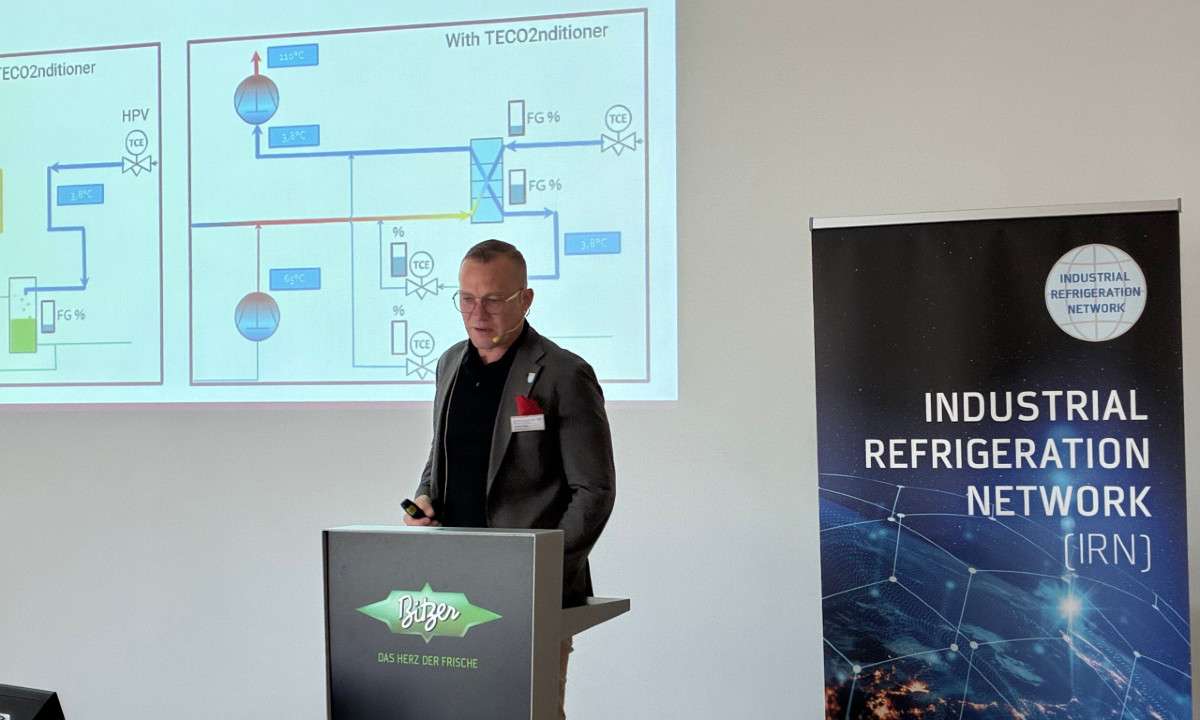
The global logistics provider’s new 18,000m2 (193,750ft2) warehouse in Landsberg, Germany, provides refrigerated storage for 25,000 pallet positions. Teko Managing Director Andreas Meier outlined the warehouse’s CO2 system in a presentation at the 2025 Industrial Refrigeration Network (IRN) conference. The event, organized by Bitzer, was held June 6–7 in Rottenburg am Neckar, Germany.
One of the measures highlighted by Meier was the adapted Wurm controller. Other efficiency measures incorporated in the system included adiabatic gas cooling, parallel compression, superheat control, heat recovery and Teko’s heat exchanger, TECO2nditioner, which provides a constant low-suction gas temperature to the transcritical medium-temperature (MT) compressors.
“With our new Wurm controller, we’ve built something new and interesting for the industrial market,” Meier said. “Instead of relying on one guy who knows all the programming, which is a nightmare for most of our customers, we’ve taken the standard retail Wurm controller and added industrial client-specific visualization using web technology. It’s a consistent, user-friendly dashboard.”
Warehouse design
The warehouse turns over 100 metric tons of cooled products daily, which necessitates a large refrigeration load, according to Meier. In addition, the facility’s more than 1km (0.6mi) of piping required Teko to account for refrigerant pressure loss, proper oil return in partial load operation and risers to adjust for long distances between vertical suction lines.
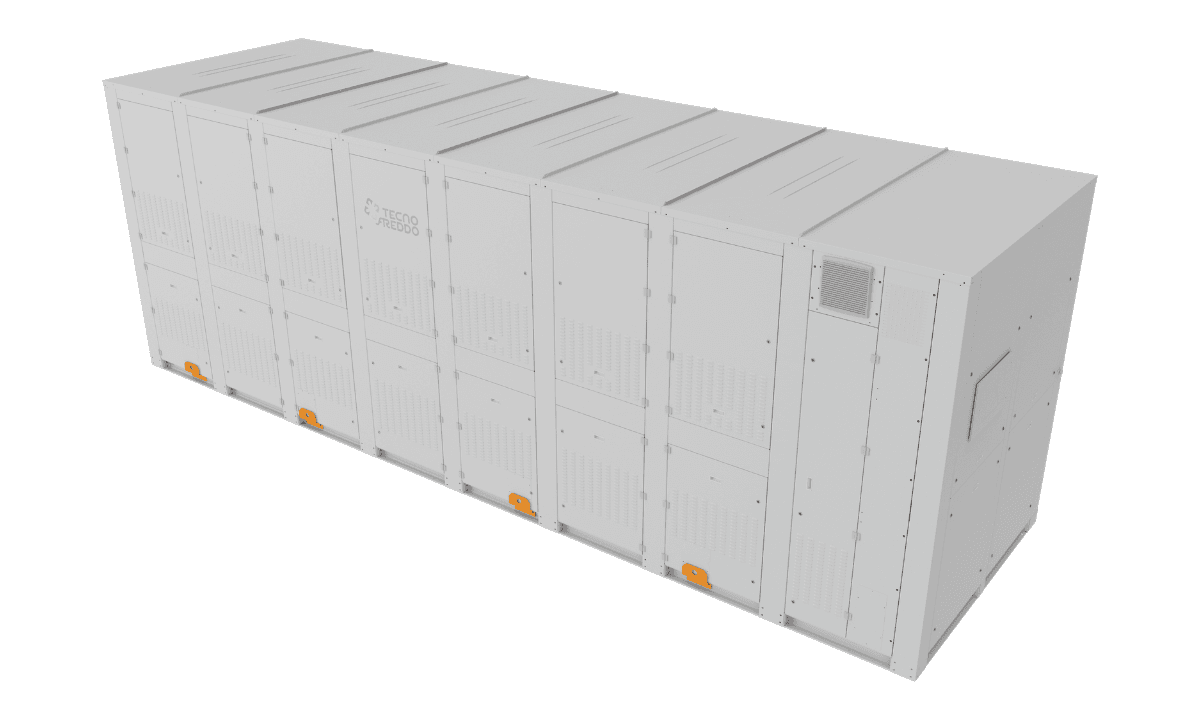
To meet the requirements, Teko installed three identical 500kW (142.2TR) cooling capacity industrial ROXSTA G6 racks. Every rack contained five MT compressors and two ECO compressors in parallel compression. One rack supplied cooling for the 12/18°C (53.6/64.4°F) storage zone, and the other two cooled two 2/7°C (35.6/44.6°F) zones.
Adiabatic gas coolers support the system in ambient conditions above 30°C (86°F). Recovered heat from the refrigeration system supplies 45kW (12.8TR) of heating capacity for heating the facility’s offices and social spaces and 60kW (17.1TR) for defrosting evaporators. Teko started installing the CO2 system in August 2024 and completed the project in February.
Intelligent logistics: The new controller, implemented by Wurm and developed in partnership with Dachser and German industrial refrigeration designer and manufacturer Kreutzträger, allows users to monitor the system and make remote adjustments.
- With a graphic interface, Wurm’s dashboards show a main overview, individual zones, major parameters, evaporator settings, equipment diagrams and evaporator monitoring for trend analysis.
- Tens of thousands of retail locations use Wurm controllers, according to Meier.
Two is better than one: To improve efficiency during summer, Teko used two small, roughly 30kW (8.5TR) ECO compressors for parallel compression in the Dachser warehouse instead of a single large compressor.
- The smaller compressors begin operation at 12°C ambient temperature to provide a small efficiency gain over a long period. Assuming a 50% run time, the annual efficiency gain is approximately 8%, according to Meier.
- On the other hand, a larger compressor would start operation at 22°C ambient. Assuming the compressor runs 14% of the time, the annual efficiency gain is roughly 4%.
Controlling superheat: The warehouse system uses Evalift, Teko’s new solution for semi-flooded systems. The product, released last fall, supports year-round CO2 operation in ambient temperatures from roughly −6 to 34°C (21.2 to 93.2°F).
- “It controls the superheat in the suction lines by raising the evaporation temperature by 3 to 6K [3 to 6°C/5.4 to 10.8°F] to increase the usable evaporator surface area,” Meier said.
- In summer, with a gas cooler temperature of 36°C (96.8°F), Evalift raises the evaporation temperature from −8 to −3°C (17.6 to 26.6°F) to improve the COP by roughly 22%.
- In winter, with a condensing temperature of 15°C (59°F), the evaporation temperature is raised from −8 to −3°C to improve the COP by roughly 37%.
Quotable: “Compared to the CO2 systems we were building 10 years ago, the efficiency enhancements are making CO2 more attractive on a larger scale,” Meier said.
“Compared to the CO2 systems we were building 10 years ago, the efficiency enhancements are making CO2 more attractive on a larger scale.”
Andreas Meier, Managing Director at Teko