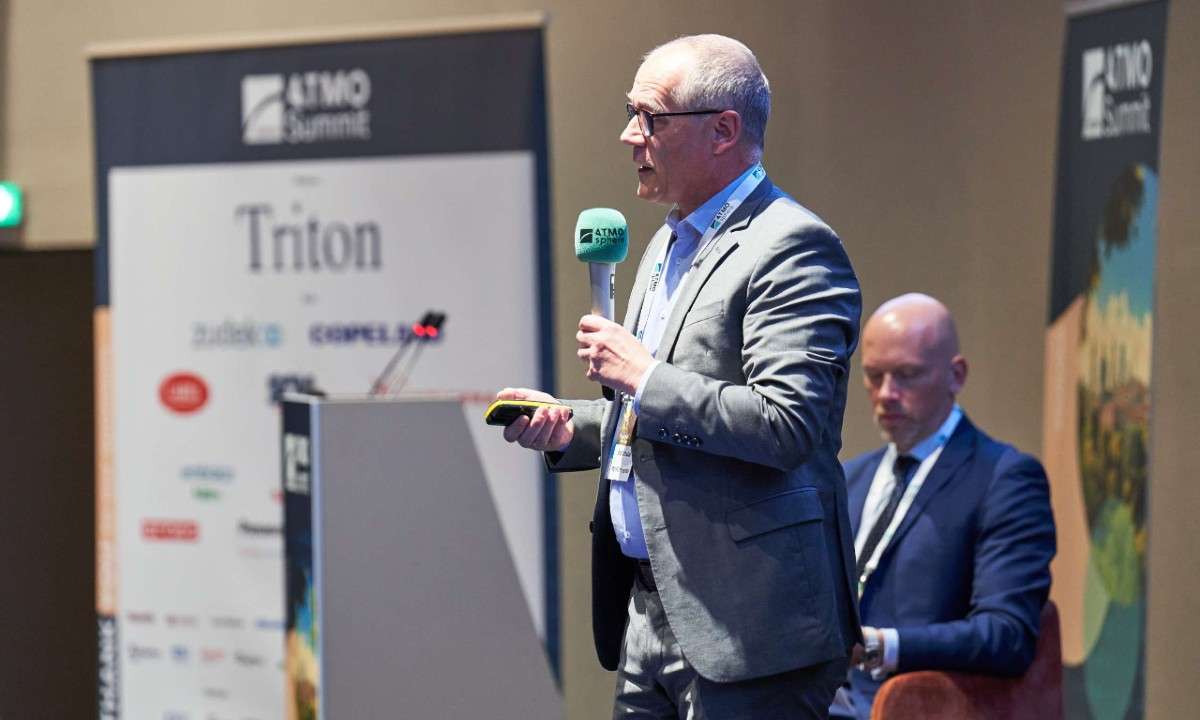
Olaf Schulze, Director of Energy Management/Real Estate Sustainability at METRO Properties, outlined the wholesaler’s refrigeration and heating decarbonization strategies in a presentation at the ATMOsphere (ATMO) Europe Summit 2025, with 59% of its global stores/depots already using natural refrigerants.
The event, organized by ATMOSphere, was held November 24–25 in Padua, Italy. ATMOsphere is the publisher of NaturalRefrigerants.com. As a business-to-business food wholesaler, METRO operates 624 stores/depots in 21 countries across Europe and parts of Asia, including Turkey. It also supports food service distribution in an additional 12 countries.
“As part of our F-gas Exit Program [FEP], we are investing, as far as it’s technically possible, in natural refrigerants,” Schulze said. “In fiscal year 2025, we completed 49 FEP projects, with 40 more planned in 2026.”
Full steam ahead: METRO’s typical store design features CO2 (R744) refrigeration, providing 100kW (28.4TR) of low-temperature cooling capacity and 500kW (142.2TR) of medium-temperature capacity.
- As part of its decarbonization plan, the wholesaler is moving country by country to remove f-gas systems, according to Schulze.
- “Moldova, with its three stores, and Slovakia, with its six stores, are refurbished and f-gas free,” Schulze said. “Next year, with the budget confirmed, France ‒ with its 95 stores ‒ will become f-gas free, and Portugal is next in line in 2027, with its 27 stores.”
- At the end of fiscal year 2024, 50% of METRO stores/depots operated with natural refrigerants, including transcritical and subcritical CO2, propane (R290)-based plug-in units and absorption-based refrigeration solutions using ammonia (R717).
By the numbers: With a 2040 net-zero target, METRO has reduced its per–square–meter carbon footprint by 52% compared to its 2011 baseline as of September 2024, according to Schulze.
- Electricity, thermal energy consumption and refrigerant loss account for roughly 90% of its total carbon footprint.
- The continued switch to natural refrigerants supports the company’s decarbonization goals, with Schulze aiming to see a more than 90% CO2e reduction by the time he retires in 2030.
- Schulze reports that 73% of all METRO’s EU stores operate with natural refrigerants.
Other methods: In addition to FEP, the wholesaler’s other decarbonization actions include a Heat Exit Program and an As-Cold–as–Ice Initiative.
- The company seeks fossil-free, PFAS (Per- and polyfluoroalkyl substances)-free heating solutions. It mandates heat recovery when installing CO2 cooling equipment for hot water and space heating, with Schulze noting that the new Hamburg store is heated solely by the refrigeration system’s waste heat.
- Instead of heated shopping spaces with refrigerated cases, METRO has built customer shopping rooms chilled to 4°C (39.2°F) for refrigerated products as part of its As-Cold–as–Ice Initiative. The design reduces CAPEX and energy consumption, while improving flexibility and food safety, according to Schulze.
- In places where CO2 doesn’t make financial sense, like in Turkey, where the equipment costs 50% more than it does in Europe, METRO is relying on propane cases, with approximately 14,000 R290 pieces in operation.
Quotable: “I need your support, dear industry colleagues, to help us invest in clever technologies to reduce our carbon footprint,” Schulze said. “We are loyal. We have a lot of demand. We need the industry to offer us f-gas-free, PFAS-free technology at a fair price.”
“We need the industry to offer us f-gas-free, PFAS-free technology at a fair price.”
Olaf Schulze, Director of Energy Management/Real Estate Sustainability at METRO Properties