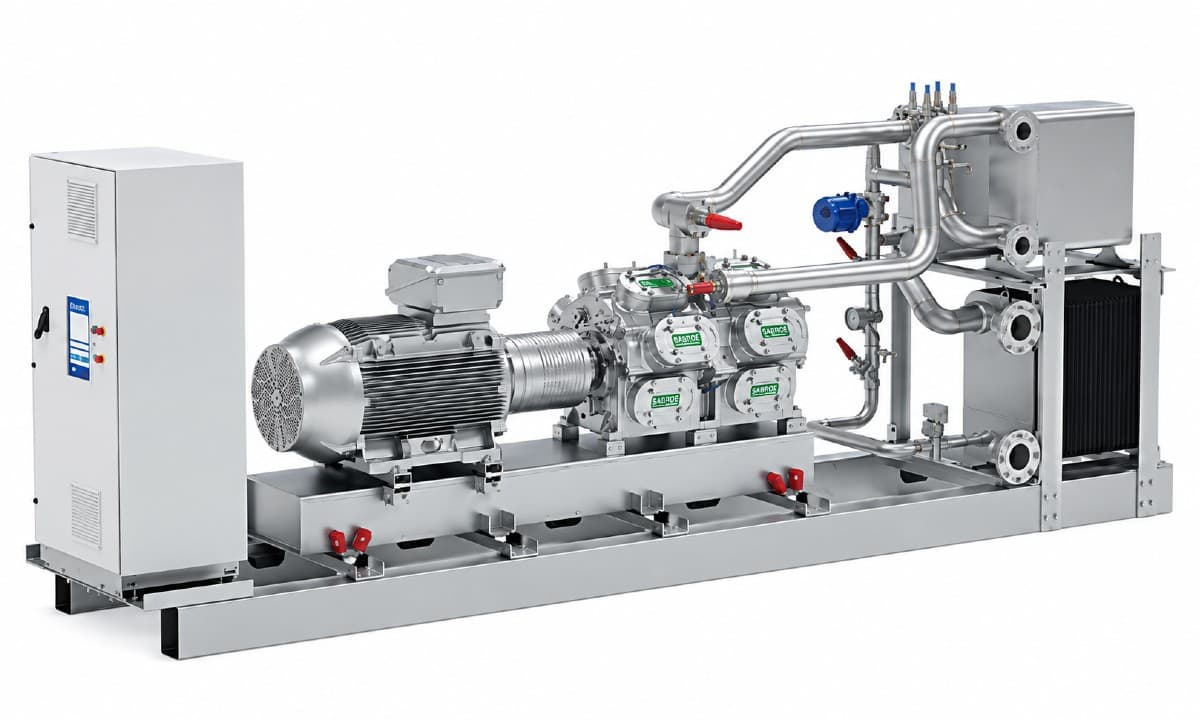
Two rotation heat pumps developed by Austrian clean-tech firm ecop Technologies are set to be installed in Meldorf, Germany, as part of an upgrade to the town’s district heating network, which serves around 7,500 inhabitants.
Using a mixture of noble gases as their working fluid and drawing power from solar photovoltaics, the air-to-water heat pumps are expected to help decarbonize the town’s heating supply, according to Caspar von Moy, Head of Sales and Business Development at ecop. The units are scheduled for installation and commissioning in early 2026.
The heating network serves mostly single-family homes, schools and other municipal buildings, as well as some industrial sites.
Details of the project – known as Wärmewende Meldorf (Meldorf heat transition) – were presented by von Moy at the ATMO Europe 2025 Summit together with Joris Zimmermann, Research Associate at Steinbeis Innovationszentrum energieplus, which has served as the project’s scientific advisor.
ATMO Europe 2025 took place November 24–25 in Padua, Italy, and was organized by ATMOsphere, publisher of NaturalRefrigerants.com.
System architecture
Once operational, ecop’s heat pumps will form part of an integrated multi-source heating network that also includes a solar thermal installation, an existing biogas-fired combined power and heat plant (CHP) and waste heat recovered from an existing natural gas-powered industrial printing facility. Depending on demand, heat from any of these sources can be supplied directly to the district heating network or stored for later use in a newly constructed 45,000m3 (1.6 million ft3) pit thermal energy storage (PTES) system.
The PTES – currently the largest of its kind in Germany, according to Zimmerman – can also serve as a heat source for the rotation heat pumps during winter, when ambient air temperatures are low.
The two heat pumps can operate either in parallel, maximizing available thermal output, or in series when higher temperature lifts are required to meet supply temperatures, Zimmermann explained.
The district heating network operates with supply temperatures of 70 to 80°C (158 to 176°F) and return temperatures of 50°C (122°F). Around 610kW (173TR) in heating capacity is provided by the CHP plant at 85°C (185°F), while 800kW (227TR) of heat is recovered from the printing facility at 80°C. The supply temperature and capacity of the ecop heat pumps have not been specified.
Municipal leadership
The Wärmewende Meldorf project faced significant technical and commercial challenges, noted von Moy. Construction of the PTES system was complicated by marshy ground conditions, low soil stability and high groundwater levels, requiring the use of high-performance membranes to retain water and limit thermal losses.
Long development timelines – including around three years for planning and permitting – combined with high inflation in 2022 and 2023 led to rising costs, particularly for the PTES. The project was further challenged by the low density of heating lines in the town, putting additional pressure on capital costs.
“There was a point when the project was at risk, and it was the local council that really solved its problems,” he said. “They were involved in an absolutely exemplary way from the beginning, and they will play a critical role in the operation.”
The local council provided long-term loans, established a municipally-owned energy-supply company to operate the system and secured public buildings such as schools as anchor customers. Public information campaigns and an innovation partnership framework were also used to ensure local acceptance and buy-in and to maximize regional value creation.
“This was a huge project, and its realization was only possible through the collaboration of many dedicated partners,” said von Moy. “We hope that it will be a kind of example for a possibility to decarbonize local heating systems, particularly rural applications.”
“We hope that [this project] will be a kind of example for a possibility to decarbonize local heating systems, particularly rural applications.”
Caspar von Moy, Head of Sales and Business Development at ecop Technologies
Unconventional heat pump design
Ecop’s rotation heat pumps are based on an unconventional thermodynamic cycle that makes them particularly well suited to complex district-heating applications, according to von Moy. The heat pumps are designed for flexible operation, allowing them to run in various configurations and to switch between different heat sources depending on seasonal conditions and system demand.
The units can operate with high temperature glides – up to 40K on the source side – enabling efficient heat extraction. In the Wärmewende Meldorf project, it will enable the system to maintain thermal stratification within the PTES, he noted.
The heat pumps can also achieve temperature lifts of up to 100K, ensuring reliable supply temperatures across operating conditions.
For its refrigerant, ecop’s heat pump uses a mix of natural noble gases – argon (R740), krypton (R784) and xenon (R7131) – which are non-flammable, non-toxic and free of f-gases. Its low specific heat capacity supports the high temperature lifts achievable by the system, while overall efficiency helps reduce the levelized cost of heat.
The rotation heat pump compresses the working gas using centrifugal force rather than conventional compressors, with a rotating rotor operating at speeds of up to 3,800rpm. Each unit has a nominal thermal capacity of 700kW (199TR), with larger system capacities of up to 10MW (2,843TR) by deploying multiple units in parallel.
In June 2025, ecop announced that it had secured €10.5 million ($12.3 million) in funding to expand production of its heat pump and finalize its newly redesigned rotor for series manufacturing. This funding follows an award of up to €8.5 million ($10 million) from the European Innovation Council Accelerator in 2024 to support the production of its rotation heat pump technology.