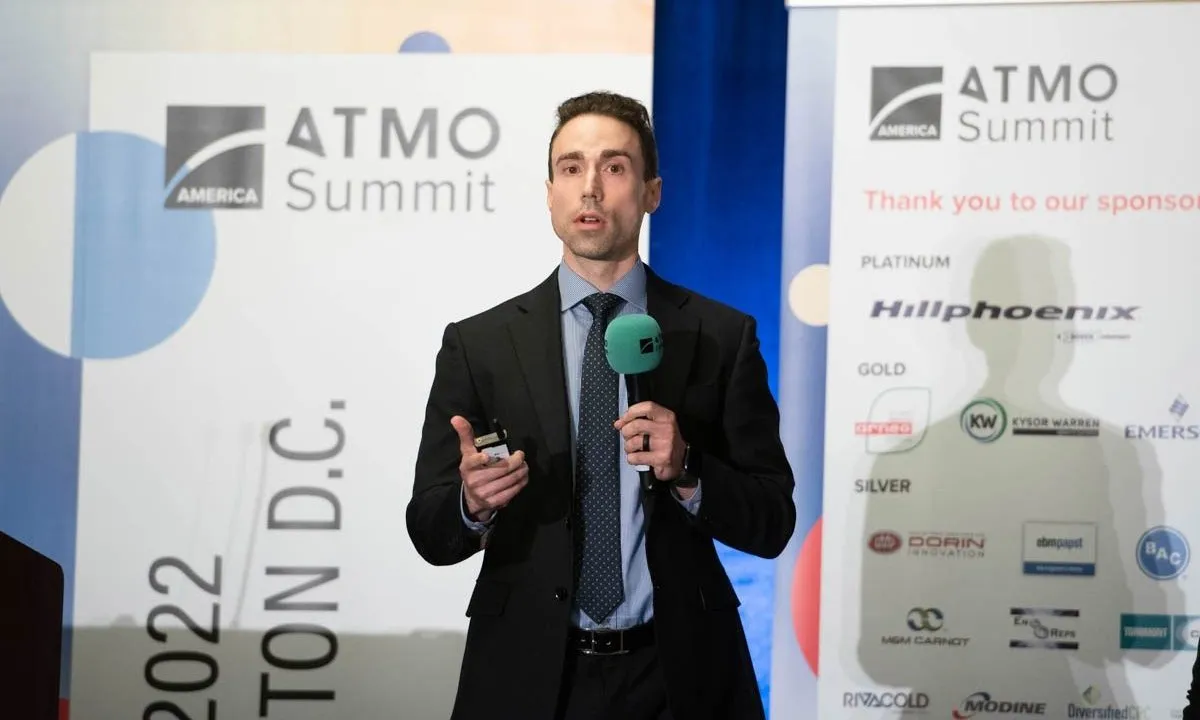
The Hydronic Shell, a new modular heating/cooling distribution system for apartment buildings, could help reduce residential HVAC emissions by 80% and operating costs by 50%, according to a recent presentation by David Goldstein, CEO of the system’s creator, Hydronic Shell Technologies.
Details of the technology were shared during the HVAC and heat pumps session at the ATMOsphere (ATMO) America Summit 2022 on natural refrigerants. The conference took place June 7–8 in Alexandria, Virginia, and was organized by ATMOsphere, publisher of R744.com.
The emissions reductions and cost savings come from improving an existing building’s envelope, transitioning its centralized HVAC system from fossil fuels to a heat pump and improving system efficiency, explained Goldstein.
Individual Hydronic Shell panels deliver heating and cooling to each apartment through their exterior walls. They contain water-filled pipes that connect to a centralized rooftop or district HVAC system – such as a CO2 (R744)-based electric heat pump.
Retrofitting for decarbonized buildings
As cities around the world work towards achieving net zero emissions, a large part of their work is to cap emission from buildings. Many are particularly challenged by the task of retrofitting existing buildings, explained Goldstein.
For example, in New York City, which aims to achieve net zero emissions by 2050, 40% of its built area is made up of large, multi-family buildings, and over 50,000 of these buildings were built before 1980, he added. Due to a lack of energy codes at that time, these buildings are highly inefficient and will require significant investment to decarbonize.
According to Goldstein, the Hydronic Shell can help overcome the challenges associated with decarbonizing such buildings.
“With retrofitting, there are two major problems – they’re too expensive in terms of installation and operations, and they’re too invasive,” said Goldstein. “The solution has to be something that has an attractive return on investment, and it has to be non-invasive That’s where Hydronic Shell comes in.”
There are three key elements to decarbonizing an existing building, explained Goldstein: transitioning to a high-efficiency electric heat pump or district system that uses natural refrigerants, improving the building envelope and installing a new HVAC distribution that is cost effective and non-invasive.
How the Hydronic Shell works
A retrofit would begin with a new centralized HVAC system like an electric heat pump on the building’s roof or a district-based system, explained Goldstein during his presentation.
“It’s really flexible in terms of what the central source is,” he added. “Hopefully it’s a CO2 heat pump or some other natural refrigerant. We’re going to be putting heat pumps on literally millions of buildings across the country as we electrify, and I think it’s really important that they be natural refrigerants, or else we’re going to have some big problems.”
“We’re going to be putting heat pumps on literally millions of buildings across the country as we electrify, and I think it’s really important that they be natural refrigerants, or else we’re going to have some big problems.”
David Goldstein, Hydronic Shell Technologies
Hydronic risers and ventilation ducts are then run down the side of the building and enclosed within the Hydronic Shell modular panels.
At the apartment level, the panels replace existing windows and include a six-inch (15cm) cavity between the building’s existing façade and the newly created shell. The cavity is then heated or cooled by the panel’s water-filled piping, which in turn heats or cools the adjoining apartment through what was previously the external wall. The system operates on 90°F (32.2°C) hot water and 60°F (15.6°C) chilled water.
The panels also include a “supplemental unit” called a HydroBox, which is similar to a fan coil unit that sits below the window and provides additional capacity, as well as ventilation air. According to Goldstein it has been designed to be “very low power, very low maintenance and very low noise.”
“This is how we can heat an apartment efficiently, provide superior thermal comfort, superior indoor air quality, all without actually having to go into the apartment,” he added.
Reduced emissions and costs
The system is currently in its prototyping and testing phase, and Hydronic Shell Technologies is currently designing a system for a 1949 co-op building in Manhattan. The building has a two-pipe steam heating system with natural gas boilers, window air-conditioning for cooling and no mechanical ventilation.
In this context, a Hydronic Shell retrofit could reduce the building’s HVAC emissions by 80%, and once the grid is fully renewable, “you essentially have a 100% reduction in [HVAC] emissions,” said Goldstein.
Due to an improved building envelope – which will reduce demand for heating and cooling – and a high-efficiency system, HVAC operating costs for this building will be reduced by 50%, and further cost savings will come from less HVAC and building façade maintenance, he added.
In addition to being used to retrofit existing buildings, Goldstein said that the Hydronic Shell can also be used in new construction, offering “lower costs, better performance and quicker installation.”
According to Goldstein, ASHRAE will be publishing technical details on the Hydronic Shell system later this year.