This is an excerpt from an article featured in ATMOsphere’s “Clean Cooling for Data Centers 2025” report, which can be downloaded here. ATMOsphere is the publisher of NaturalRefrigerants.com.
Zudek built its first ammonia (R717) chiller for a data center in 2013 in South Africa. Since then it has provided chillers for four more data centers, two of which were in Germany: one with a cooling capacity of 700kw (199TR) and another with a cooling capacity of 6MW (1,706TR). The company is currently working on a new data center project but did not share specifics.
Ammonia is not widely used in data center cooling, and Zudek acknowledges that there is still caution in the market. The company’s chillers are designed with a low refrigerant charge and incorporate “advanced” safety systems.
“There is no problem using ammonia in an outdoor unit because the ammonia is lighter than air, and, in case of a leakage, a sensor inside the unit raises the speed of the fans to launch the air as high as possible,” said Fabrizio Amati, Sales and Marketing Director at Zudek. “For chillers installed inside a building, every installation has a system that extracts the air, which can be run through an optional scrubber, to release the air to the atmosphere with just a few ppm of ammonia.”
One of the aspects driving Zudek’s push in the data center sector is the increasing regulatory pressure in Europe regarding PFAS (per- and polyfluoroalkyl substances). Many synthetic refrigerants, including some HFOs, are PFAS and could be banned in the European Union under the universal PFAS restriction proposal currently being reviewed by the European Chemicals Agency. Amati emphasized that this could significantly impact the long-term viability of such refrigerants, while ammonia, being a natural refrigerant, remains a future-proof solution.
Case study
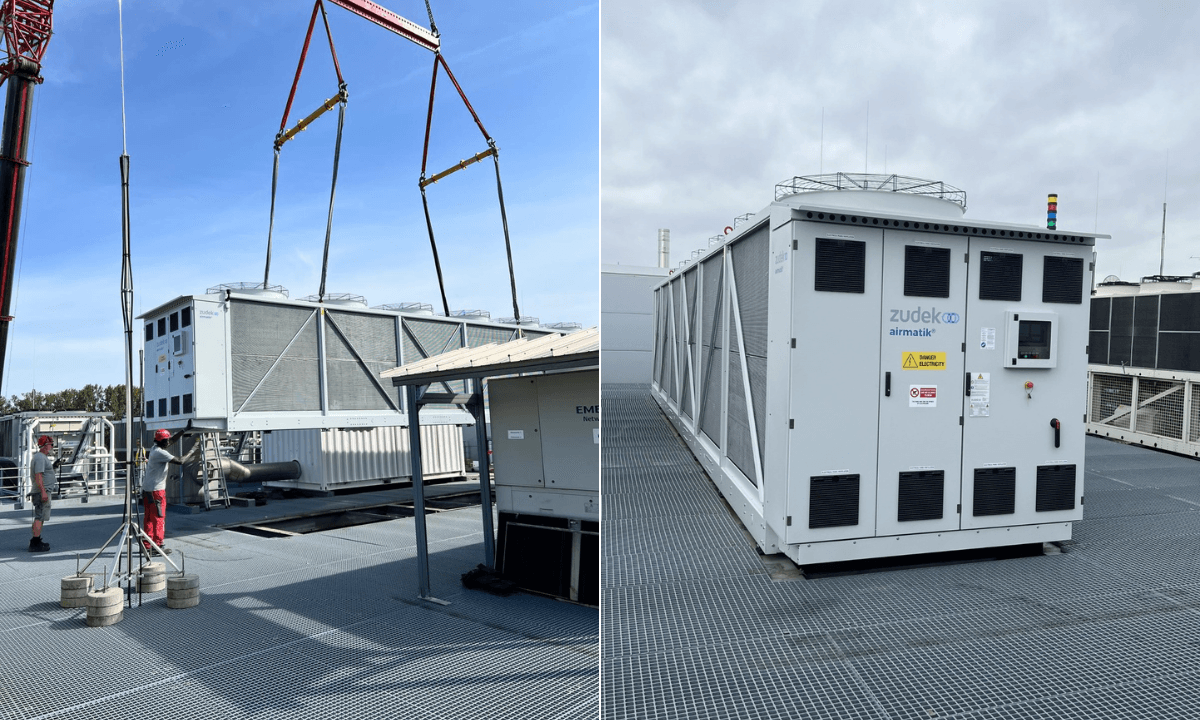
In 2024, Zudek delivered an Airmatik ammonia chiller with 790kW (224TR) of cooling capacity to a data center located in the German state of Baden-Württemberg that serves a company in the financial sector. The Airmatik chiller replaced an existing chiller of the same size using R407C.
In selecting its new chiller, the data center operator prioritized a system that would reduce its environmental impact, be energy-efficient and guarantee maximum reliability, according to Amati. The Airmatik air-cooled chiller is designed to cool water to 11°C or 14°C (52°F or 57°F) and is connected to a dry cooler with an integrated plate and shell heat exchanger for free cooling.
Partial free cooling can be provided from an ambient temperature of 10°C (50°F) and full free cooling is available at 6°C (49°F). By contrast, the replaced R407C chiller could only offer free cooling from an ambient temperature of −4°C (25°F). Zudek’s ammonia chiller can provide an annual average of 2,131 hours of free cooling compared to just 195 hours for the R407C chiller.
“Normally chillers with synthetic refrigerants have an additional coil on the chiller itself,” said Amati. “We don’t do that because it increases the energy consumption of the fans. The piping for an ammonia chiller is also different, so we need to use an external and more efficient dry cooler.”
Amati added that this setup enables Zudek to keep the glycol in the external circuit and only circulate water inside the data center, reducing the energy needed for the pumps as they have a less viscous fluid to move. This focus on energy efficiency and free cooling – along with the general efficiency of ammonia – led to the Airmatik chiller being 43% more energy efficient than the R407C chiller it replaced. This translates to annual savings of €185,752 ($195,128).
“There is no problem using ammonia in an outdoor unit because the ammonia is lighter than air, and, in case of a leakage, a sensor inside the unit raises the speed of the fans to launch the air as high as possible.”
Fabrizio Amati
Sales and Marketing Director at Zudek