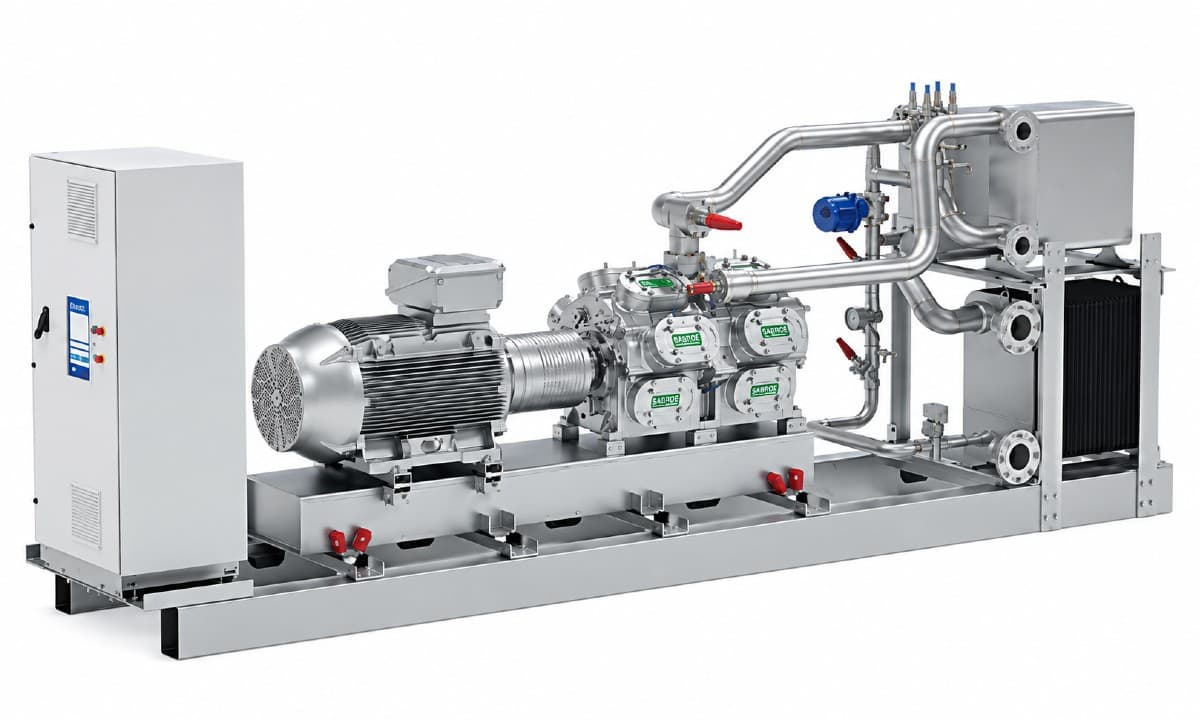
The Queen’s Medical Centre (QMC) in Nottingham, U.K., aims to cut its CO2 emissions by 43% with the installation of four ammonia (R717)-based heat pump-chiller units from German manufacturer GEA.
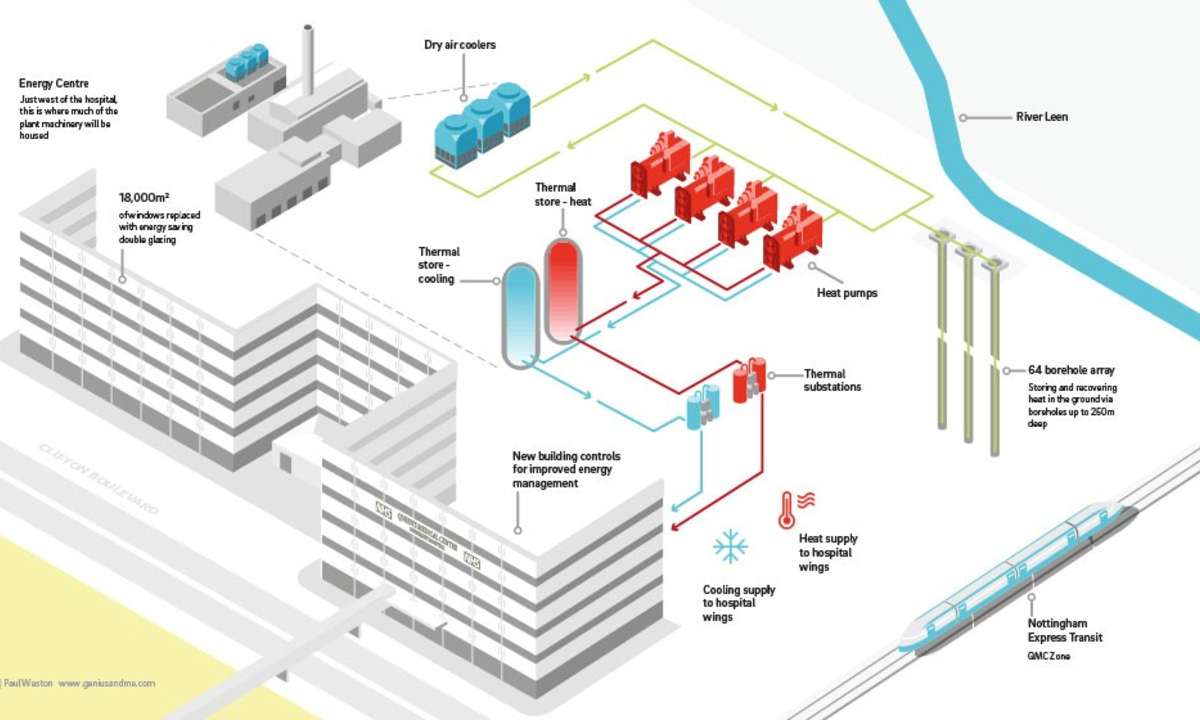
GEA’s Blu-Red Fusion units – a combination of the company’s Blu chiller and Red heat pump – form a central part of the QMC’s new £15 million (€17.8 million/$18.3million) energy center, which will provide low-carbon heating and cooling to the hospital. It will also deliver heating to other local buildings via a district heating network.
The hospital’s new HVAC system will be installed and commissioned in two phases:
- Phase 1: installation of two heat pumps providing 4MW (1,137.4TR) of heating and 2.88MW (818.9TR) of cooling. These units arrived on-site in October 2024 and will be commissioned in February 2025.
- Phase 2: addition of another 4MW of heating and 5.8MW (1,649.2TR) of cooling capacity.
Once the project is complete, the heat pumps will replace the hospital’s existing gas-fired combined heat and power (CHP) plant, which has been in operation since 2001, and its f-gas-based chillers.
Details of the project were presented by Kenneth Hoffmann, Director of Heat Pumps at GEA Heating & Refrigeration Technologies, at the Industrial Heat Pumps conference in Prague, Czech Republic, in November.
Flexible solution
During his presentation, Hoffmann emphasized the importance of a high-efficiency, space-saving solution. The new system utilizes dry air coolers and 64 boreholes, each 200m (656.2ft) deep, to extract heat from the air and ground. It can deliver hot water at temperatures of up to 85°C (185°F).
“Instead of having four chillers and four heat pumps, we have units which are able to do both,” Hoffmann told NaturalRefrigerants.com. “We only need to deliver half the [number] of units. [We can also] double the efficiency as we are using the waste heat from the cooling as a heat source for the heating.”
This approach also allows greater flexibility when it comes to meeting the hospital’s varying heating and cooling demands, he noted.
When there is no cooling need, the heat pump can take heat from the ground or ambient air. If cooling demand outstrips heating demand, excess heat can be saved for future use, either in the energy center’s thermal stores or in the boreholes for longer term storage. It could also be rejected into the air via the air coolers.
“It is a bit like a Swiss army knife with multiple options for heat recovery and heat rejection,” he added.
Creating a greener hospital
The installation is part of a broader £64 million (€76 million/$78.1 million) project that will initially cut QMC’s carbon emissions by 30%, increasing to around 43% once the facility’s existing heating system is decommissioned. The project also includes upgrading 12,000 of the hospital’s windows with double-glazing to improve thermal efficiency.
Funded through Phase 3 of the U.K. government’s Public Sector Decarbonization Scheme, the project is part of a 15-year partnership between energy provider E.ON and QMC that is focused on boosting the facility’s energy efficiency to achieve net-zero emissions by 2030.
“This partnership demonstrates our significant commitment to environmental sustainability and offers a creative solution to meeting our energy needs and tackling climate change, while improving patient and staff comfort by allowing us to better manage temperatures within our buildings,” said Anthony May, Chief Executive of Nottingham University Hospitals NHS Trust, of which the QMC is a part. “Innovative projects like these will play a hugely important role in helping us meet our ambitious goal of achieving a net-zero carbon operation for heating and cooling system emissions.”
“We’ve provided a source of heating and cooling to the QMC for many decades already, and I’m proud Nottingham University Hospitals are trusting us to build on that successful relationship to support their net-zero ambitions,” added Chris Norbury, E.ON U.K. Chief Executive.
According to Hoffmann, E.ON and the QMC are exploring options to expand the district heating network to serve additional buildings, though the final capacity has yet to be determined.
“This partnership demonstrates our significant commitment to environmental sustainability and offers a creative solution to meeting our energy needs and tackling climate change, while improving patient and staff comfort by allowing us to better manage temperatures within our buildings.”
Anthony May, Chief Executive of Nottingham University Hospitals NHS Trust
Decarbonizing European industry
GEA has long advocated for the combination of ammonia heat pumps and district heating as an effective way of reducing energy consumption and mitigating climate change. Recent projects include a waste-water district heating plant in Germany and a CHP-linked facility in Estonia.
According to Hoffmann, the manufacturer is currently working on several similar projects for multiple universities and hospitals.
“Ammonia heat pumps will be key to Europe’s decarbonization both for industry and district heating,” he said. “Because ammonia heat pump solutions offer the most efficient way of electrifying heat, it also gives the highest decarbonization per kW of electricity used. As Europe is electrifying both their transport and heating, it is important to do it in the most efficient way to avoid overloading the electricity grid.”
To accelerate industrial decarbonization and heat pump adoption, Hoffmann emphasized the importance of sector coupling.
“Many heat pump projects – especially for district heating – are only focused on the heating part and reject all the cooling instead of using it for active cooling,” he said. “If sector coupling becomes a higher priority in the future, we will be able to produce both cooling and heating at a significantly lower electricity cost.”
“Ammonia heat pumps will be key to Europe’s decarbonization both for industry and district heating.”
Kenneth Hoffmann, Director of Heat Pumps at GEA Heating & Refrigeration Technologies