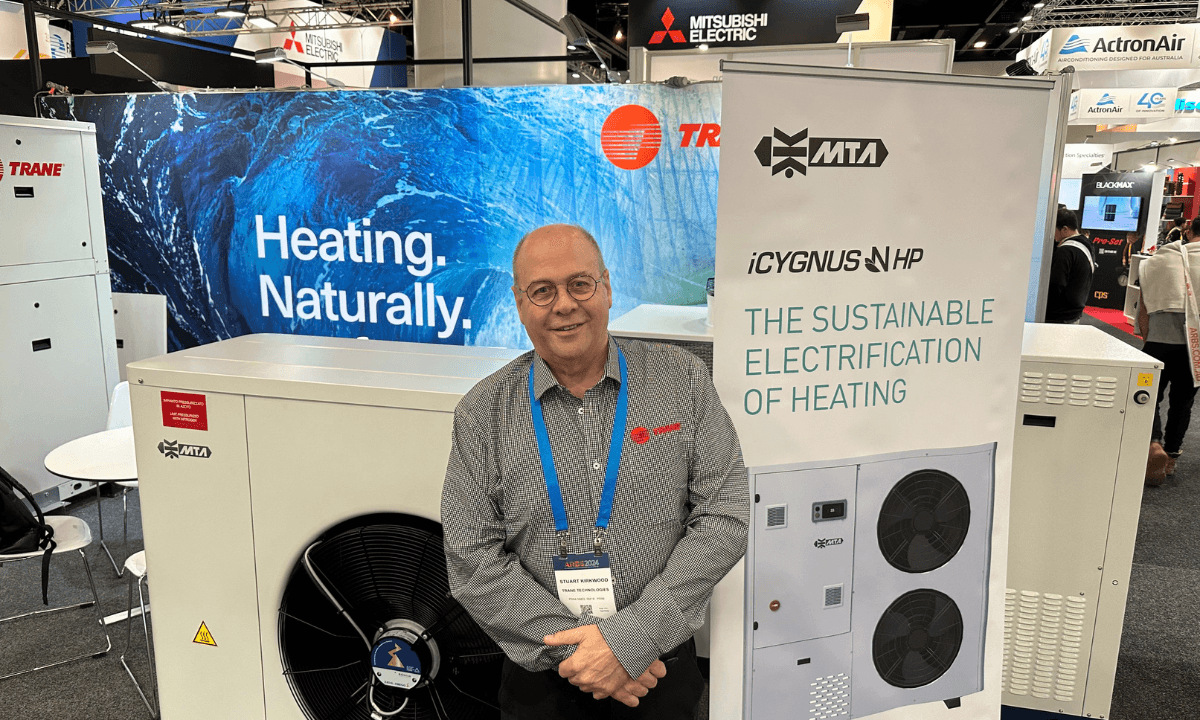
Ireland-based Trane Technologies expects to make its MTA brand R290 chillers and heat pumps available to the Australian market later this year, according to Stuart Kirkwood, District Leader of Trane Technologies in Australia and New Zealand.
Trane Technologies acquired MTA, an Italian manufacturer of industrial process cooling, air-conditioning and air treatment equipment, in May 2023, and in December the local company became part of Trane’s Australia and New Zealand organization.
“We want to leverage MTA’s established presence here in the Australian market, particularly with the company moving fairly quickly into the R290 space,” Kirkwood told NaturalRefrigerants.com in an exclusive interview at the Air-Conditioning, Refrigeration and Building Services (ARBS) 2024 expo. The event was held in Sydney from May 28‒30.
“Compared to two years ago, there is a different environment here at the exhibition with a huge R290 presence,” Kirkwood said. “It’s an environment of change.”
Two MTA branded R290 units were showcased at ARBS, including the TAE N mini chiller, designed for process chilling applications, with the line offering a cooling capacity between 1.7‒4.4kW (0.5‒1.3TR). The company also brought the recently released Cygnus N reversible heat pump to the show.
According to Kirkwood, both MTA TAE-N and Cygnus N will be available in Australia once the necessary approvals are obtained. Local regulatory testing is currently underway.
In his conversation with NaturalRefrigerants.com, Kirkwood outlined the R290 equipment Trane Technologies expects to make available in the region, the Australian A3 refrigerants regulatory process and the company’s move into the natural refrigerants space.
The interview has been edited for length and clarity.
What R290 products is Trane Technologies releasing in Australia, and are there additional products in the pipeline?
Stuart Kirkwood: We have MTA’s TAE N mini chiller and two models of its Cygnus N heat pump moving through the approval process. We expect the units, manufactured in Italy, to be available in the market this year for sale and rent.
The TAE N mini chiller offers a good product for the industrial market, particularly for manufacturing, process line cooling, medical or other small operations requiring 1‒2kW [0.3‒0.6TR] of cooling capacity. It uses microchannel condenser technology to keep the R290 charge small.
The technical differences between the smaller and slightly larger units of the Cygnus N heat pump mean two different models require approval. The R290 heat pumps, aimed at the small commercial/industrial sector, provide cooling and heating, with the largest offering in the range providing around 30kW [8.5TR] of heating.
We plan to increase our product offerings in Australia by the end of the year, including Trane branded units and other larger-capacity models, depending on the market and the availability of compressor technology and components.
The largest capacity R290 chiller currently produced by MTA [iARIES N Inverter] goes up to about 350kW [100TR], with two refrigerant circuits each containing about 8kg [17.6lbs] of propane.
What is the local approval process like for A3 flammable equipment?
SK: When you move to R290 refrigerant, with its A3 safety rating, the requirements for compliance become stricter. Even the compressor, which in many instances acts as a pressure vessel, has to be certified and registered.
The other main area is electrical safety, with Australia using a different safety standard than ATEX [Atmosphere Explosive] in Europe. It doesn’t mean a unit built to ATEX cannot comply with Australia’s IECEx [International Electrotechnical Commission Explosive] standard. However, it does require additional approvals.
Finally, A3 flammable refrigerant units require approval from a certified laboratory or test facility showing the equipment meets the electrical safety standard, and we look forward to completing these processes. Importantly, there also needs to be industry education on the safety requirements for the transportation, installation, and service of R290 equipment, and we plan to take a proactive role.
With Trane’s past focus on HFC and HFO equipment, what brought it into the R290 space?
SK: From a chiller perspective, R290 looks attractive as a refrigerant for equipment with a relatively small charge. For heat pumps, we see it as a good refrigerant choice to deliver high performance with larger operating maps.
In this environment of change, major global players like Trane see an opportunity to include natural refrigerant products in our portfolios with the ability to cover a broader range of temperatures, with specific application advantages in low-temperature cooling and high-temperature heating systems with low charge.
Our focus moving forward is to offer a variety of choices for the customer, with all products moving to lower GWP for more sustainable options. Trane will continue to innovate its portfolio of thermal management systems use low-GWP refrigerants and deliver high efficiency and low carbon emissions.