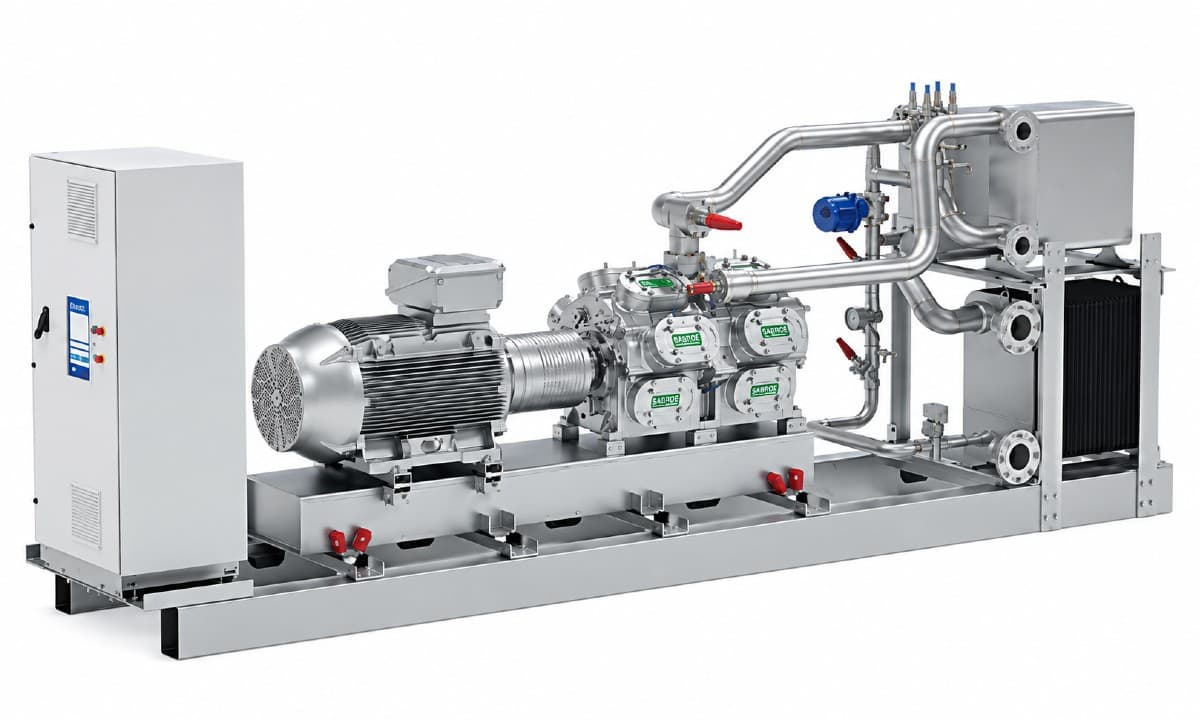
In September 2023, MAN Energy Solutions announced it was supplying the coastal city of Aalborg, Denmark, with three 44-megawatt (12,511TR) CO2 (R744) water-to-water heat pumps to retrofit an existing coal combined heat and power plant. The OEM called the system, with an overall heating capacity of 132MW (37,533TR), “one of the largest of its kind” in the world.
Less than a year later, the Germany-based company announced that it was supplying Aalborg’s utility company, Aalborg Forsyning, with a fourth 44MW CO2 heat pump, increasing the district heating plant’s total thermal output to 177MW (50,329TR) and providing up to 700,000 MWh of heat annually for the city of 224,000.
The new facility will open in 2027, and when it does it has a chance to make history.
“This is becoming the biggest CO2 heat pump system on the planet that I’m currently aware of,” said Raymond Decorvet, Senior Account Executive of Global Business Development Heat Pumps at MAN Energy Solutions.
Natural refrigerant heat pumps are increasingly being used to decarbonize district heating systems, and MAN has been one of the companies leading this charge. NaturalRefrigerants.com spoke with Decorvet to learn more about the company’s work in Aalborg and how it sees the market for large-scale heat pumps developing.
This interview has been edited for length and clarity.
What can you tell me about this district heating plant in Aalborg? Is it a new build or a retrofit?
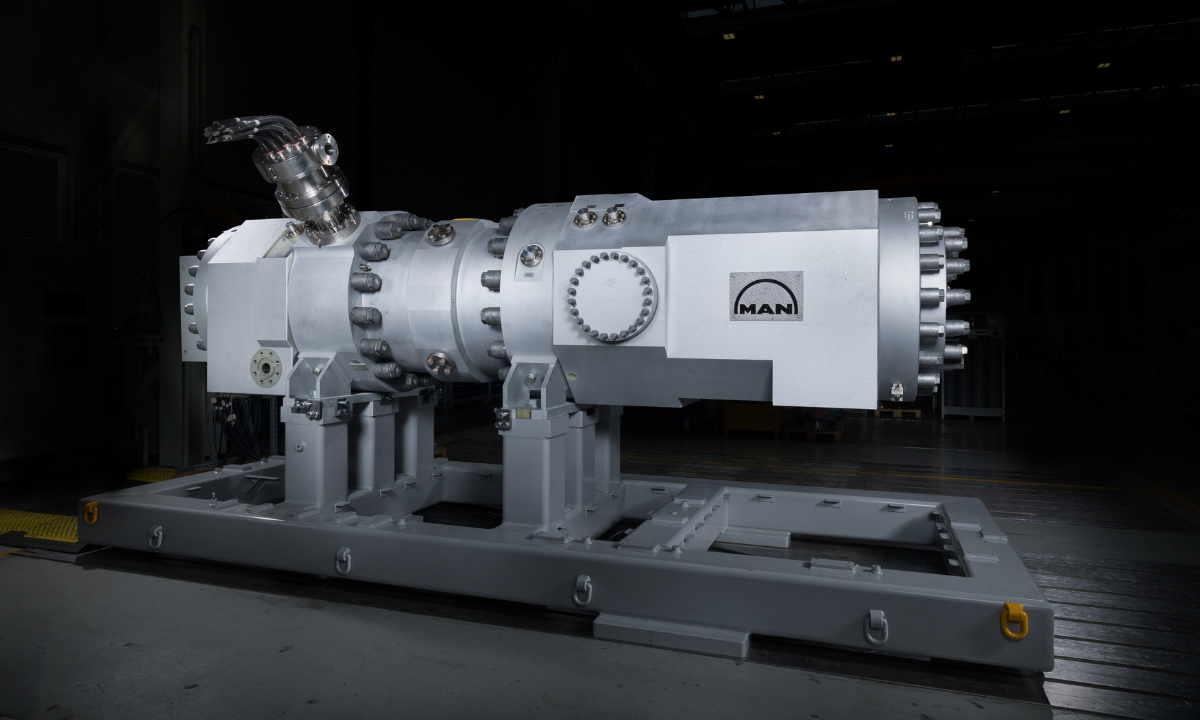
Aalborg has a very large district heating network that they want to retrofit to decarbonize the heating source, which is why they decided to order four of our very large – I use the term “mega” – heat pumps. Each heat pump provides 44 megawatts of thermal output using seawater as a heat source. And because we are using 2–3°C (35.6–37.4°F) seawater as a heat source, it’s very beneficial to use CO2 as a refrigerant.
Before the biggest CO2 heat pump project was Esbjerg, Denmark. But with 177MW (50,329TR) of thermal output, this is more than three times that size.
Why didn’t Aalborg originally order four heat pumps?
Good question. Originally they were looking for three heat pumps, but they always wanted to have an option for a fourth one, and it looks like there is more demand than they had in mind last year. It makes more sense to implement the fourth unit into the same project than to handle it separately a few years later. It will bring down the costs as well.
This district heating plant will supply one third of Aalborg’s annual heat production. Could this facility be expanded to meet all of Aalborg’s heating needs using MAN’s CO2 heat pumps?
I don’t know their plans for the next decade or so, but sometimes it’s wise not to put everything in one basket. But hopefully Aalborg will come back and order more units if the project is successful. They have sufficient seawater there, which is kind of an infinite heat source. Using heat pumps for decarbonizing heat production is a wise thing, as is using CO2 as a natural refrigerant with this cold heat source. When the project goes well, they will hopefully come back and order more units. We are ready for that.
Jesper Høstgaard-Jensen, Technical Director at Aalborg Forsyning, said it was a “clear advantage” that MAN’s technology uses a natural refrigerant. What makes CO2 an advantage in this application?
It provides high performance using a heat source that is near 0°C (32°F) in winter. We have a temperature lift from 2–3°C up to 98°C (208.4°F). This is the flexibility CO2 gives to a heat pump system. What’s also important to note is that the district heating network has a very low return temperature, lower than 40°C (104°F). So this heat pump also provides extremely good efficiency and COP, which is why Aalborg decided on CO2.
In addition, if we are dealing with a natural heat source like seawater, we have to make sure there is no contamination in the rare event of a leakage. CO2 is natural and won’t harm the environment if it leaks.
Okay, so CO2 is the best refrigerant for this heat source, but is it the best choice when working with other heat sources?
We should talk about shallow geothermal because a CO2 heat pump is especially efficient if we have a low return temperature in the district heating network and also a relatively low-temperature heat source. Drilling only about 500 meters (1,640ft), you already find 12–15°C (53.6–59°F) aquifers. If the aquifer provides enough volume then this is a very good heat source for a CO2 heat pump.
That is why we don’t need to drill 3,000m (9,842ft), which is costly and brings a lot of risk if you don’t hit the well. Additionally, we are not seeking any type of 60–70°C (140–158°F) heat coming out from geothermal sources.
“When the project goes well, they will hopefully come back and order more units. We are ready for that.”
Denmark seems to have a lot of district heating plants using natural refrigerant heat pumps. Is MAN seeing interest in this technology in other countries?
The market for these mega heat pumps is in baby shoes. That said, there is a lot of demand coming from Germany. The U.K. is a sleeping lion. They don’t have a lot of district heating networks in place, but we will see a lot of projects in the next 10 years demanding larger heat pumps. Also in the Nordics in general, as well as in France and in Eastern Europe.
I just learned that in the U.S. they are using steam on university campuses for district heating networks that could also be transferred to hot water, which would bring down costs. This is getting more and more popular now and is very interesting. We will have a look at the U.S. as well.
MAN recently announced it is supplying a heat pump using an f-gas refrigerant for a Scout Motors factory in South Carolina. Why did Scout Motors, which is owned by Volkswagen, not opt for a natural refrigerant heat pump?
While I am not fully informed about the specific details of this project and the decision-making process involved, I can say that our overarching strategy is to prioritize natural refrigerants. These include hydrocarbons, ammonia (R717) and CO2 for sure.
What percentage of your current heat pump projects use natural refrigerants?
Besides the Scout project, 100%.
You presented at ATMO Europe 2023, and in your presentation you mentioned a 500MW heat pump project. Can you share an update on that?
Yeah, the 500MW (142,173TR) represents the heat demand to be decarbonized in a large city in the Nordics. In the Nordic countries, there is huge demand for decarbonizing heat production for their large district heating networks. That’s why they have such a large demand for these big volumes of thermal output.
We will hear more soon about this region. Whether this is going to be seawater heat pumps or other heat pumps is yet to be defined. The situation sometimes for natural heating sources is not always that optimal, but we need to find ways. The technology is here, and we are developing it and are really at the forefront.