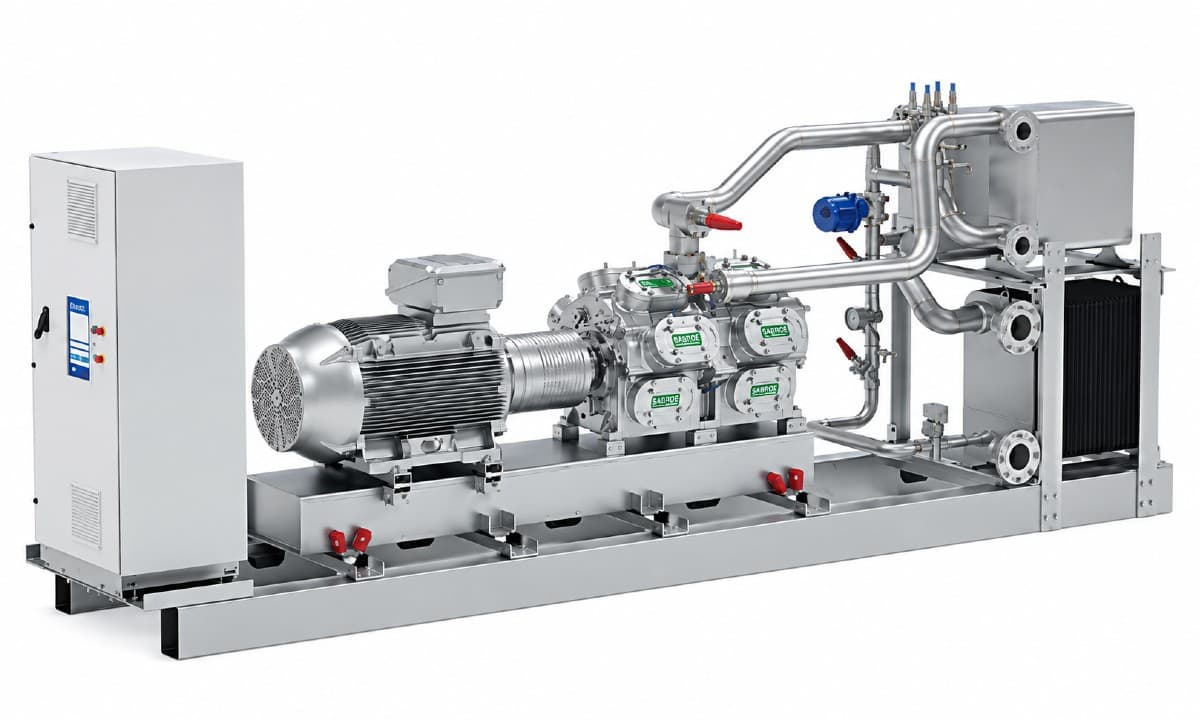
Chemigate, a Finnish producer of bio-based products for the paper industry, expects to reduce its CO2e emissions by over 900 metric tons annually at its Lapua plant with the installation of an isobutane (R600a) heat pump system.
Currently, the facility burns propane to meet its process heating needs. The new system ‒ designed and implemented by Caverion, a Swedish contractor headquartered in Stockholm ‒ will “significantly reduce the use of propane” by transferring the plant’s waste heat for use in other areas of the production process.
“The solution uses a natural refrigerant, isobutane, which means it also meets the requirements of the evolving refrigerant legislation,” said Harri Heikkinen, Head of Production at Chemigate. “We are taking a significant leap forward in reducing the emissions of our plant, with the solution tailored to our needs.”
NaturalRefrigerants.com reached out to Caverion and Chemigate for technical details of the new isobutane heat pump.
System logistics: Chemigate manufactures starch-based adhesives and binders for technical use. Its primary clientele is the Nordic cardboard and paper industries.
- The new system will recover waste heat from the plant’s air compressors and drying operations and transfer it to the supply air for production processes.
- The company estimates that the isobutane system will slash the plant’s carbon emissions by roughly 20%.
Supporting decarbonization: The pulp and paper industry faces challenging decarbonization issues due to high processing temperatures. Depending on the process stage, temperature requirements range from 60‒150°C (140‒300°C), with the pulp cooking stage requiring temperatures between 165‒170°C (329‒338°F).
- “Developments in the area of high-temperature heat pumps able to provide heat above 100°C (212°F), with some reaching 165°C (329°F), are a promising means for accommodating the industry’s low- and medium-temperature heat needs,” says the International Energy Agency.
- In December 2023, Italian manufacturer Turboden reported combining isobutane and isopentane (R601a) heat pumps with a mechanical steam compressor to reach 170°C for a paper producer in Northern Europe, with a 12MW (3,412.1TR) thermal output.
Evolving legislation: The isobutane heat pump helps Chemigate meet its emissions reduction targets and complies with the EU’s F-gas Regulation, which was revised in 2024 and bans the use of f-gases in new equipment across the bloc by 2050.
- Starting in 2030, new heat pumps with a capacity of more than 50kW (14.2TR) will be required to use refrigerants with a GWP of 150 or less.
- The European Chemicals Agency (ECHA) is currently considering a proposal to regulate PFAS (per-and polyfluoroalkyl substances) as a category, which would include f-gases and TFA (trifluoracetic acid), an atmospheric degradation product of HFC-134a and several HFOs, including HFO-1234yf.
Quotable: “The Finnish industry has huge potential to reduce emissions by using waste heat from production processes,” said Riku Mandelin, Head of Projects at Caverion Finland. “Chemigate’s Lapua plant is a great example of a strong commitment to environmental goals and sustainable choices along the value chain.”
“We are taking a significant leap forward in reducing the emissions of our plant, with the [isobutane] solution tailored to our needs.”
Harri Heikkinen, Head of Production at Chemigate