China is set to lead the adoption of natural refrigerants in electric vehicles (EVs) by the end of this decade, according to Matteo Martini, Research and Analysis Associate Director at automotive intelligence company S&P Global Mobility.
Speaking at the ATMO MAC Summit 2025 × TU Berlin, Martini highlighted that a forthcoming Chinese regulation setting a GWP limit of 150 for mobile air-conditioning (MAC) systems in new cars is likely to accelerate the country’s transition to CO2 (R744) and propane (R290).
“China’s enforcement of a low-GWP refrigerant limit by 2029 is accelerating its shift to natural refrigerants, positioning Chinese automakers ahead of European competitors,” he said.
In contrast, Europe is expected to trail by around five years, with the EU’s proposed ban on PFAS (per- and polyfluoroalkyl substances) unlikely to impact the market until 2035.
The ATMO MAC Summit 2025, held September 23–24 in Berlin, was organized by ATMOsphere, publisher of NaturalRefrigerants.com, in partnership with Technische Universität (TU) Berlin’s Department of Heat Transfer and Heat Conversion. This was ATMOsphere’s second conference focused solely on MAC and transport refrigeration following the inaugural summit in 2024.
“China’s enforcement of a low-GWP refrigerant limit by 2029 is accelerating its shift to natural refrigerants, positioning Chinese automakers ahead of European competitors.”
Matteo Martini
Research and Analysis Associate Director at S&P Global Mobility
Global outlook
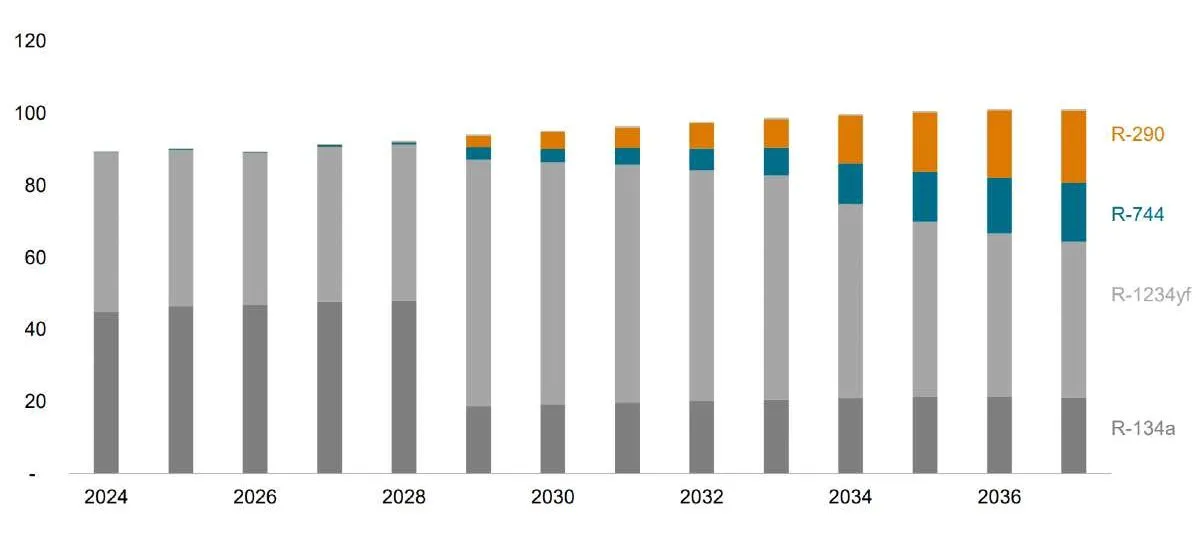
Martini’s analysis, covering automotive powertrains and refrigerants through 2037, pointed to natural refrigerants becoming mainstream in light vehicles worldwide.
“We expect that by 2037, R744 and R290 will both be adopted by the automotive industry,” he explained. “Roughly 16 million vehicles worldwide will be manufactured using R744 with more than 20 million adopting R290.”
He highlighted that two key milestones will guide the transition. In 2029, China’s MAC regulation will trigger a sharp decline in the use of the HFC R134a. While most of the gap will be filled by R1234yf – an HFO that is already widely used in EVs today – adoption of R744 and R290 will rise significantly. In 2034, the EU’s zero-emissions vehicle mandate and proposed PFAS restrictions, if approved, will prompt a surge in R744 and R290, cutting into R1234yf’s market share.
Despite the current cost challenges for natural refrigerant systems compared to R1234yf, Martini noted that economies of scale and broader OEM adoption will bring prices down. Progress in this task is already evident, with Hanon Systems recently announcing it has produced over 1 million CO2 electric compressors for EVs since 2019.
He also emphasized that automakers remain reluctant to invest in refrigerant blends, with no promising pure chemical alternatives emerging.
China’s EV market
China currently manufactures about 30 million vehicles annually, with production forecast to rise to 33 million by 2037. EV adoption has been rapid, and by 2027, battery electric vehicles (BEVs) are expected to become the dominant propulsion type in the country. Plug-in hybrid electric vehicles (PHEVs) will continue to play a significant role, with about 5 million units produced annually.
Natural refrigerants are not expected in Chinese internal combustion engine (ICE) vehicles, however their adoption in EVs will grow quickly. Martini forecasts a “significant leap” in 2029 when the new regulation that bans the use of high-GWP refrigerants in new cars is enforced. This shift will involve both CO2 and propane, each meeting different system requirements.
R744 adoption is already underway, making it a relatively easy choice for manufacturers, while R290 development is advancing, with some adoption possible as early as 2027 or 2028, Martini noted.
China’s PHEVs will also partially adopt R744, benefitting from shared platforms with BEVs.
Slower progress in Europe
Europe is projected to remain the second-largest automotive producer with annual volumes of around 18 million vehicles but minimal market growth. While EV adoption continues, it has slowed due to reduced government incentives, Martini stated, adding that electric vehicles will outpace ICE manufacturing in the region from 2032.
The region’s real shift to natural refrigerants will not take place until around 2034 as new vehicle platforms align with the zero-emissions mandate and PFAS restrictions.
“We see a faster increase of R744 adoption that is mostly linked with the fact that it’s already in production,” he said. “We think propane will close the gap very quickly and will reach R744 very easily by 2036.”
In other parts of the world, growth in South Asia, led by India, will drive adoption of natural refrigerants between 2028 and 2032, largely due to commonality with platforms being developed in other regions. In North America, forecasts have been revised downward, with no near-term EV growth and an overall market contraction due to tariffs. Growth is expected to return within four years, favoring EVs over ICE vehicles.