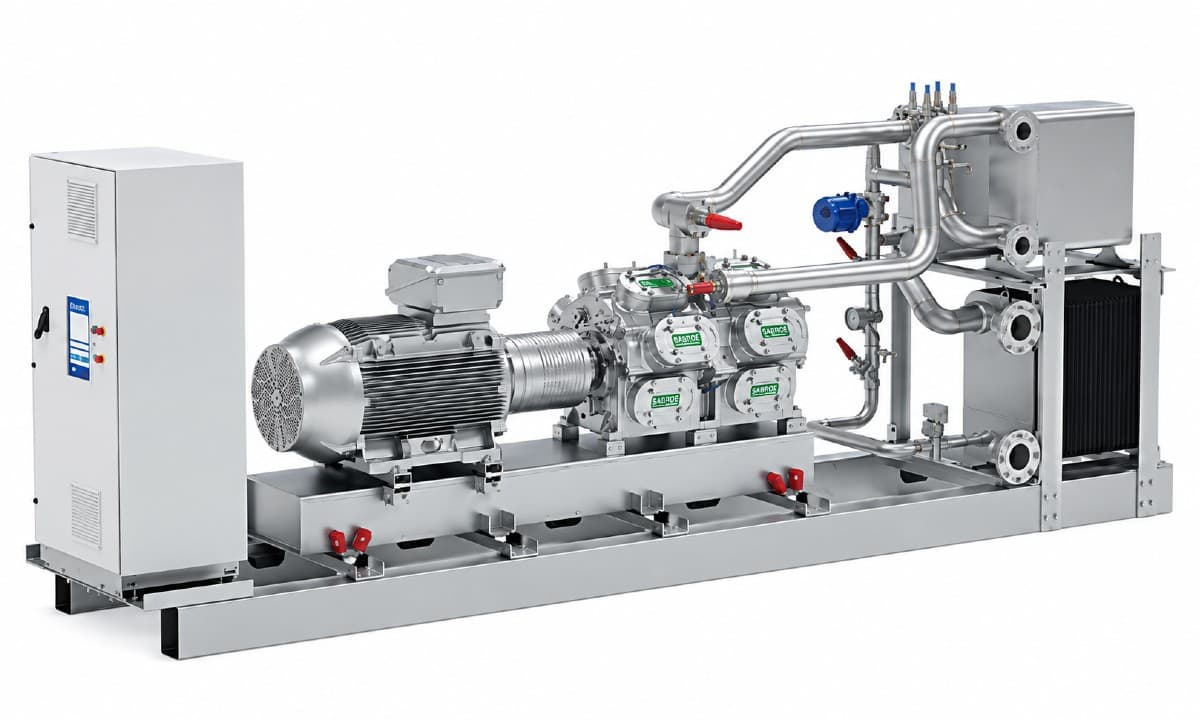
Saputo, an international producer of dairy products, is replacing the fossil fuel boilers in its British Columbia, Canada, facility with a plug-and-play 1.5MW (426.5TR) water-to-water Vilter VQ95 ammonia (R717) heat pump, according to Jake Krause, Global Product Manager at Vilter by Copeland.
The facility uses hot water for pasteurization, processing dairy products and equipment sanitation. Krause outlined the project in a presentation at ATMO America 2025, which was organized by ATMOsphere, publisher of NaturalRefrigerants.com, and held June 11‒12 in Atlanta.
“To decarbonize its operations, Saputo sought an industrial natural refrigerant heat pump ‒ specifically ammonia ‒ to integrate with the plant’s ammonia refrigeration system,” Krause said. “Through the use of this equipment, Saputo will reduce GHG emissions at the facility by approximately 40% annually.”
The specs: The VQ95 unit uses the condenser waste heat from the ammonia refrigeration system. The inlet water temperature is 37°C (98.6°F), which is lifted to a maximum of 85°C (185°F).
- The modular unit, with rough dimensions of 18 × 6 × 8ft (5.5 × 1.8 × 2.4m), fits in the existing engine room.
- The facility requires various capacities of hot water at 18 separate heating points, which has complicated the design, according to Krause.
- Vilter created a separate water circuit to prevent the cross-contamination of working fluids since the facility produces multiple types of food and beverage products.
Operating off–peak: With British Columbia implementing energy demand surcharges for electricity use, Saputo sought a design that cut power use during peak periods.
- “A thermal storage tank decouples heat generation from power demand, avoids peak demand surcharges and balances the heat pump load profile to maximize efficiency,” Krause said.
- The thermal stratification in the tank helps Vilter meet the 18 process heating points with a smaller compressor using less energy.
Sustainability goals: In its “2024 Promise Report,” Saputo pledged to reduce its CO2e emissions by 20% and the energy intensity of its operations by 10% across its global operations by 2025, compared to its 2020 baseline. The company has identified heat pumps as the solution to meet its promise and eliminate fossil fuel boilers, Krause said.
- “The ammonia heat pump retrofit in the British Columbia facility is [Saputo’s] initial demonstration of the technology,” Krause said. “They plan to use the data and everything else they have learned during the installation to scale it across other North American sites.”
Quotable: “Depending on the inlet and outlet temperatures, ammonia heat pumps are three to five times more efficient than fossil fuel boilers,” Krause said, adding that Vilter has several new technology projects in its pipeline.
“Depending on the inlet and outlet temperatures, ammonia heat pumps are three to five times more efficient than fossil fuel boilers.”
Jake Krause, Global Product Manager at Vilter by Copeland