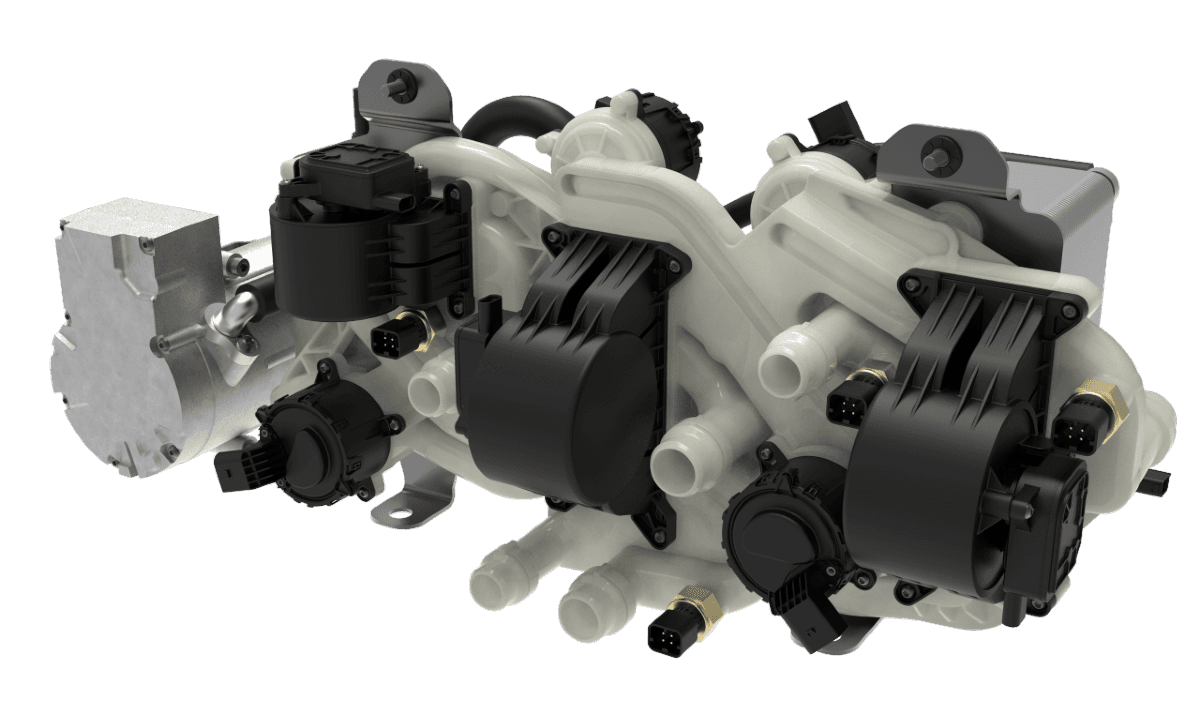
The United Nations Industrial Development Organization (UNIDO) is currently developing pilot projects in China and India for natural refrigerant-based mobile air-conditioning (MAC) systems for cars.
UNIDO launched the three-year project in 2023, which is funded by the Climate and Clean Air Coalition (CCAC), with the goal of piloting a CO2 (R744)-based air-conditioning system for electric vehicles (EVs) in China and an updating propane (R290)-based air-conditioning system for EVs in India.
The project’s activities in China include:
- Developing a set of standard R744 AC systems for EVs
- Build pilot models and conduct road tests
- Form design specifications of R744 systems and components
In India the activities will include:
- Developing two prototype vehicles to demonstrate the safe use of R290 as a refrigerant in cars
- Creating guidelines for the safe use of R290 AC systems in passenger and small commercial cars
The project budget is set at $800,000 (€682,282) and key stakeholders include the Foreign Economic Cooperation Office (FECO) of the Ministry of Ecology and Environment for China, the China Automotive Technology and Research Center (CATARC) and Tata Motors, according to a 2024 presentation from Stephen O. Andersen, Director of Research at the IGSD (Institute for Governance and Sustainable Development). In addition to FECO and CATARC, Chinese automaker Dongfeng is listed as a stakeholder in the CO2 MAC pilot project for China and Tata is listed as the stakeholder for the R290 project in India.
An update from India
Sangeet Hari Kapoor, formerly the Technical Chief of Climate Control at Tata and now an independent MAC advisor, provided an update on Tata’s role in the UNIDO project during a presentation at the Network Meeting of South Asia National Ozone Officers, held in Bangkok from July 3–5. Hari Kapoor noted that Tata and automotive OEM Mahle developed a secondary-loop MAC system in 2017 that used R152a, an A2 mildly flammable refrigerant with a 100-year GWP of 164 and a 20-year GWP of 591 (IPCC AR6).
Tata’s pilot projects consist of a passenger vehicle with a secondary-loop heat pump air-conditioning system and a commercial vehicle with a secondary loop air-conditioning system. Tata’s Nexon EV was chosen for the passenger vehicle pilot and the Ace EV, a compact box truck, was chosen for the commercial vehicle pilot. On the Nexon EV, the R290 MAC system provides cabin and battery heating and cooling while on the Ace EV it provides cabin and battery cooling.
Vehicle cooling and heating tests will be conducted in ambient temperatures ranging from -25 to 55°C (-13 to 131°F) while the fluid/systems will be tested at 21 different set points (11 for the AC and 10 for the HP) ranging in ambient temperatures from -40 to 45°C (-40 to 113°F). Testing of components and vehicles is set to run from June 2025 to May 2026.
China’s MAC system GWP limit
China will ban the use of refrigerants in new cars with a GWP greater than 150 beginning July 1, 2029. The regulation is part of “China’s National Plan for Implementing the Montreal Protocol on Substances that Deplete the Ozone Layer (2025–2030)” and applies to M1 category vehicles, which are passenger cars with no more than eight seats (excluding the driver).
China will also “encourage research and application of natural refrigerant alternatives in electric vehicle thermal systems” and conduct research on “incorporating requirements for automotive air-conditioning refrigerant use and leak control into the next phase of motor vehicle emission standards.”
This article has been updated with information on Chinese automaker Dongfeng’s participation in the CO2 MAC pilot project.