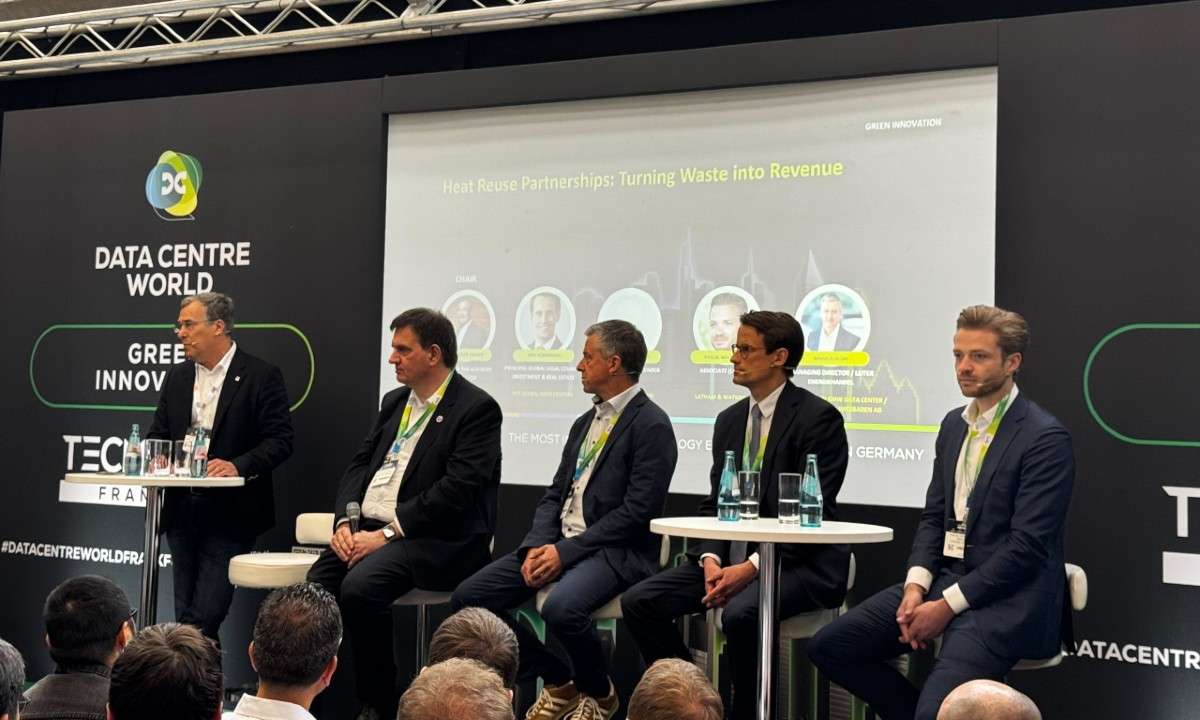
A panel of stakeholders ‒ representing German data center operators, energy utilities and municipality leadership ‒ shared insights into reusing data center waste heat to decarbonize district heating at Tech Show Frankfurt 2026.
Positioning themselves as pioneers in data center heat-reuse schemes, the panel emphasized that successful projects rely on early municipal planning that aligns power, heat and zoning. Other points discussed included financing, potential for industrial applications and regulations. The event was held May 6‒7.
“If you want to use the heat from the data center, it only works if the [facility] is close to the existing district heat system,” said Markus Blüm, Managing Director of Green Mountain KMW Data Center. “There’s no business case to transport 30°C [86°F] heat over 5‒10km [3.1‒6.2mi].”
To put it in perspective, Jörg Reinshagen, Principal Legal Counsel for Investment and Real Estate at NTT Global Data Centers, added that “one kilometer [0.6mi] of heat piping costs roughly €2 million [$2.3 million].”
Besides Blüm and Reinshagen, other panel participants included Christoph Meier, CEO of EVO, the city of Offenbach, Germany’s, municipal utility company, and Pascal Wagenführ, Associate Lawyer at Latham & Watkins, who focuses on digital infrastructure and energy transition. The discussion was moderated by Alexander Hauser, Managing Director of TTSP HWP and an advisory board member of the German Data Center Association.
Typically, data center cooling systems generate waste heat at around 30°C, which heat pumps can upgrade to roughly 60–80°C (140–176°F) for use in district heating networks. While the panel did not discuss heat pump refrigerants, natural refrigerants, including CO2 (R744), ammonia (R717) and hydrocarbons, offer future-proof decarbonization solutions as the EU tightens restrictions under its revised F-gas Regulation and PFAS (per- and polyfluoroalkyl substances) restriction proposal.
Implementation examples: Both KMW and EVO have interactions with data centers at various stages to supply heat to German district heating networks.
- At its Maniz energy campus, KMW is building three data centers with a combined IT power capacity of 54MW. The facility will be powered by renewable energy from KMW’s wind and solar portfolio, with gas turbine generators providing the backup power. The site currently produces district heating for Maniz via gas-fired power plants. However, the new data centers, cooled using water from the Rhine River, will also be able to supply district heating when surplus wind power is available, according to Blüm. “As the central operator of both the data center and the gas power plant, we can optimize [the usage] on an hourly basis,” he said.
- In Offenbach, EVO has “signed contracts with several data center operators,” a development that Meier attributes to early stage municipal planning. In February 2023 EVO signed a letter of intent with CloudHQ.
- “The city makes certain ‘green’ requirements, and then we have to find technical solutions that include space for the data center and the heat pump,” Meier said.
The big picture: Other points discussed included CAPEX expenditures and potential industrial applications.
- NTT is willing to co-invest in heat-reuse projects, particularly with data centers benefitting from the energy reductions for cooling, according to Reinshagen. “However, the CAPEX investment needs to work for [all] parties, with many stakeholders involved in the solution,” he said.
- “What we see from a lot of investors is a willingness, law or no law, to procure that goal of energy efficiency and waste reuse,” said Wagenführ, adding that the real challenge is aligning the interests of all stakeholders through contracts and planning.
- With industrial processes requiring temperatures of up to 200°C (392°F), neither Blüm nor Meier sees strong demand or a compelling business case for reusing 30°C data center waste heat. Reinshagen, however, said it could be used in industrial applications such as preheating diesel for backup power systems or for space heating.
Directing the industry: Three regulatory developments are accelerating the reuse of data center waste heat in Germany.
- The EU’s revised 2023 Energy Efficiency Directive requires member states to ensure that data centers with an installed IT power demand above 1MW access and enable waste heat recovery where technically or economically feasible, particularly for integration into district heating systems.
- Germany’s 2023 Energy Efficiency Act creates requirements for new data centers, including minimum levels of waste heat utilization through an Energy Reuse Factor (ERF). From July 2026 new facilities must achieve at least a 10% ERF, increasing to 15% from July 2027 and 20% from July 2028.
- Under its 2023 Heat Planning Act, Germany aims to achieve climate-neutral heat by 2045, requiring municipalities to develop heat plans that align with full decarbonization of heat supplies by that date.
Green technologies: In its 2025 Clean Cooling for Data Centers report, ATMOsphere, publisher of NaturalRefrigerants.com, profiled manufacturers supplying natural refrigerant solutions for reusing data center waste heat and provides examples.
- Hydrocarbon heat pumps produced by Fenagy provide cooling only or cooling and heating based on district network demand at a data center in Kajaani, Finland. The first phase of the project targets 13.5MW of IT power capacity matched by approximately 13.5MW (3,838TR) of cooling capacity. The heat pumps capture the resulting waste heat and reuse it in the local district heating network, delivering roughly 18MW (5,118TR) of heating output, with an expected heating COP of 4.2–5.
- At the EcoDataCenter in Falun, Sweden, SWEP’s brazed plate heat exchangers recover waste heat from the 80MW data center and transfer it either to the nearby combined heat and power facility for use in wooden pellet production or into the local district heating network.
“If you want to use the heat from the data center, it only works if the [facility] is close to the existing district heat system.”
Markus Blüm, Managing Director of Green Mountain KMW Data Center