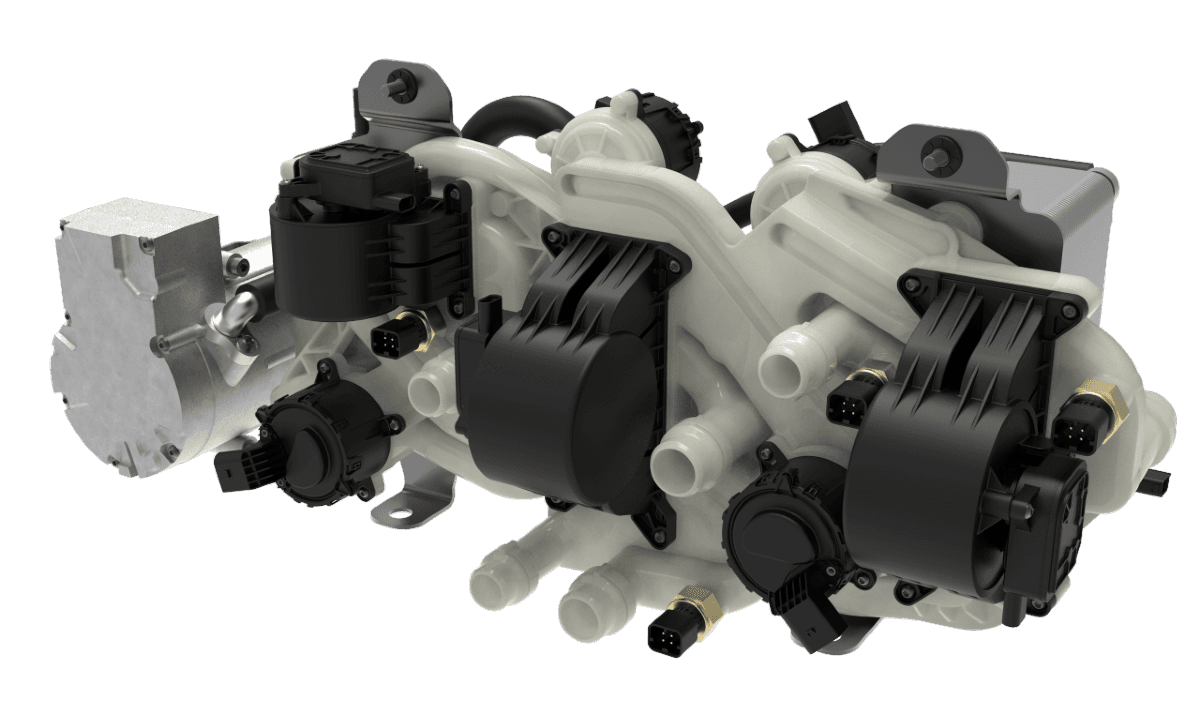
ATMOsphere, publisher of NaturalRefrigerants.com, will host a webinar to discuss the findings of a recently published report by Hanon Systems estimating the amount of trifluoroacetic acid (TFA) generated in Europe by emissions of refrigerants HFC-134a and HFO-1234yf from car cooling and heating systems.
The webinar will be held on June 18 at 3 pm CEST. You can register for the event here.
The report – “TFA contaminations caused by fluorinated gases inside mobile air-conditioning systems and already available alternatives” – was authored by two Hanon executives, Dr. Roman Heckt, Global Chief Engineer for Natural Refrigerant Systems, and Dr. Henning Freitag, Natural Refrigerant Systems Development Engineer. The report can be read and downloaded here. Hanon manufactures components for CO2 (R744) and R290 (propane) air-conditioning and heat pump systems.
Its new report outlines a model devised to calculate and evaluate TFA created in the atmosphere from refrigerant leakages in passenger car cooling and heating systems. The model focuses on passenger cars in Europe, comprising the 27 EU member states, the European Free Trade Association countries and the United Kingdom. It covers internal combustion engine vehicles, hybrid electric vehicles, plug-in hybrid electric vehicles and battery electric vehicles. It assumes an average refrigerant charge per vehicle of 500g.
“The main goal is to quantify current and future emissions and to show the impact of different future regulatory scenarios,” said the report. “Annual TFA emissions are rising strongly. This will continue for the next ten years at least, unless a PFAS restriction leads to an early switch to natural refrigerants.”
Alternatives available
In its report, Hanon calculated that the use of HFC-134a, starting in the mid-1990s in air-conditioned vehicles, led to the creation of roughly 2,000 metric tons per year of TFA by 2010. But after 2014 a steady transition to HFO-1234yf took place as a result of the EU MAC Directive, which fully banned HFC-134A as of 2017 due to its high GWP. By 2025, annual TFA emissions exceed 6,000 metric tons per year, with R1234yf accounting for more than 80% of the total emissions but only 44% of the vehicle fleet, the report said.
While R1234yf is the dominant refrigerant in the air-conditioning systems of new vehicles, there are more than 1 million Volkswagen electric vehicles (EVs) on the road today in Europe equipped with CO2-based heat pumps. In addition to cabin heating and cooling, heat pumps also regulate the battery temperature in electric cars. Along with Hanon, German commercial mobile air-conditioning (MAC)-system developer Konvekta has built CO2-based heating and cooling systems for electric buses and farming vehicles.
Numerous companies are developing propane (R290)-based MAC systems for EV, which has already proven to be road-worthy in commercial applications. Aurora Netherlands, a vehicle HVAC manufacturer, having sold 165 of its secondary loop propane heat pump systems to electric bus manufacturers as of November 2025.