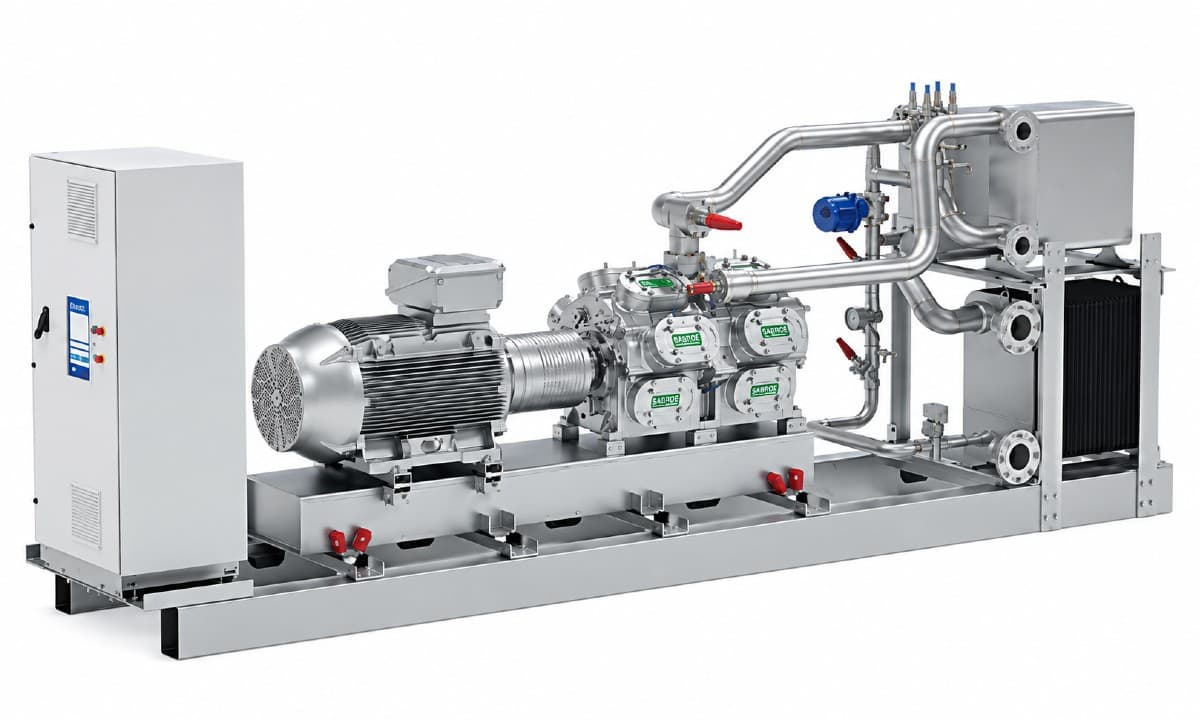
Italian heat pump manufacturer Turboden has started up what it says is “the world’s largest steam-producing heat pump,” an isobutane (R600a) unit that can generate 12MWth of superheated steam at 3.4bar (49.3psi).
Delfort, a manufacturer and distributor of papers for the tobacco, pharmaceutical, food and label industries, installed the heat pump at its paper mill in Tervakoski, Finland. It is part of a €50 million ($58 million) project to convert the Tervakoski mill to run on fossil-free energy. Turboden announced that the heat pump was started up on February 17, 2026.
The heat pump is paired with a mechanical vapor recompression (MVR) unit, enabling it to deliver steam at 150–180°C (302–356°F). The MVR unit takes the low-pressure, low-temperature steam from the heat pump and recompresses it to raise its pressure and temp. Waste heat from the paper production process is used as the heat pump’s heat source.
“For the industrial and energy sectors, this project stands as clear evidence that large-scale heat pump technologies are a viable and already available decarbonization solution, delivering outstanding performance as a high-efficiency alternative to traditional fossil-based systems,” said Paolo Bertuzzi, Managing Director and CEO Turboden.
As part of its decarbonization commitment, Delfort sought a solution that could produce fully decarbonized steam, while “guaranteeing the same quality, reliability, and continuity traditionally provided by fossil-fuel boilers,” Turboden said. The new heat pump, which replaced a fossil fuel boiler, will reduce Delfort’s annual CO2 emissions by 19,000 metric tons.
“This project marks a significant milestone in Delfort’s decarbonization journey,” said Hannes Kinast, COO of Delfort, in a press release. “The successful implementation of this efficient and sustainable heat pump process into our heat generation system clearly proves the potential of this technology. This investment reinforces our ability to deliver high-quality, sustainably produced paper solutions to our customers.”
The successful implementation of this efficient and sustainable heat pump process into our heat generation system clearly proves the potential of this technology.
Hannes Kinast
COO, Delfort
A burgeoning sector
A growing number of companies are developing steam-producing heat pumps that use natural refrigerants to decarbonize different industrial processes. U.S. compressor manufacturer Copeland acquired Sustainable Process Heating (SPH), a German manufacturer of industrial high-temperature heat pumps (HTHP) in October 2025.
At IIAR 2026, held March 15–18 in San Antonio, Texas, Copeland told NaturalRefrigerants.com that it has made SPH’s ThermBooster HTHP available in North America. The unit delivers steam and pressurized water at up to 180°C with nominal heating capacities from 0.4 to 1.5MW (114 to 427TR) using hydrocarbons or HFO refrigerants. There are currently seven ThermBooster heat pumps installed in Europe, with a roughly even split of those using hydrocarbon and HFOs, per Copeland.
Prior to the acquisition, a high-temperature butane–water (R600–R718) heat pump from SPH was installed at a Takeda manufacturing facility in Vienna. The heat pump, which is used in the production of pharmaceutical products, has a capacity of 1.2MW (341TR) and can generate steam at up to 195°C (383°F).
In late 2025, Norwegian manufacturer Enerin announced that it would supply a 1.2MW high-temperature heat pump that uses helium (R704) as a refrigerant to the pharmaceutical company Roche Switzerland. The system will be used to produce steam for the chemical production process at Roche Switzerland’s facility outside of Basel, Switzerland.
The heat pump produces 171°C (340°F) steam year-round at 6bar (87psi) and uses waste heat between 30–40°C (86–104°F) from a cooling circuit as a heat source during the summer and river water at 2–4°C (36–39°F) in the winter.