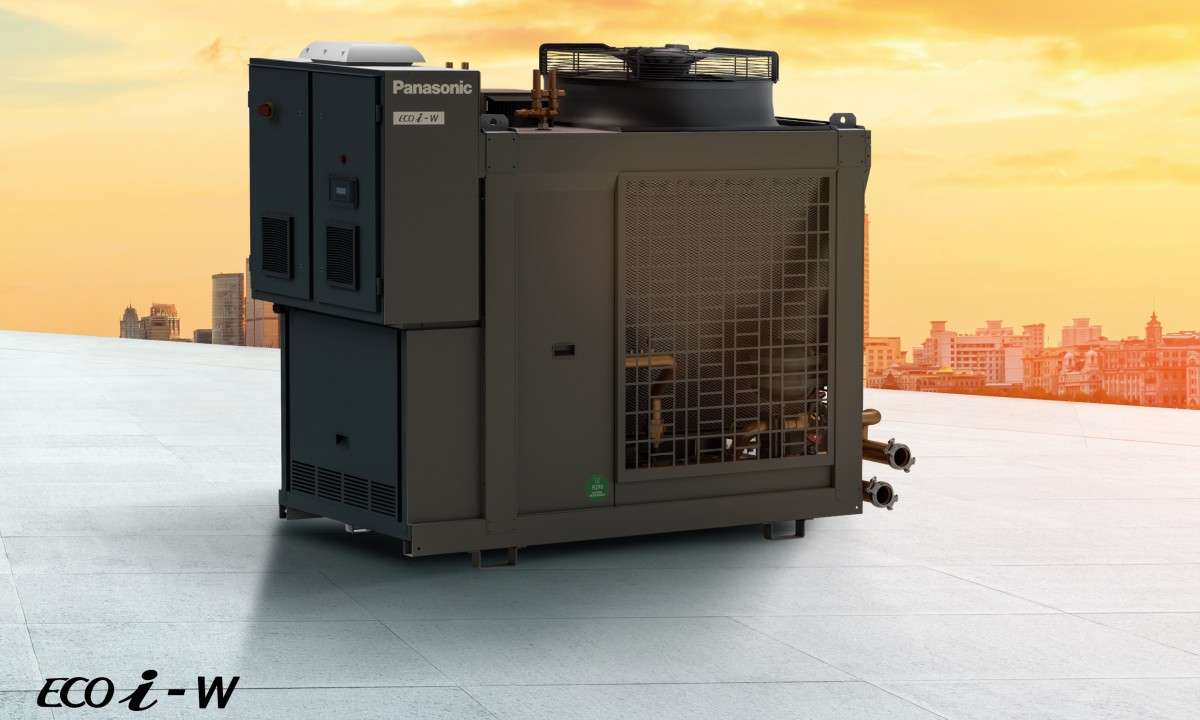
Panasonic Heating and Cooling Solutions, the European division of Japan-based Panasonic, has launched the AQUA-G EVO series, a new propane (R290) air-to-water (A2W) heat pump range optimized for heating in commercial, light industrial and multi-residential applications.
The units, available in 60, 80 and 110kW capacities, extend the company’s ECO-i W commercial range. The design allows combining up to eight units in cascade, for a total capacity of roughly 880kW.
“The AQUA-G EVO has been purpose-built to meet the rising commercial demand for sustainable heating technologies that can effectively replace gas boilers,” Panasonic said. “It aligns with evolving F-gas regulations and supports corporate [decarbonization] commitments across European markets.”
The details: The new range features an inverter-driven compressor and pump, with refrigerant circuits and defrost management providing reliable performance in harsh winter conditions, according to Panasonic.
- In −2°C (28°F) ambient conditions, AQUA-G EVO generates domestic hot water at an outlet temperature of up to 75°C (167°F).
- At −18°C (0°F) it can produce 55°C (131°F) outlet water temperature.
- While conventional heat pumps lose roughly 38% of their heating capacity at a −10°C (14°F) ambient temperature, Panasonic reports that the range loses only about 15% of heating capacity under the same conditions.
Other R290 offerings: Panasonic started manufacturing propane A2W heat pumps for Europe in 2023, with its first products for residential applications.
- In 2024 the company released its Aquarea M Series, with three models providing 20, 25 and 30kW (5.7, 7.1 and 8.5TR) capacities. With compressor injection technology, the M series maintains hot water temperatures in ambient conditions down to −20°C (−4°F) with a SCOP of 5.0, according to Panasonic.
- Also in 2024, it launched its reversible AQUA-G BLUE range, providing heating capacities of 49.2–83.6kW (14–23.7TR) and cooling capacities of 48.2–74.1kW (13.7–21.1TR). Combining up to eight units meets heating and cooling demands of up to 640kW (182TR) and 592kW (168TR), respectively.
Increasing production: Panasonic said that it spent €320 million ($373.8 million) to expand and refurbish its manufacturing facility in Pilsen, the Czech Republic, with the potential to produce 1.4 million R290 residential and commercial heat pumps for the European market by 2030.
- Panasonic increased the facility’s floor space by 102,000m2 (1,097,918ft2) and moved both production and R&D of heat pumps from Southeast Asia to Europe.
- “We’re seeing a marked uptick in interest in heat pumps in the European market,” said Toshikatsu Fukunaga, CEO of Panasonic HVAC Europe, adding that with the investment, the company anticipates meeting future demand.
Quotable: “The AQUA-G EVO 60‒110H reflects Panasonic’s longstanding commitment to sustainable, future-ready HVAC solutions,” Panasonic said. “The range showcases the latest R290 technology, delivering high seasonal efficiency, quiet operation and reliable heating even in extreme conditions.”
“The AQUA-G EVO has been purpose-built to meet the rising commercial demand for sustainable heating technologies that can effectively replace gas boilers.”
Panasonic