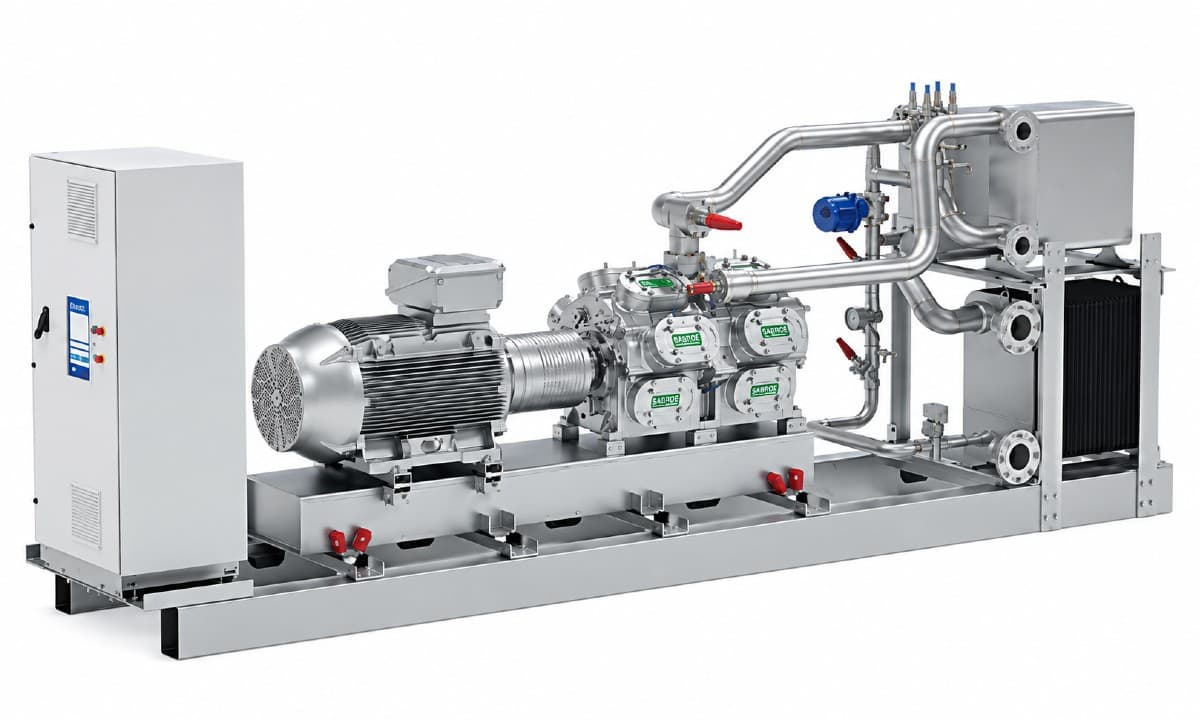
New Yorkers for Cool Refrigerant Management, a regional grassroots group aimed at reducing fluorinated refrigerant emissions, is seeking individuals and organizations to co-sign a letter urging the New York State Building Code Council to allow higher but safe levels of A3 (flammable) refrigerants in monobloc heat pumps and other HVAC equipment when those levels are approved by the American Society of Heating, Refrigerating, and Air Conditioning Engineers (ASHRAE) and Underwriters Laboratories (UL).
The deadline for signing the letter is May 25. Interested stakeholders can add their signature or that of an organization here. Email ny4cool@gmail.com with any questions about the letter. Stakeholders interested in submitting their own letter or participating in the public comment period can learn how to do so here.
The letter, written by Anne Erling, Project Manager for New Yorkers for Cool Refrigerant Management, and Michael Helme, Coordinator for the group, is addressed to Chad Sievers, Professional Engineer 1, Division of Building Standards & Codes, and members of the New York State Fire Prevention and Building Code Council. It asks that specific language, included in the letter, be added to Chapter 11 of the New York State Mechanical Code.
This language would “position New York State to allow access to R290 [propane] heat pumps and other advanced technologies that employ A3 refrigerants as soon as their use is greenlighted by the ASHRAE and UL Committees,” which are responsible for nationally recognized safety standards, the letter said.
New Yorkers are in a period of accelerating heat pump installations, during which choices of which heat pump to install will lock in climate impacts for the working life of the equipment.
New Yorkers for Cool Refrigerant Management
The letter stresses that referencing the ASHRAE and UL committee standards in the current code “will speed up access to these climate friendly technologies; [New York] access would begin when these committees complete their approval (projected for 2028), as opposed to after inclusion in the subsequent ICC model code and a subsequent [New York] Mechanical Code update cycle review.” This would “cut many years off of our expected wait to be able to adopt these technologies” at a time of urgent need to address climate change.
The letter asks for the acceptance of equipment such as factory-built low-probability systems located in machinery rooms or outdoors that contains a maximum of 10.8lbs (4.9kg) of A3 or B3 refrigerants. R290 residential heat pumps of this type are already widely available in Europe and elsewhere in the world.
Last year Jim VerShaw, chair of ASHRAE’s SSPC (Standing Standard Project Committee) 15.2, said it would be not be until “2025 or later” for the higher charge levels for R290 in monobloc heat pumps to be approved. Currently allowed charge of R290 in the U.S. (114g/0.3lbs) are insufficient to support monobloc heat pumps.
The letter noted that the US Department of Energy (DOE) and Oak Ridge National Laboratory have initiated safety research and testing projects that will inform standards committees on safety requirements for A3 refrigerants in air conditioners, chillers and heat pumps. Last year, the Air-Conditioning, Heating and Refrigeration Institute (AHRI) said it would receive $2.5 million from the DOE as part of a collaborative effort to address performance and safety concerns for implementing air-to-water heat pumps that use A3 refrigerants. States are also supporting demonstration projects for low-GWP refrigerants, including R290 in residential and light commercial refrigeration systems.
Reasons for R290 heat pumps
The letter pointed out the following reasons for supporting A3 refrigerant options for heat pumps:
- Heat pumps leak significant amounts of refrigerant; the California Air Resources Board estimates an average refrigerant leak rate during a 15-year operating life of heat pumps at 67%, then an additional 80% at end of life, for a lifetime emissions rate of 147% of the initial charge.
- Heat pumps currently available in New York use synthetic refrigerants that have extraordinarily high global warming potentials – the 20-year global warming potential (GWP20) of R410A is 4,715, of R32 is 2,690, and of R454B is 1,854 – so the persistent leaks of these refrigerants have a significant, destabilizing impact on the climate.
- In addition, the latest generation of synthetic refrigerants, notably HFO-1234yf (used by itself or in blends, including in heat pumps), breaks down rapidly when it escapes into the atmosphere to form trifluoroacetic acid (TFA), a type of PFAS, which is then absorbed in rainfall and infiltrates the environment and our food and water. European researchers have labelled TFA, a highly persistent and potentially toxic substance, a “planetary boundary threat.”
- New Yorkers are in a period of accelerating heat pump installations, during which choices of which heat pump to install will lock in climate impacts for the working life of the equipment.
- This code language change will enable early access for New Yorkers to R290 heat pumps, which use a refrigerant with a negligible climate impact (the GWP20 of R290 is .07), and also that has no TFA formation potential.