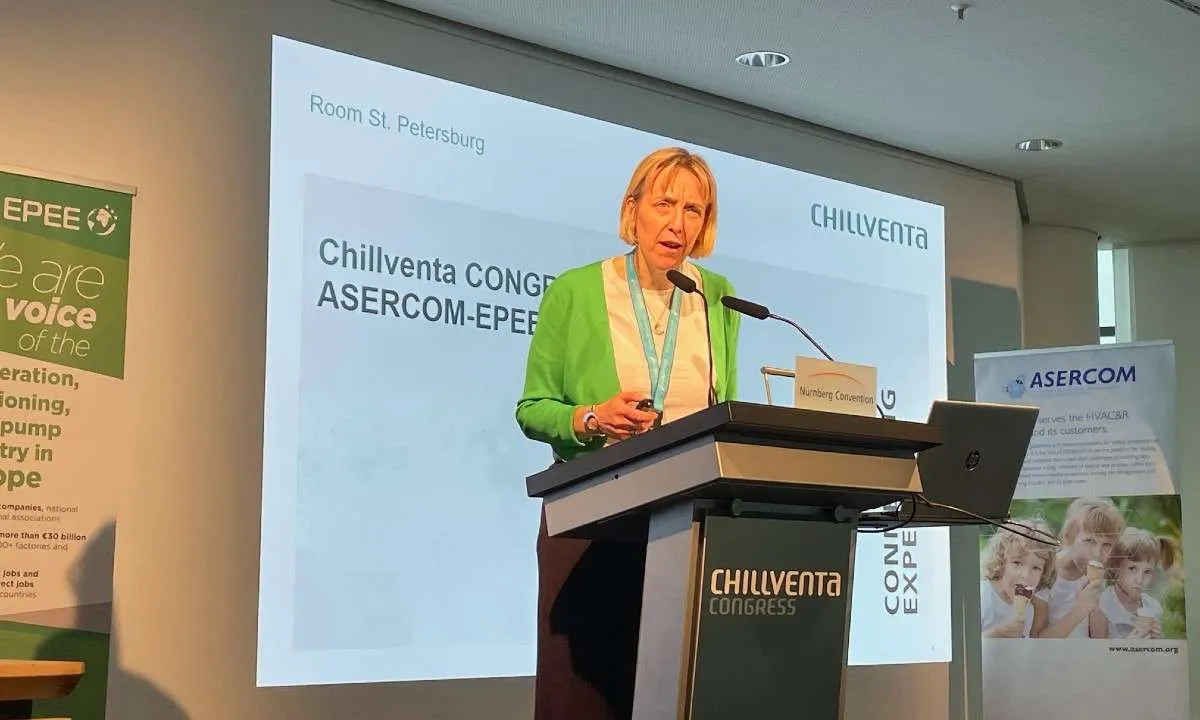
A representative of chemical manufacturer Honeywell denied that f-gases and their degradation product trifluoroacetic acid (TFA) represent “an unacceptable risk” that would justify their regulation as a PFAS (per-and polyfluoroalkyl substances) under the EU’s REACH (Registration, Evaluation, Authorisation and Restriction of Chemicals) regulation.
The representative, Mary Walsh, Honeywell’s Lead Environmental Policy, Europe, made this comment as part of a presentation on October 7 at the Chillventa Congress’s EPEE/ASERCOM symposium, in Nuremberg, Germany. EPEE is the European Partnership for Energy and the Environment, representing the European HVAC&R industry while ASERCOM is the Association of European Refrigeration Component Manufacturers. Chillventa, one of the world’s largest HVAC&R trade events, is taking place October 8–10 at the NürnbergMesse convention center.
“We don’t believe they are an unacceptable risk for there to be a REACH restriction,” said Walsh. “There must be an unacceptable risk.”
“From our perspective, the unintentional consequences of a ban outweigh the benefits,” added Walsh.
Should f-gases be regulated under REACH, “we at EPEE believe there should be a time- unlimited derogation [exemption] for f-gases, with a 10-year review clause.”
Honeywell is one of the primary producers of HFO-1234yf, which is widely used as a refrigerant in car air-conditioning and in blends with other f-gases that are used in commercial and industrial applications. HFO-1234yf and other HFOs and HFCs are being evaluated for regulation as PFAS by the European Chemicals Agency (ECHA), which last year published a proposal from the national authorities of Denmark, Germany, the Netherlands, Norway and Sweden to restrict PFAS – so called forever chemicals because of their persistence – under REACH.
This would include HFCs and HFOs such as HFC-125, HFC-134a, HFC-143a, HFO-1234yf, HFO-1234ze(E), HFO–1336mzz(Z) and HFO-1336mzz(E). The proposal would apply to TFA, an atmospheric degradation product of, notably, HFO-1234yf (100% conversion) and HFC-134a (up to 20% conversion).
Over the past few years, many studies have shown the proliferation of TFA in the environment as a result of the breakdown of HFO-1234yf in the atmosphere, producing TFA that comes down to earth in rainfall. Most recently, Swedish researchers have found “elevated levels” of TFA in juices and drinks – especially orange juice and some hand-squeezed oranges – as well as in fruit purées for small children.
Walsh noted that Honeywell “works with the Montreal Protocol,” the global body that regulates f-gases, adding that “the TFA experts at the Montreal Protocol have been looking at this topic since 1990 and they don’t think the risk assessment should be linked to a PFAS proposal.”
Response to reproductive toxicity link
Following her talk, in a Q&A exchange, Walsh was asked to respond to the decision by the German Federal Office for Chemicals (Bundesstelle für Chemikalien or BfC) to submit to the ECHA in a proposal linking reproductive toxicity to TFA and its inorganic salts. “We are awaiting with interest to see that that proposal will look like when it becomes public,” she said, adding that there will be a chance to respond to a public consultation at that point. She also said, “until we see the proposal, we don’t know what studies it’s based on. We will see that in the coming weeks.”
The German agency’s two classification and labelling proposal dossiers linking reproductive toxicity to TFA, sodium trifluoroacetate and TFA’s other inorganic salts can be found here and here. For this proposal, BfC used study summaries from ECHA’s non-confidential registration dossiers. For example, ECHA posted a 2022 internal study on rats that concluded that 3000/1500 ppm (approximating 242–265 mg NaTFA/kg/day) was the No Observed Adverse Effect Level (NOAEL) for both reproductive performance/offspring development and for general systemic toxicity.
In another study from 2021 provided by ECHA, eye malformations occurred in all three dose groups of rabbits administered TFA. The study concluded that the NOAEL of sodium trifluoroacetate for maternal toxicity in rabbits was considered to be 180 mg/kg/day, and the NOAEL of sodium trifluoroacetate for embryo-fetal developmental toxicity in rabbits was considered to be less than 180 mg/kg/day. The source of the study is not provided.
The German Environment Agency (Umweltbundesamt or UBA) has set a human health-based guideline value of 60μg/L for TFA in drinking water and a “precautionary measure” of 10μg/L.
“We don’t believe they are an unacceptable risk for there to be a REACH restriction.”
Mary Walsh, Honeywell