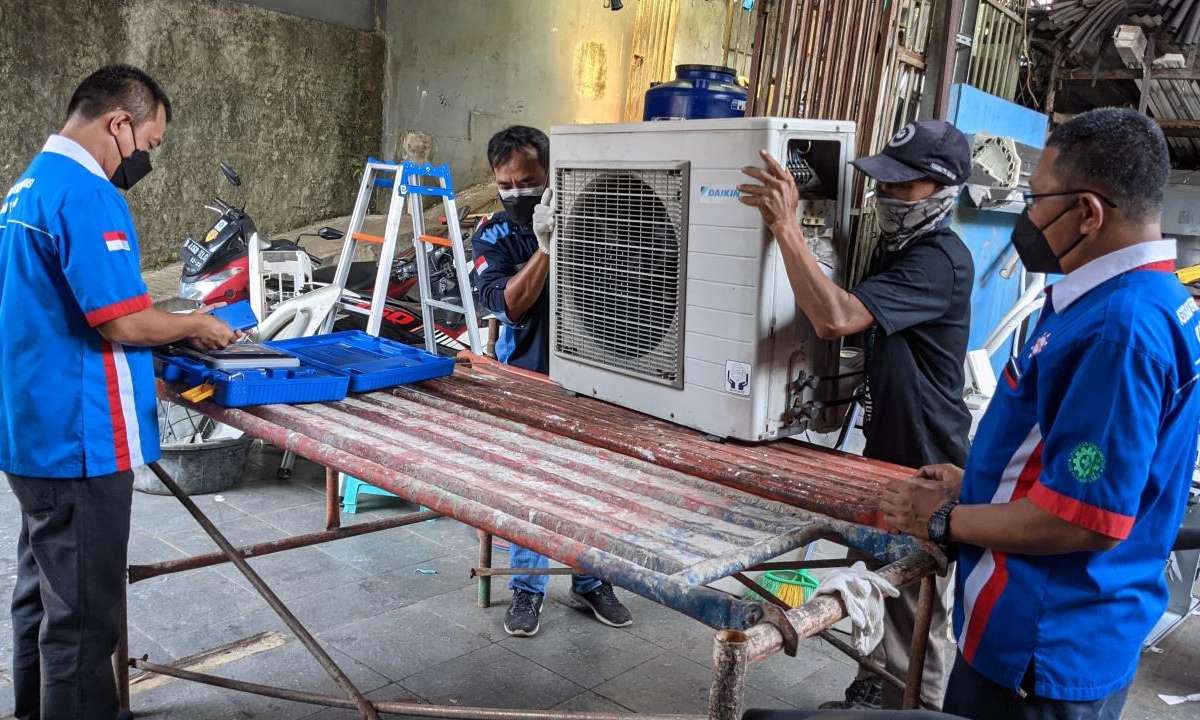
In a move to address some of its residual greenhouse gas emissions, global tech leader Google has announced a multi-year agreement to purchase 250,000 carbon credits from Recoolit, an Indonesian company specializing in the recovery and destruction of HFCs from HVAC&R systems.
According to its latest sustainability report, Google’s total emissions in 2023 amounted to approximately 14.3 million metric tons of CO2e emissions, with Scope 1 emissions — including refrigerant leaks — totaling 79,400 metric tons of CO2e. Emissions from refrigerant leaks are also included in its Scope 2 emissions – totalling 3.4 million metric tons of CO2e – when occurring in leased facilities.
Google has said it is working to more accurately track refrigerant leaks while exploring technologies like diagnostics to reduce them. The company has also said it is deploying cooling solutions across its data centers and offices that “include natural, low-GWP refrigerants,” although no further information or targets have been detailed.
Transitioning to natural refrigerants
While efforts to reclaim and destroy HFCs play an important role in reducing the environmental impact of existing HVAC&R equipment, industry experts have pointed to the transition to natural refrigerants as the most sustainable long-term solution.
According to the Environmental Investigation Agency (EIA), focusing solely on reclaiming and destroying HFCs, without phasing them out entirely, may limit the overall impact.
“Effective leak prevention and end-of-life management of HFC/HCFC systems could prevent 39 [billion metric tons of] CO2e from being released between 2025 and 2050,” the EIA stated in a report on refrigerant myth busting. “However, these figures are based on best practices. The only realistic way to prevent all emissions of high-GWP refrigerants is to stop using them in appliances.”
Natural refrigerants such as CO2 (R744), ammonia (R717) and hydrocarbons offer significantly lower GWPs and lower environmental risk in the event of a leak, the organization noted, making them increasingly attractive alternatives.
“The only realistic way to prevent all emissions of high-GWP refrigerants is to stop using them in appliances.”
Environmental Investigation Agency
Action on super-pollutants
The investment in Recoolit is part of Google’s broader strategy to tackle short-lived climate pollutants, or super-pollutants, which also includes methane destruction from landfills in Brazil.
“We can’t combat climate change without solving for super-pollutants – and we’re eager to use every tool we have available to catalyze the range of solutions needed to address near-term warming,” explained Randy Spock, Carbon Credits and Removals Lead at Google, in a LinkedIn post. “Destroying these pollutants is one of the most powerful levers available today to slow down climate change in the near term.”
Combined, the two projects are expected to eliminate 25,000 metric tons of high-GWP super-pollutants by 2030, the company said. Based on GWP over a 100-year time frame, this is equivalent to 1 million metric tons of CO2 emissions, or 3 million metric tons when evaluated over 20 years.
The funding will help Recoolit expand into new countries and scale their operations tenfold, he noted.
“We can’t combat climate change without solving for super-pollutants – and we’re eager to use every tool we have available to catalyze the range of solutions needed to address near-term warming.”
Randy Spock, Carbon Credits and Removals Lead at Google