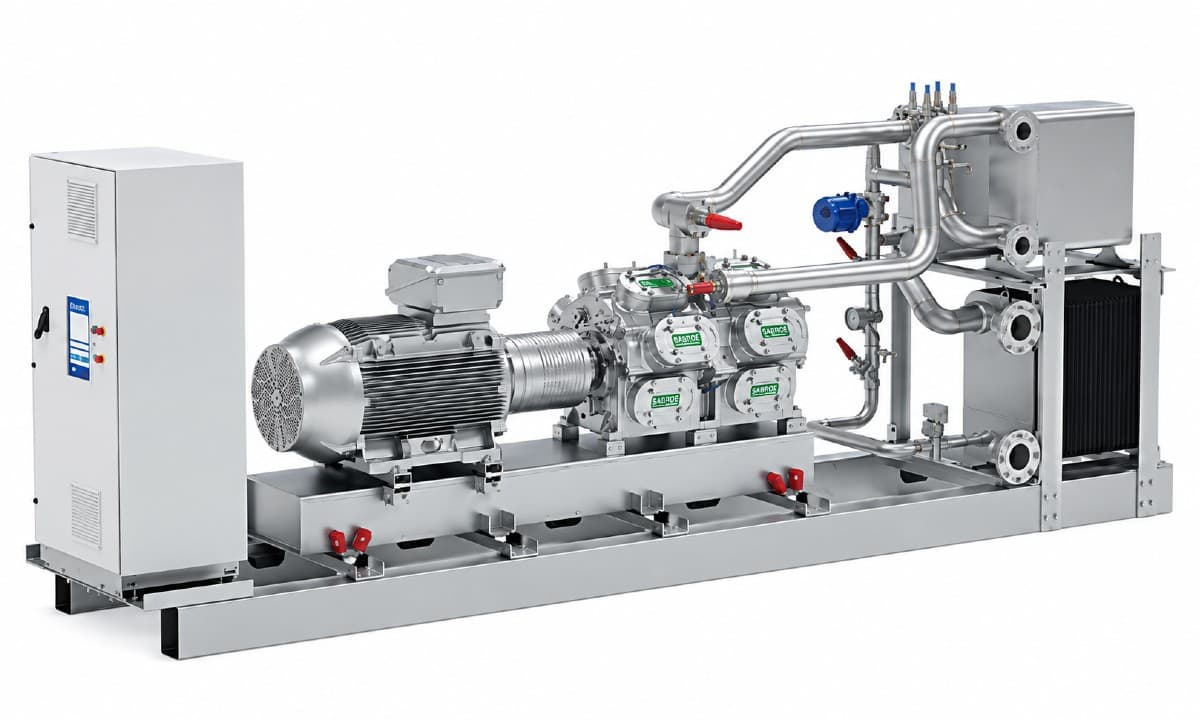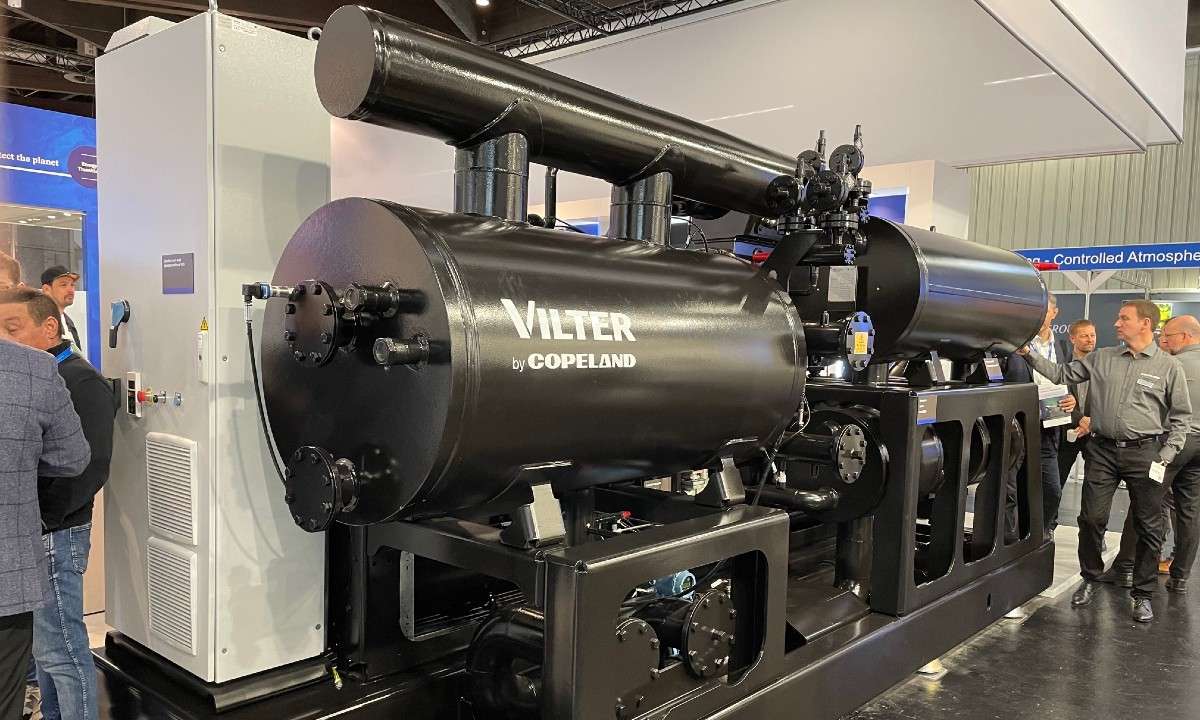
Markham District Energy (MDE) announced on October 21 that it has selected U.S. manufacturer Copeland’s Vilter-branded VQ95 single-screw ammonia (R717)-based industrial heat pumps to power MDE’s wastewater energy transfer (WET) facility at its Low Carbon Energy Centre in downtown Markham, Ontario.
Owned by the City of Markham. MDE provides heating and cooling services to commercial, residential and institutional buildings. The WET facility – which MDE called the “world’s largest wastewater energy transfer facility” – will extract and convert energy from wastewater for sustainable heating and cooling, reducing reliance on fossil fuels and lowering greenhouse gas emissions.
The project is expected to reduce carbon emissions from the production of thermal energy by more than 30,000 metric tons per year at the plant’s full capacity — equivalent to taking about 7,000 cars off the road, said MDE.
“This initiative is set to revolutionize the use of wastewater as a renewable energy source,” said Ryan Garrah, Vice President of Canada for Copeland. “Markham District Energy’s selection of our heat pumps demonstrates their trust in our differentiated technology to deliver efficient and reliable energy transfer from wastewater sources.”
The MDE WET facility taps sewage wastewater via an 8ft (2.4m)-diameter underground sewage pipeline as the primary heat source at about 5°C (41°F), which is converted by the heat pumps into usable heat at 95°C (203°F) as well as cooling capacity. Traditional systems draw energy from more conventional sources like ambient air or ground heat.
MDE announced the groundbreaking of the WET project in July. MDE leveraged funding from several programs offered by the Canadian government, including CA$16.7 million (€11.9 million) from the Low Carbon Economy Fund, CA$8.2 million (€5.5 million) from the Green Municipal Fund, and CA $135 million (€90.5 million) loan facility from the Canada Infrastructure Bank combined with a CA$135 million facility with the Canadian Imperial Bank of Commerce (CIBC) to support the expansion of its district energy network and transition to net-zero emissions by 2050.
Chillventa launch
Copeland announced the launch of the VQ95 water-to-water ammonia heat pump in Nuremberg, Germany, at the Chillventa trade show, which took place October 8–10. The heat pump offers 1 to 5MW (284 to 1,422TR) heating capacity on a single skid for decarbonizing district heating and industrial process heating applications. “It’s perfect for district heating,” said Grant Kovac, Vilter’s Director – Product Management. Copeland’s industrial heat pumps are slated for delivery to MDE by mid-summer 2025 and to be fully operational by January 2026.
The VQ95 heat pump uses less than 250kg (551lbs) of ammonia, said Kovac. It employs a single-screw compressor, which enables the system to generate “higher pressures and higher temperatures because of the balanced design of the single screw,” he added.
According to Copeland, the single-screw design is not susceptible to damage from liquid droplets, eliminating the need for superheat, which reduces efficiency. In addition, Parallex slides enable the compressor to modulate capacity from 20 to 100%, eliminating the need for a variable frequency drive.
“This initiative is set to revolutionize the use of wastewater as a renewable energy source.”
Ryan Garrah, Vice President of Canada for Copeland