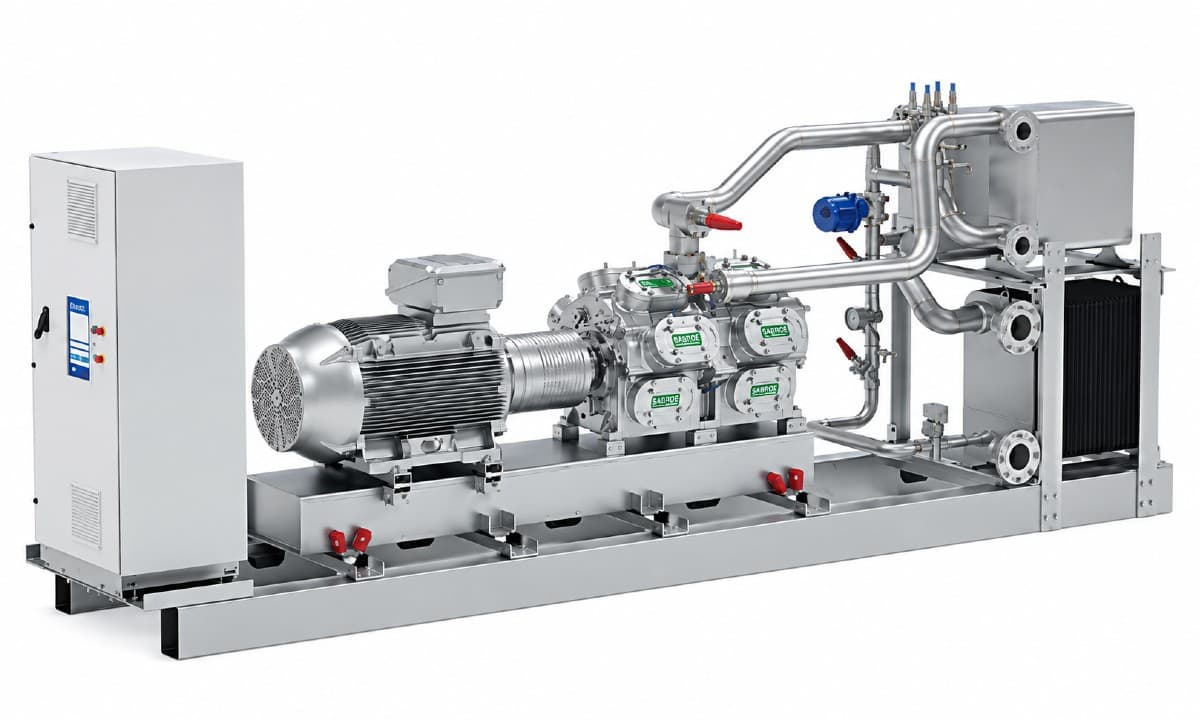
Danish component manufacturer Danfoss has developed a prototype water-to-water propane (R290) residential heat pump with a charge of 130g, which Heat Pumps System Engineering Leader Matthieu Stoll said will be made available to OEMs.
In a presentation at Chillventa 2024, Stoll explained the development of the technology for indoor installations and the various configuration options.
Chillventa, held October 8‒10 in Nuremberg, Germany, is one of the world’s largest HVAC&R trade shows.
The prototype unit, which Stoll compared in size to a 1.5L water bottle, provides 4.71kW (1.34TR) of heating capacity with a COP of 3.85 while operating at 120rps (rounds per second) and 2.26kW (0.64TR) of capacity at 60rps with a COP of 2.98.
“We have a bill of materials ready and qualified for OEMs interested in the unit,” Stoll said. “I guarantee the charge and the performance. An OEM simply designs the right system for their application and develops the assembly.”
According to Stoll, Danfoss developed the unit specifically for indoor installations in order to comply with the recently revised EU F-gas Regulation, which became law earlier this year and instituted a ban on using f-gas refrigerants in small (less than12kW/3.4TR) monobloc heat pumps starting in 2032. He acknowledged the work done by the German-based Fraunhofer Institute and the French-based Cetiat (Technical Centre for Heating, Air Conditioning and Air Handling Industries) to help convince the industry of the viability of such a low-charge R290 heat pump.
Stoll indicated that the new design, appropriate for single-family homes or as a booster in multi-family apartments, could also be used in fifth-generation district heating and cooling networks.
“We have a bill of materials ready and qualified for OEMs. I guarantee the charge and the performance.”
Matthieu Stoll, Heat Pumps System Engineering Leader
Design methodology
Unlike an outdoor system, the water-to-water heat pump requires the propane charge to remain under 150g to minimize flammability concerns. To meet the heating challenge with such a low charge, Stoll explained that Danfoss compressed the internal volume of the heat pump as much as possible. “We accomplished this by using short, small diameter piping and compact line components and relocating the filter dryer to the suction end.”
When considering a compressor, Danfoss sought to maximize the refrigerant in the heat pump cycle by using a design with a lower dilution, minimizing the oil charge and operating with minimal free volume (or the volume of air a compressor can deliver). According to Stoll, a specific Danfoss VRN rotary compressor best met most of the established design criteria.
Since a compressor naturally traps refrigerant in its coolant oil, Stoll said Danfoss used PAG (polyalkylene glycol) oil instead of POE (polyolester), which is commonly used in air-conditioning applications. “PAG oil provides twice as little dilution as POE,” Stoll explained. “However, you need a qualified compressor to work with it.”
Danfoss also considered the heat exchanger, desiring high pressure for low-flow volume between plates and a high-heat transfer. The company manufactures a line of brazed plate heat exchangers for R290 heat pumps using “MicroPlate technology” with single, double-walled and low-charge options.
“We also have this new heat exchanger that comes with a mixing chamber,” Stoll said. “This is the ideal unit for a reversible system, particularly with a low-charge water-to-water system.”
Prototype details
After running simulated models that determined an optimized propane charge of 158g, Danfoss built a prototype using 130g of propane. According to Stoll, the success of the lower charge heat pump gives the manufacturer a 20g margin of design flexibility to meet OEM needs.
The prototype, with an internal volume of roughly 2L, used a Danfoss VRN compressor with an inverter and Danfoss’s new heat exchanger with a mixing chamber. However, it left out the filter dryer. In such a compact system, Stoll questioned the need for a filter dryer, noting that it can be added if field operation shows the need.
“Between the compressor chosen on design criteria and the PAG oil, we have three to four times less refrigerant trapped in the compressor,” Stoll said. “That gives so much more opportunity to have useful refrigerant in the system.”
According to Stoll, the operational trends of the tested prototype matched those seen in the simulated models. “I guarantee this unit can meet the energy rating requirements, especially since we have charge leeway allowing an increase in the number of plate heat exchangers,” Stoll said.
“Between the compressor and the PAG oil, we have three to four times less refrigerant trapped in the compressor.”
Matthieu Stoll, Heat Pumps System Engineering Leader