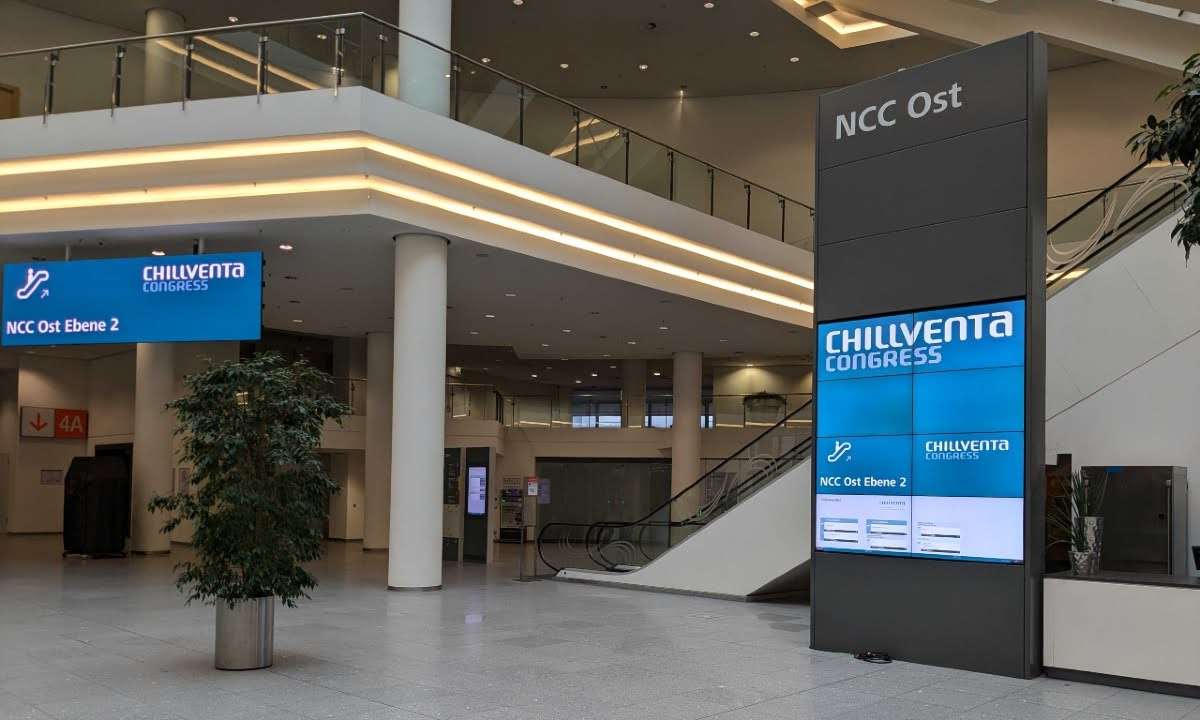
Several presentations at the Chillventa Congress’s “Heat Pumping Technologies” series of lectures focused on strategies for accelerating the deployment of residential propane (R290) heat pumps.
The Congress was held Monday, October 7, at the NürnbergMesse exhibition center in Nuremberg, Germany. Chillventa begins Tuesday, October 8 and ends Thursday, October 10.
With more than 50 manufacturers now producing small-capacity outdoor R290 heat pumps for residential applications, these units have become widely accepted as a proven, safe technology market.
The focus is now shifting to address emerging market demands, such as indoor heat pump models and higher-capacity systems designed for multi-family buildings. This is driving a renewed reassessment of safety measures to effectively manage the risks associated with propane’s flammability in these new applications.
Indoor and higher-capacity models
In a presentation on the use of R290 heat pumps in Germany, Thore Oltersdorf, Senior Engineer at Fraunhofer ISE, discussed various design strategies aimed at improving the safety of indoor installations. These include charge-reduction, leak-detection and installation-location considerations. He emphasized that every aspect of system design and installation affects safety.
Similarly, Odile Cauret of the French public utility company Électricité de France (EDF) highlighted the importance of detecting refrigerant leaks early as leaks significantly impact both heat pump performance and safety. In her presentation, she noted that as the technology evolves, high-performance heat pumps with enhanced resistance to refrigerant loss will become more common.
Kashif Nawaz, Section Head of Building Technologies Research at Oak Ridge National Laboratory, outlined nine key research activities identified by Oak Ridge and the Air-Conditioning, Heating, and Refrigeration Institute (AHRI) to ensure the safe deployment of propane and other A3 refrigerants in the U.S. These include establishing safe distances between units, studying leaked refrigerant pools and preparing training and certification programs for technicians.
AHRI Gets U.S. Funding to Study Higher R290 Charge for Residential Heat Pumps
In South Korea, Professor Minsung Kim of Seoul’s Chung-Ang University, is researching how the design of heat exchangers can lead to a reduced refrigerant charge. His findings show that reducing the inner diameter of heat exchanger channels can lower refrigerant charge, and this can be further reduced through the use of multi-channel heat exchangers.
The IEA’s Annex 64
Professor Björn Palm of the KTH Royal Institute of Technology in Stockholm presented on the International Energy Agency (IEA)’s Heat Pumping Technologies (HPT) program, which is advancing research through Annex 64. This initiative is focused on developing updated standards for the safe use of flammable refrigerants in heat pumps.
Researchers are exploring risk-mitigation strategies, designing components and systems that reduce refrigerant charge and investigating advanced leak detection methods – all aimed at facilitating the safe and efficient use of low-GWP refrigerants like hydrocarbons in HVAC&R systems, with a focus on residential heat pump applications.