In eight years – by the end of 2032 – HFOs, the latest generation of fluorinated refrigerants, will no longer be a viable refrigerant option, following their predecessors HFCs, HCFCs and CFCs into the dustbin of history, predicted Michael Kauffeld, Professor at the Karlsruhe University of Applied Sciences, Institute of Refrigeration, Air-Conditioning and Environmental Engineering in Germany.
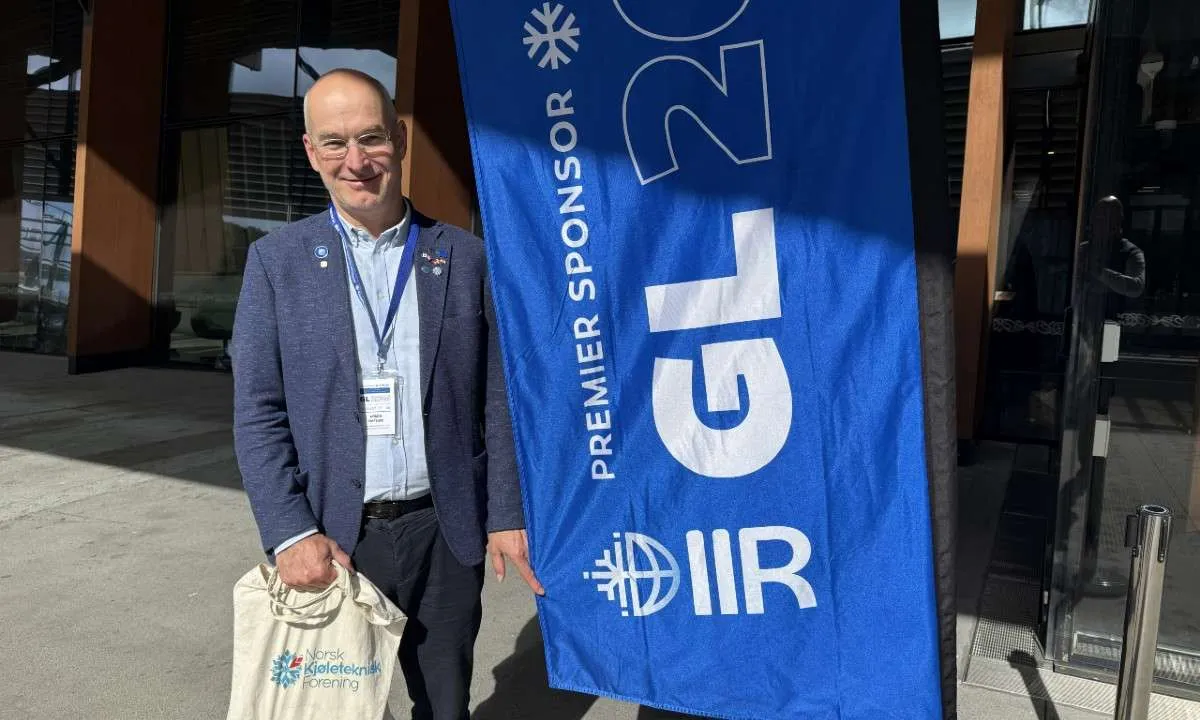
Kauffeld made this prognostication during his keynote address on November 26 at the ATMOsphere (ATMO) Europe Summit 2024 on natural refrigerant-based cooling and heating, held in Prague, Czech Republic, November 25–26.
“It’s eight years left before HFOs will disappear,” he said in his keynote, titled “PFAS – a growing concern in the HVACR industry.” He attributed this largely to the proliferation of the HFO degradation product trifluoroacetic acid (TFA), which is “polluting our soil and groundwater.” HFOs will be replaced, not by another generation of f-gases, but by natural refrigerants such as CO2 (R744), hydrocarbons such as propane (R290), ammonia (R717), water, air and other substances that don’t harm the environment, he said.
In fact, given the increasing severity of the TFA issue, “we shouldn’t wait eight more years,” said Kauffeld. “The politicians should have banned HFOs and the fluorinated pesticides yesterday, rather than tomorrow, but not in eight years.”
In his address, Kauffeld examined certain HFOs, other f-gases and TFA, which fall under the category of PFAS (per- and polyfluoroalkyl substances), a large group (at least 14,000 compounds) also known as “forever chemicals” because of their extreme persistence in nature and possession of at least one fully fluorinated carbon atom. His talk was followed by a PFAS panel discussion, co-moderated by Kauffeld and ATMOsphere CEO Marc Chasserot, with Christine Luetzkendorf, Policy Advisor on Fluorinated Greenhouse Gases, Deutsche Umwelthilfe (DUH); Jonatan Kleimark, Senior Chemicals and Business Advisor, ChemSec; and Cinzia Verzeletti, Senior Campaigner, ATMOsphere.
A longtime expert on natural refrigerants, Kauffeld was named Person of the Year at the ATMO Europe Summit, which was organized by ATMOsphere, publisher of NaturalRefrigerants.com. In addition to writing more than 100 scientific papers, he is the co-editor of Natural Refrigerants: Applications and Practical Guidelines, which offers a comprehensive and practical guide to working with natural refrigerants. Most recently, he was part of a team of researchers who found that in a commercial reversible heat pump using R410A refrigerant, the amount of PFAS components by weight was less than 1%.
“This is, in my eyes, a much bigger environmental scandal than what we ever had before.”
Michael Kauffeld, Professor at Karlsruhe University
Kauffeld offered his original forecast about the longevity of HFOs in 2017 at the EuroShop trade show in Dusseldorf, Germany, giving the gases 15 years at that time. At EuroShop and again at the ATMO Europe Summit, he noted that it took roughly 60 years (1930 to 1990) “to find out that CFCs damage the ozone layer.” It then took about half as long, 30 years (1990 to 2020), to fully acknowledge that HFCs contribute noticeably to global warming and would take half as long again, 15 years, “to accept that HFOs are harmful to the local environment – technician‘s health and terminal water bodies.”
Kauffeld, a member since 1997 of the UNEP (United Nations Environment Programme) Refrigeration, Air-Conditioning and Heat Pumps Technical Options Committee (RTOC), does not expect the transition away from HFOs to be smooth or easy. “We had a very tough fight in the [RTOC] at the end of the 1990s to get HFCs included in the report. We have the exact same fight now again, getting TFA included in the report.”
The European Chemicals Agency (ECHA), an EU body, is considering a proposal to regulate PFAS as a category, including f-gases and TFA, under REACH (Registration, Evaluation, Authorisation and Restriction of Chemicals), the EU’s chemicals regulation, with rules expected to be enforced before the end of the decade. Also in the EU, a new organization, the Coalition for PFAS Free Cooling & Heating, has been launched, with ATMOsphere as a founding member.
The chemical industry is strongly opposed to regulating HFOs or TFA, especially because there will be no subsequent generation of f-gases, and therefore no more f-gas business, once HFOs are gone, Kauffeld said, citing research conducted by his former colleague Mark O. McLinden, Research Chemical Engineer, National Institute of Standards and Technology (NIST), Boulder, Colorado. “He analyzed 60 million different chemicals, and said there’s no fifth generation after HFOs, Kauffeld noted. “After HFOs, only natural fluids are left.” Kauffeld added that natural refrigerants are the best choice anyway because they have the highest energy efficiency and produce the least CO2e emissions during production.
‘TFA is a forever chemical’
While several f-gases degrade to TFA in the atmosphere, HFO-1234yf, used globally in millions of car air-conditioning systems and in commercial refrigerant blends, undergoes 100% transformation to TFA within a few days to a few weeks; the TFA then comes down to Earth in rainfall. Other HFOs, like HFO-1234ze(E) and HFO-1233zd(E) produce less TFA in the atmosphere, up to 10% conversion.
“The real problem is the TFA, because once it’s in the water, it will stay there for thousands of years,” said Kauffeld. “So TFA is a forever chemical.” He added that TFA, an ultrashort-chain PFAS with two carbon atoms, is the smallest member of the subgroup of PFAS that includes eight-carbon PFOA (perfluorooctanoic acid), a well-known carcinogenic chemical. “If you remove the middle part [of PFOA], it’s exactly TFA.”
TFA is also generated in the environment from the breakdown of pesticides, pharmaceuticals, fluoropolymers and other PFAS, as well as from the direct release of industrially produced TFA and TFA emitted from wastewater treatment plants and landfills. As a consequence, TFA has been proliferating in rain, surface water, soil, human blood serum, plants, plant-based foods and drinking water.
Exposure to TFA has not been conclusively associated with health effects, but the German government this year proposed to the EU linking TFA to reproductive toxicity based on evidence of embryo-fetal developmental toxicity in rabbits, and TFA has been connected to liver dysfunction in rats. Germany has also proposed categorizing TFA in the EU as persistent, mobile and toxic (PMT) and very persistent and very mobile (vPvM). A recent study described TFA as a “planetary boundary threat.”
“This is, in my eyes, a much bigger environmental scandal than what we ever had before,” said Kauffeld. Even if water filters ultimately protect humans from TFA, animals and plants will remain vulnerable, he noted.
Some reports, such as UNEP’s Environmental Effects Assessment Panel (EEAP) 2022 assessment, say that TFA is not bioaccumulative. Asked about that, Kauffeld referred to a U.S. study of Indiana households that found TFA in blood serum and to a much lesser extent in urine, suggesting that the TFA “stays in the body.” He also noted that the half time of TFA in the body is 16 hours. “So until everything is gone, it’s like 32 hours. Can you live without drinking or eating for 32 hours? No, you can’t, and that’s why the concentration in your body is increasing all the time.” In addition, he mentioned studies showing the accumulation over time of TFA in plants and the leaves and needles of trees.
European studies
In his keynote. Kauffeld reviewed a number of studies indicating the proliferation and source of TFA in Europe. One 2021 study in Switzerland showed that in the Zurich area, where many cars are emitting refrigerant and many refrigeration systems are used, a great deal of HFO-1234yf was found in the atmosphere, while much less was seen in the far less populated Jungfraujoch area. He also cited a recent study of groundwater in Switzerland that found greater than 10mcg/L of TFA near the city of Basel and another 2021 study that detected 0.25mcg/L–0.91mcg/L in Swiss lakes and 0.25–0.80mcg/L in Swiss drinking water.
A 2022 German study mentioned by Kauffeld traced TFA in 2020 largely and equally to emissions of HFC-134a and HFO-1234yf, the legacy and new-generation refrigerants for car air-conditioning, respectively. (Between 7 and 20% of HFC-134a converts to TFA over 13–14 years.) In December 2023, the German Environment Agency published TFA data showing a maximum of more than 30mcg/L in rivers and groundwater in Germany. The agency also reported that compared to 1995–96 there were three to five times higher TFA concentrations in rainwater in 2018–2020.
Kauffeld cited a 2024 study from the European Pesticide Action Network (PAN Europe) that found TFA in 34 of 36 European tap-water samples from 11 EU countries and in 12 of 19 bottled mineral and spring waters. Several of the samples exceed the 0.5mcg/L drinking water limit for total PFAS set by the EU for January 2026. “We have to filter our water because we can simply not drink the water from the first layer of the groundwater any longer,” he said.
TFA is also now “in the beer we drink,” said Kauffeld, citing a study showing that 104 beer samples in 23 countries had “rather high” TFA concentrations. “It’s no longer water, hops and barley, but it’s water, hops, barley and TFA,” he said.
The chemical industry addressed the environmental deposition of TFA in an October 2021 study funded by the Global Forum for Advanced Climate Technologies (globalFACT), which represents f-gas producers Chemours, Honeywell, Arkema and Koura. The study concluded that “with the current knowledge of the effects of TFA on humans and ecosystems, the projected emissions through 2040 would not be detrimental.” But the study also acknowledged that “the major uncertainty in the knowledge of the TFA concentrations and their spatial distributions is due to uncertainties in the future projected emissions.
PFAS in heat pumps
Kauffeld also described a project in which he participated that looked at the PFAS components in an 800-kilogram (1,763lbs) air-to-water heat pump using R410A refrigerant. Designed for use in multi-family buildings, the heat pump has a capacity of 30kW (8.5TR) and was manufactured by Swiss OEM Heim AG Heizsysteme.
The 22kg of R410A refrigerant includes 11kg of HFC-125, a PFAS, about 1.4% of the total weight of the heat pump; about 400 grams consist of solid PFAS parts, including the coating of the evaporator, power electronics, the O-rings and some gaskets, such as the shaft seal of the expansion valve. “We also looked at the production process, and you can see here where there are different processes where PFAs are involved.”
“Are [heat pumps] really clean heating technologies?” he asked. “Because we do have problems with f-gases and maybe also with some components.”
However natural refrigerant and component options exist that PFAS-free, he noted. “If you want to replace your O-rings or whatever in your product, then talk with your suppliers and get this shifted,” he said. “If you’re uncertain or your supplier cannot guarantee that it’s PFAS free, there are ways of analyzing it, such as at the University of Applied Sciences of Eastern Switzerland. They have the equipment to check pure material if there’s PFAS inside or not.”
In regard to O-rings, he said, one possible PFAS-free option are paper gaskets or using a supplier like OLAB, which won the Innovation of the Year/Refrigeration award at ATMOsphere Europe for its PFAS-free O-ring gaskets in CO2 components.
As for the refrigerants in heat pumps, Kauffeld predicts home heat pumps will follow the path of home fridges, which converted within three years in the 1990s from HFC-134a to a hydrocarbon, isobutane (R600a). “I foresee the exact same happening with the heat pump industry, except they will not use isobutane but propane for the residential heat pumps.”