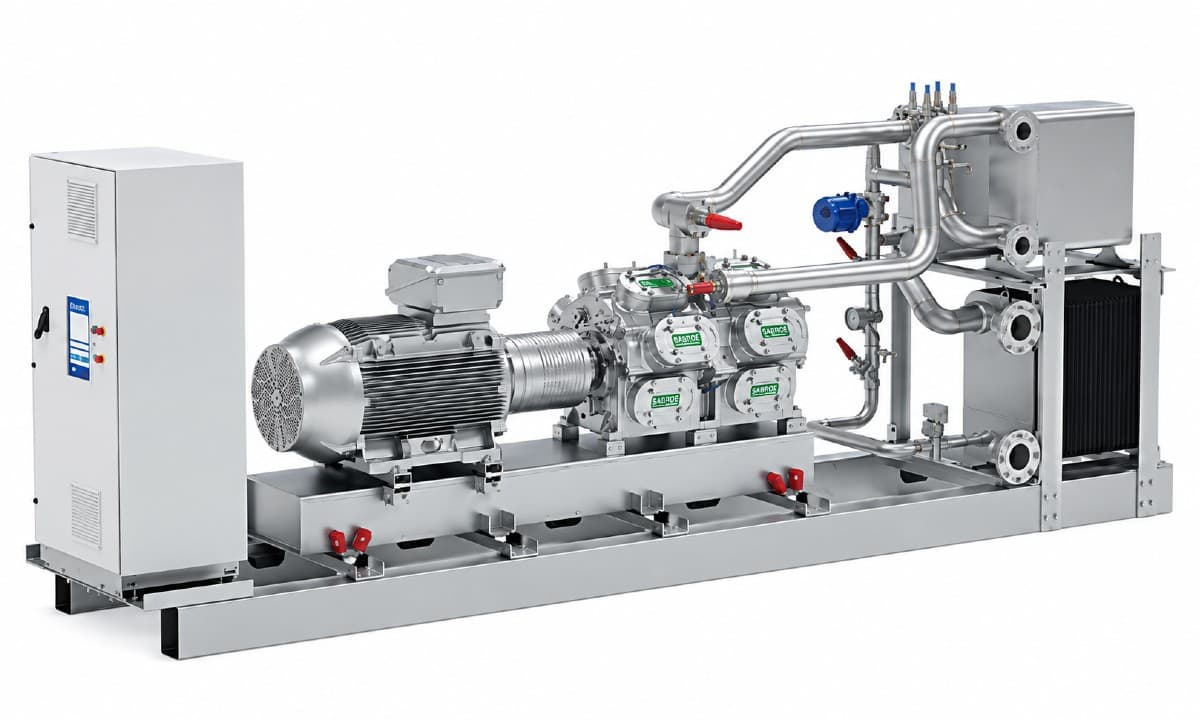
With the three-year LC R290 project nearing completion, the Germany-based Fraunhofer Institute for Solar Energy Systems (ISE) highlighted its developments in low-charge propane (R290) heat pumps for multi-family homes at the ATMOsphere (ATMO) Europe Summit 2025.
In a presentation, Timo Methler, the institute’s Building Heat Pump Department Team Lead, shared details about the project and considerations for lowering the propane charge in heat pumps. The event, organized by ATMOSphere, was held November 24–25 in Padua, Italy. ATMOsphere is the publisher of NaturalRefrigerants.com.
“In 2019 when I started, a state-of-the-art 8kW [2.3TR] R290 heat pump used 550g of propane ‒ now we can produce the same heating capacity with 148g,” Methler said. “At a larger scale, we’ve developed a central indoor brine–water heat pump prototype that delivers 28kW [8TR] of heating capacity using just 760g of propane, with a SCOP of 3.6 at an outlet temperature of 55 °C [131°F].”
The project, funded by Germany’s Federal Ministry for Economic Affairs and Climate Protection, started in January 2023 and will conclude in December. With a €9 million ($10.6 million) budget and support from 20 companies in the heating and housing sectors, the project focuses on developing heat pumps to replace gas and oil heating systems in both centralized and decentralized applications based on existing German multi-family buildings.
Methler reports that after the conclusion of the LC R290 project, the institute will continue its work on R290 heat pumps, disseminate publicly available low-charge research findings and transfer knowledge to other sectors to aid the transition to natural refrigerants, including the mobile cooling industry and CNC (computer numerical control) machining. He also noted that, for a fee, the institution provides workshops for heat pump manufacturers and reviews industry-developed R290 prototypes.
Details/results: The LC R290 project aims include design, system integration, simulation, safety assessment and public representation of propane heat pumps, with a focus on heating capacities from 16 to 35kW (4.5 to 10TR) for medium-sized multi-family dwellings.
- Research focused on three types of units: a 30kW (8.5TR) brine-to-water heat pump for centralized basement heating systems; a 30kW centralized air-to-water version; and a 6kW (1.7TR) brine-to-water decentralized unit for old German buildings that contain a small heating unit in individual bathrooms.
- Through simulation and testing, Fraunhofer determined the optimal R290 charge to be from 100 to 270g for maximum heat pump efficiency. Factors taken into consideration include an inlet brine temperature of 0°C (32°F), a water sink range from 24 to 35°C (75 to 95°F), compressor frequency from 34 to 120Hz and superheat from 5 to 15°C (9 to 27°F).
- In June Germany’s Ait-group ‒ one of the companies supporting the project ‒ launched two residential R290 6kW heat pumps with a refrigerant charge of 150g.
Addressing flammability: To support installation in low-ventilated areas, Fraunhofer funnel tested a thermal brine–water prototype and diffusion tested another unit, according to Methler.
- A funnel test directs and concentrates leaked refrigerant towards a potential ignition source.
- “With our safety aspect unit, we leak propane to outside air in a safe environment and measure the distribution with sensors,” Methler said.
- Results from the flammability testing will be presented at the (International Energy Agency) IEA 2026 Heat Pump Conference, Mether stated. The event will be held May 26‒29 in Vienna.
Multifaceted engineering: “Although there is no single easy way to reduce the refrigerant charge in an R290 heat pump, numerous small changes compound into large reductions,” Mathler said.
- Since oil absorbs propane, making the refrigerant useless in the thermodynamic process, Methler’s first suggestion is to use less oil in the compressor. In addition, insulating the compressor supports maintaining a temperature balance in the oil sump, allowing charge reduction.
- Uniform distribution across the heat exchangers with small or asymmetric manifolds/ports increases efficiency.
- “Achieving extreme charge reductions requires additional control strategies, including starting procedures and defrost operations,” Methler said.
Quotable: “New R290 heat pump market developments are coming,” Methler said. “I know that at least 50% of the companies supporting the LC R290 project are developing next-generation low-charge propane heat pumps.”
“We’ve developed a central indoor brine–water heat pump prototype that delivers 28kW [8TR] of heating capacity using just 760g of propane.”
Timo Methler, Building Heat Pump Department Team Lead at the Fraunhofer