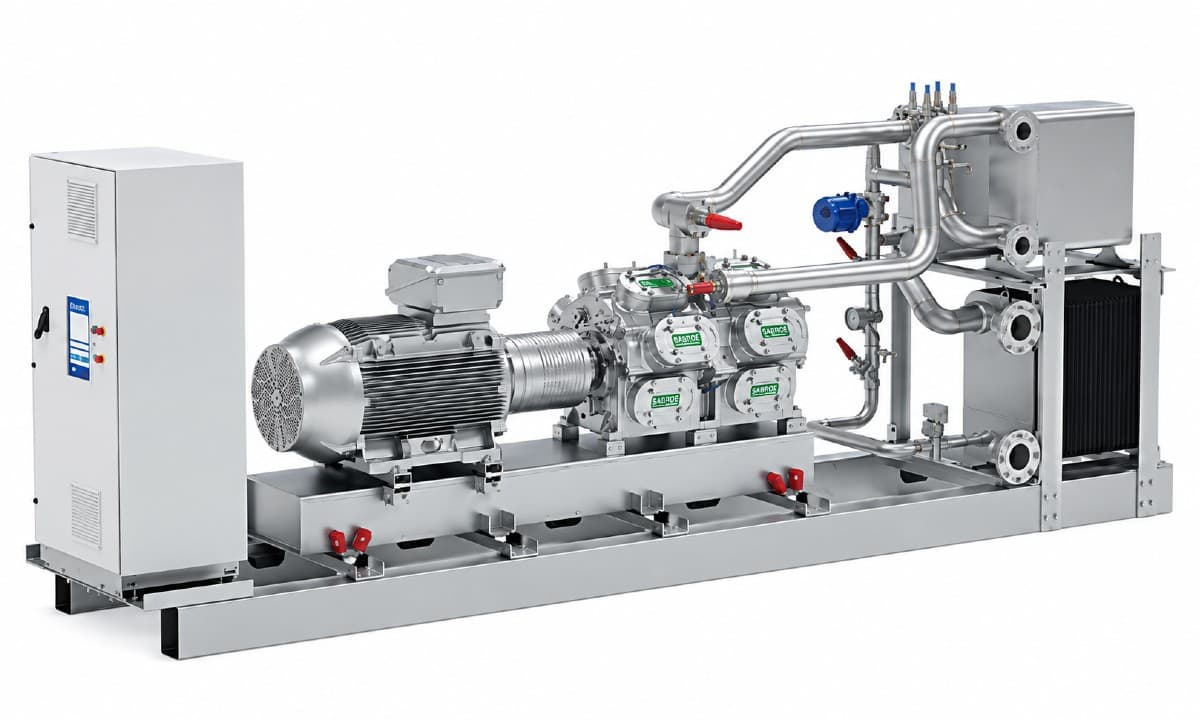
Intellihot, a U.S.-based commercial water heater manufacturer, installed two tankless CO2 (R744) heat pump water heaters at a middle school in Washington, D.C., reducing CO2 emissions by over 3,000lbs (1,360kg) in March 2024 as compared to the previous gas boilers.
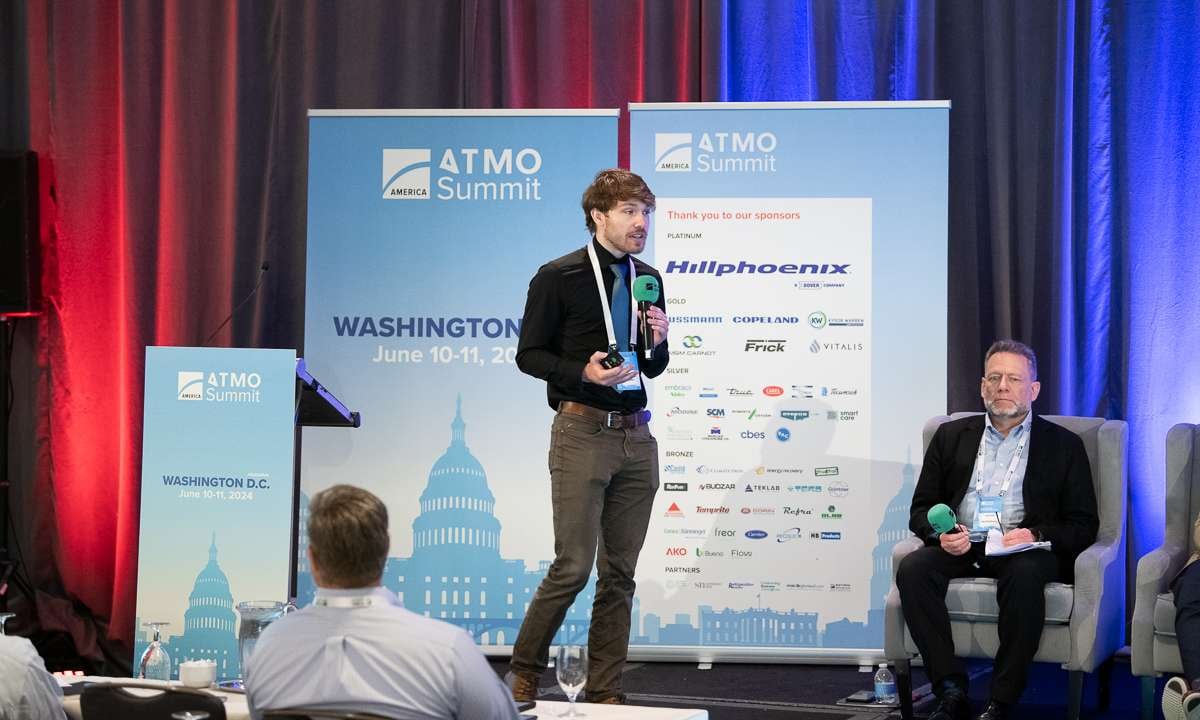
Robbie Svidron, Corporate Trainer at Intellihot, presented performance results from the installation at Kelly Miller Middle School during the ATMOsphere (ATMO) America Summit 2024. The summit, organized by ATMOsphere, the publisher of NaturalRefrigerants.com, took place June 10–11 in Washington, D.C.
Intellihot, founded in 2009 and based in Vernon Hills, Illinois, offers CO2 heat pump water heaters in its Electron Series, which it calls “the world’s first” tankless heat pump water heaters. Intellihot’s system does not store energy in water tanks but rather in a “thermal battery,” which Svidron said “is about a 60gal” (227L) mix of propylene and glycol.
“We move heat from the air to this thermal mass, and a stainless-steel heat exchanger coil suspended inside this thermal battery heats the potable water,” said Svidron.
Intellihot installed two of its iE1 Electron series CO2 heat pump water heaters at Kelly Miller in October 2023, replacing two gas-fired water heaters that provided heating for bathroom and kitchen sinks as well as showers, which Svidron noted were “rarely used.” Svidron presented data gathered from March 2024, calling it the “highest fidelity month” and noting that data from the other months was captured during periods of the system’s initial setup and calibration.
Both the CO2 system and the gas-fired system had a required heat output of 35,106,750BTU (10,288kW/2,295TR), but the energy input for Intellihot’s iE1 Electron units was 18,857,442BTU (5,526kWh) compared to the gas-fired system’s 59,102,273BTU (17,321kWh).
The CO2 system produced 3,622lbs (1,642kg) of CO2 emissions, while the gas-fired boilers produced 6,915lbs (3,136kg), a reduction of 3,293lbs (1,493kg) of emissions. The CO2 heat pump water heaters cost $829 (€765) to operate in March, while the gas-fired boilers cost $887 (€818), a savings of $58 (€53) despite gas being cheaper than electricity.
The iE1 and iE6
Intellihot’s iE1 unit has a COP of up to 4.9 with a heating capacity of up to 97,000BTU (28.4kW/8.1TR/). It can produce hot water at 100 to 170°F (38 to 77°C), and up to four units can work together, with installation possible both inside and outside a building. Svidron also mentioned the iE1 can operate in ambient air temperatures ranging from −10°F (−23.3°C) to 110°F (43.3°C) and includes backup resistive elements for redundancy.
In addition to the iE1, the company offers the larger iE6 model, which connects to a remote thermal battery, has a COP of up to 4.2 and has a heating capacity of up to 300,000BTU (25TR/87.9kW). The iE6 is installed outside a building, and its remote thermal battery is installed inside. Its output water temperature ranges from 100 to 190°F (38 to 88°C).
Both units are solar ready, operate in a wide range of temperatures and include electric heating elements for redundancy.
Future plans
Intellihot aims to expand the adoption of its heat pump water heaters. “We want to bring this to every commercial application out there,” said Svidron, mentioning the technology’s potential for use in hotels, stadiums and high-rise buildings.
In addition to scaling, another goal is to enhance the system’s scalability. Intellihot is working on a conceptual design that would split that would enable its smaller iE1 model to function like the larger iE6, with the thermal battery placed inside a building and the heat pump installed outside. “This allows us to store more thermal energy if necessary or produce more energy with the heat pump side,” Svidron explained.
Intellihot is also focusing on improving controls to eliminate the need for swing tanks, additional storage tanks used to handle fluctuations in hot water demand. Additionally, the use of phase change material (PCM) to store more energy is part of its future plans. “When that becomes cost-efficient and more widely available, that will be something we’re looking at doing,” said Svidron.
“We want to bring this to every commercial application out there.”
Robbie Svidron, Corporate Trainer at Intellihot