The Expert Opinion provides a platform on NaturalRefrigerants.com for experts to share their views on technology, market trends, policy developments and more. Contributors are not paid, and all opinions are their own. NaturalRefrigerants.com maintains full editorial control over each submission. If you’re interested in contributing to The Expert Opinion, please fill out this form.
This Expert Opinion column has been written by Stefan Jensen, Managing Director of Scantec Refrigeration Technologies, which provides low-charge ammonia (R717/NH3) solutions and transcritical CO2 (R744) packages for commercial and industrial applications. In this column, Jensen writes about the benefits of centralized and bespoke low-charge ammonia dry expansion (DX) systems in industrial refrigeration in Australia, where Scantec is headquartered.

DX NH3 uptake
The installed base of Scantec Refrigeration Technologies low-charge NH3 systems is approaching 50 plants in Australia, China and Malaysia. Some applications involve replacing existing air-cooled HFC-based installations with completely future-proof NH3-based systems delivering two to three times lower annual energy consumption.
Evaporator design represents a very important element of a successful DX NH3 installation as does the way the refrigerant injection into the evaporators is designed and controlled. With each new plant commissioned, new design and installation insights are accumulated.
The liquid overfeed concept disguises the part-load issues affecting most liquid overfeed evaporators in practice. Examples include brining, excess overfeed ratios, elevated refrigerant inventories, poor refrigerant distribution and reduced refrigeration capacities caused by less-than-optimal peripheral conditions around the evaporators.
The DX NH3 concept addresses all these practical issues and more while reducing overall NH3 charge by four–five times. DX NH3 maximizes the inherent NH3 advantage of low molecular weight, whereas liquid overfeed does the opposite.
“DX NH3 maximizes the inherent NH3 advantage of low molecular weight, whereas liquid overfeed does the opposite.”
Stefan Jensen
Managing Director of Scantec Refrigeration Technologies
Lack of awareness and design expertise appear to be the main factors inhibiting the progression of DX NH3 in all industrial refrigeration applications as well as within the HFC replacement market. DX NH3 offers many advantages over liquid overfeed systems, a handful of which are outlined below.
Energy efficiency
When refrigeration loads vary as they do, a common issue in liquid overfeed systems is that vapor velocities in evaporators and pipelines reduce, and liquid overfeed rates increase. This is because the amount of liquid circulated by the refrigerant pump(s) is rarely regulated in concert with load changes. This, combined with lack of shear stress between liquid and vapor phases during reduced loads, creates difficulties returning unevaporated liquid to the engine room.
The graph below shows recorded specific energy consumption values (SEC) for a range of refrigerated warehouses serviced by different types of refrigerating plants as marked.
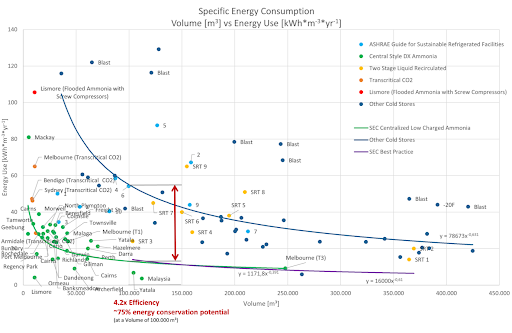
SEC is measured in kilowatt-hours per cubic meter per year where the volume refers to the total refrigerated volume of the warehouse. The upper blue line represents average practice. It has been drawn through a range of SEC values for conventional liquid overfeed NH3 systems with screw compressors. The green line represents central DX NH3 systems.
The example for a 100,000m3 (3,531,466ft3) mixed warehouse shows that the difference in SEC value between average practice and DX NH3 is a factor of around four. The energy performance of transcritical CO2 systems (TC CO2) in comparison with DX NH3 is also shown. SEC values for TC CO2 systems at sea level in Australia are 1.4 to 1.5 times higher than for equivalent DX NH3 systems.
Here, the impact of the presence of liquid in the suction line network on annual energy consumption is shown, with best practice SEC referred to as “BP.”
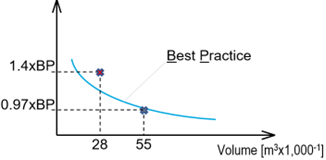
The two warehouses with refrigerated volumes of 28,000m3 (988,810ft3) and 55,000m3 (1,942,306ft3) are owned and operated by the same entity in the same geographic area performing the same duties. Both plants are conceptually identical. The only difference is the refrigerant feed method. Liquid overfeed SEC is 1.4 times higher than BP.
Automatic hot gas defrost
A DX NH3 evaporator for low temperature service has an operating refrigerant inventory that is 30 to 50 times lower than an equivalent liquid overfeed evaporator. Pumping out a liquid overfeed evaporator in preparation for a hot gas defrost can take hours. The pump-out time for DX NH3 evaporators is measured in minutes.
In in-line freezing and chilling applications, sequential defrost is often applied. The time available for defrost may be limited to a few minutes. In practice, this can cause the introduction of hot gas into evaporators that contain relatively large amounts of subcooled liquid. This situation belongs to the category of the most common causes of liquid hammer and accidental ammonia releases in industrial refrigeration applications.
Energy management
Increasingly, large consumers of electricity are being paid for reducing their electricity consumption during periods of high loads affecting the electricity grid. Elevated grid loads rarely coincide with high levels of renewable energy generation.
Central DX NH3 refrigerating plants are simpler and less problematic to manage – switch on and off – remotely than large-scale liquid overfeed systems. Liquid management issues associated with remote stopping/starting DX NH3 systems are virtually non-existent.
Technical life
The technical life of a system or concept may be said to have been reached when an alternative system or concept emerges that makes the continued use of an existing plant economically unviable.
Presently two existing Australian NH3 liquid overfeed systems that have reached end of life are being replaced with new DX NH3 systems by Scantec. The projected SEC reduction is around 40–50%. The simple pay-back period for this investment is around seven years, which is relatively unimpressive.
If, however, unit electricity costs were to escalate to AU$1,659/MWh (€936/MWh and US$1,065/MWh) as they did in two Northern European countries at the start of 2025, the simple pay-back period for these projects would reduce to around two years. This represents an end-of-technical-life scenario because the alternative, newer concept makes continued use of the existing system economically unviable.