There was no shortage of presentations on ammonia (R717) or CO₂ (R744) refrigeration systems at the second annual Industrial Refrigeration Network (IRN) conference, organized by Bitzer and held June 6–7 in Rottenburg am Neckar, Germany.
The IRN conference was held at the Schaufler Training Academy, Bitzer’s international training center, which opened in 2016. A total of 130 attendees packed its main conference room for two days of presentations from nearly 20 systems manufacturers, OEMs and contractors.
“The focus is on safe, future-proof and energy-efficient solutions based on natural refrigerants in industrial refrigeration,” Bitzer said.
In addition to presentations on best practices in industrial refrigeration and installations, the program also branched out and included other large-scale refrigeration and heating projects in the HVAC&R industry. These included presentations on a butane (R600) high-temperature heat pump (HTHP), a CO2 chiller used to cool CERN’s Large Hadron Collider and how heat pumps used for district heating can help balance the grid.
Industrial refrigeration
Among the industrial refrigeration presenters were Star Refrigeration, Evapco Europe and Danfoss. Star Refrigeration’s Group Sales and Marketing Director, Robert Lamb, presented on optimizing costs, which included a focus on how proper condenser and evaporator fan speed management could cut energy consumption.
Evapco’s Country and Branch Manager, Michael Rabenstein, spoke about the use of hybrid evaporative condensers – those containing a dry and wet coil – in industrial CO2 refrigeration. Data from Evapco showed that a hybrid condenser could enable an industrial CO2 refrigeration system to stay in subcritical mode despite an ambient temperature of 36°C (96.8°F).
Danfoss did a deep dive into NeoCharge, its system for reducing the charge of industrial ammonia systems, at the IRN conference led by Advisor Morten Juel Skovrup. Juel Skovrup gave an example of a freezing tunnel in an industrial facility that, using NeoCharge, was able to cut its ammonia charge by 300kg and have enough remaining capacity for a new freezer.
HTHPs and CERN
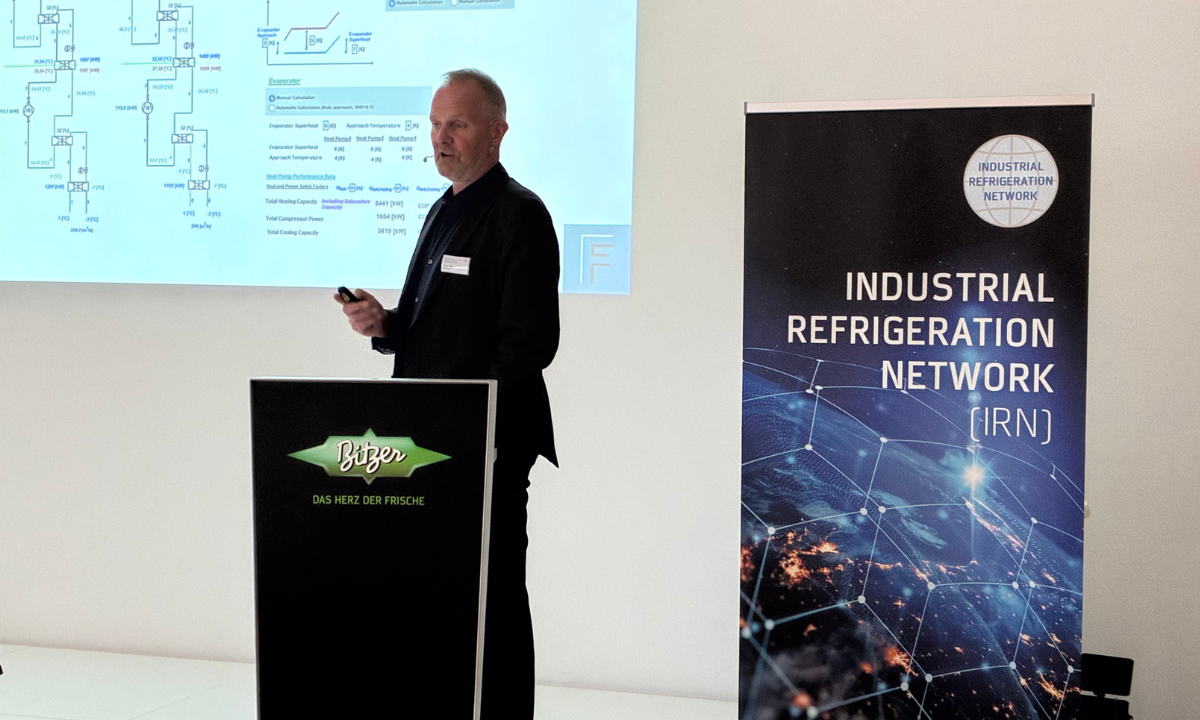
High-temperature heat pumps are a major topic of discussion in Europe as the drive to decarbonize industry and buildings heats up. Jürgen Süß, Business Development Director for DACH at Fenagy, spoke about several of the Danish heat pump manufacturer’s district heating installations in Denmark. Süß touched on how, in addition to helping decarbonize district heating systems – which can reach 10MW (2,843TR) in size – Fenagy’s air-source CO2 heat pumps can assist with grid balancing by stopping/starting in under five minutes. Its heat pumps can reach outlet temperatures of 90°C (194°C) with a propane-isobutane (R600a) setup.
Sven Leimpek, Sales Manager for Germany at Vahterus, and Tim Hamacher, Managing Director at SPH, spoke about a butane high-temperature heat pump they’re working on that produces steam at up to 115°C (239°F) that is then lifted to 195°C (383°F) via a mechanical vapor recompression system. SPH’s heat pump utilizes Vahterus’ plate-and-shell heat exchangers and will be installed at the Takeda’s Viennese production facility of Takeda, a subsidiary of global biopharmaceutical company Takeda Pharmaceutical.
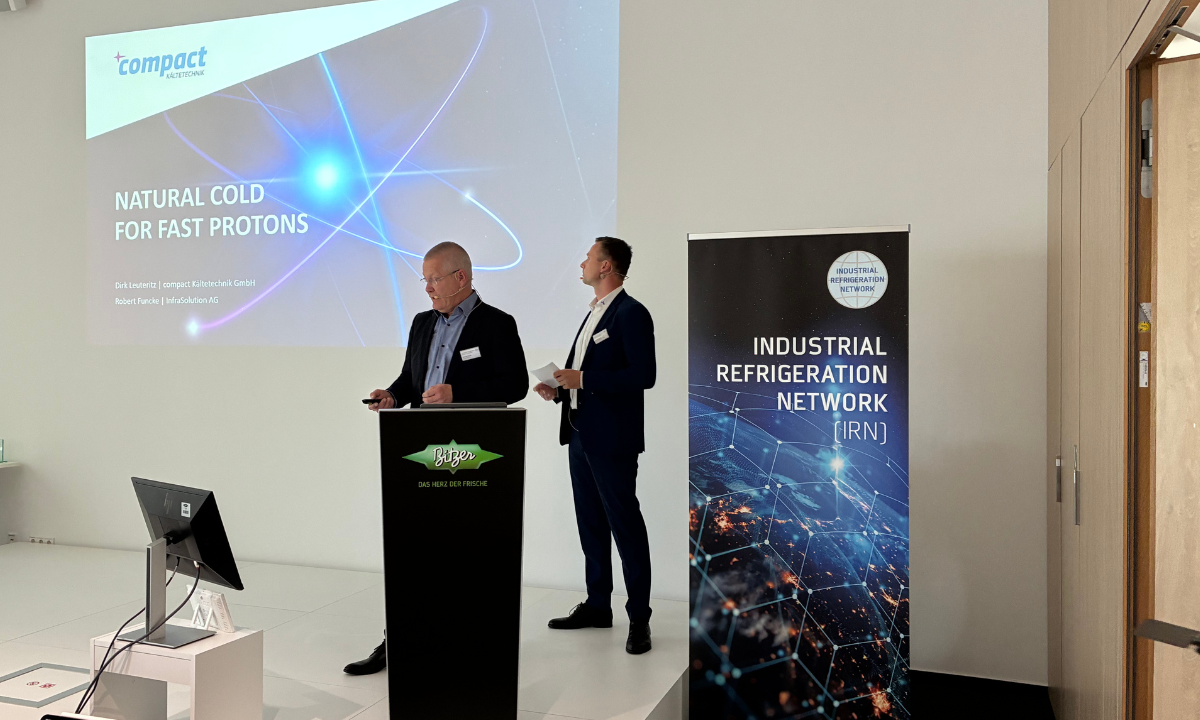
Dirk Leuteritz, Head of Sales at refrigeration systems manufacturer Compact Kältetechnik, and Robert Funcke, International Sales at refrigeration-systems contractor InfraSolution, presented one of the IRN conference’s most unique projects. The German companies collaborated on a 1.3 MW (369TR) CO2 chiller that cools the silicon detectors – used to track particles from proton collisions – in CERN’s Large Hadron Collider, which is located near Geneva. In addition to maintaining an evaporator temperature of −53°C (−63.4°F), the Large Hadron Collider’s underground location meant the evaporator and condenser were separated by 90m (295ft).