This is an excerpt from an article featured in ATMOsphere’s “Clean Cooling for Data Centers 2025” report, which can be downloaded here. ATMOsphere is the publisher of NaturalRefrigerants.com.
Secon is a German manufacturer of hydrocarbon heat pumps and chillers founded in 2010 and headquartered in Gondelsheim, Germany. Joachim Schadt, Owner and Managing Director of Secon, said the company works “in the field of critical applications,” such as pharmaceuticals, chemicals, food and infrastructure. The company is particularly active in the DACH region (Germany, Austria and Switzerland).
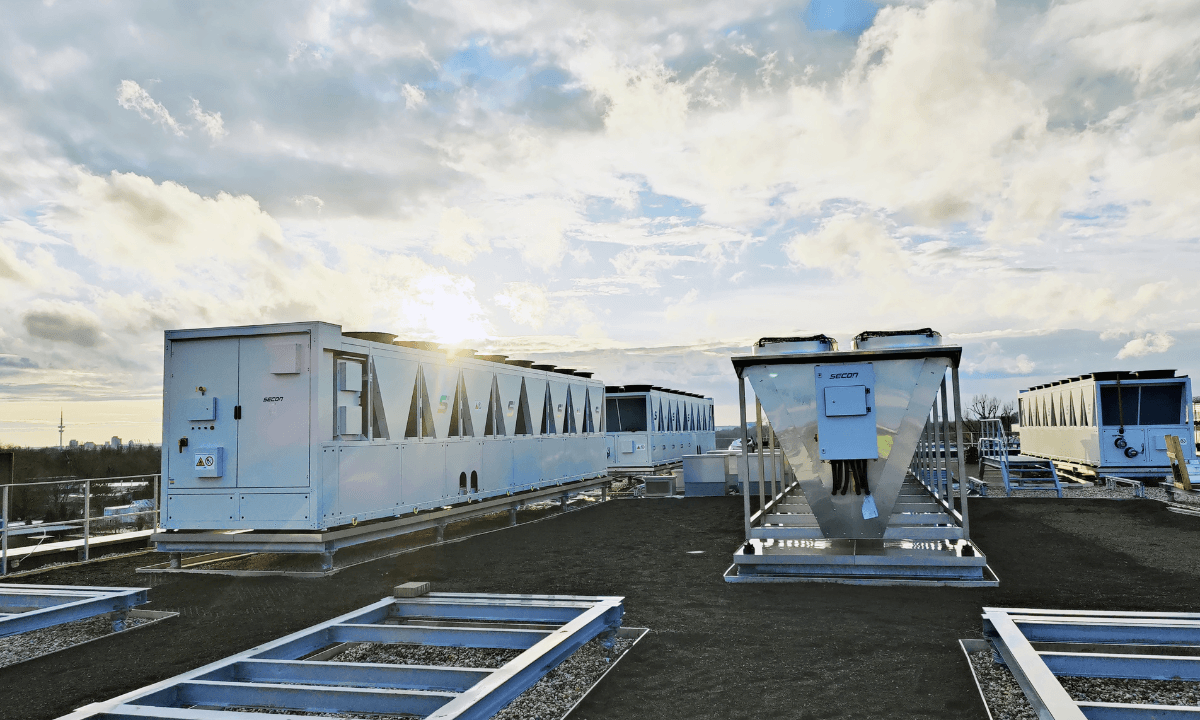
Penta Infra is a provider of edge data centers in Europe. With locations in Germany, France, the Netherlands, Belgium and Denmark, Penta’s solutions range from full-service colocation to build-to-suit data centers. The company was established in 2015 and traditionally worked with synthetic refrigerants but is shifting toward natural refrigerants. A recently built Penta Infra colocation data center in Hamburg is cooled by Secon’s propane (R290) chillers.
Secon’s hydrocarbon chillers
Secon manufactures air-cooled and water-cooled chillers and has supplied both for data center projects. Its chillers can contain up to four refrigerant circuits, which reduce the amount of refrigerant that can leak out of an individual circuit. Free cooling is standard, with Schadt noting that it is “the key to achieve low PUE [power usage effectiveness] values.”
Schadt said Secon’s hydrocarbon chillers are “not designed for the lowest possible price.” Instead, they’re “built for efficiency and operational reliability, which then translates into the lowest possible lifecycle costs,” he said, adding that Secon customizes its chillers for data center projects.
“We’re not selling out of a catalog,” Schadt said. “We talk to the customers, their consultants or both to get a feeling for their requirements. In the end, the only ‘identical’ chillers we produce are ones used for the same project.”
Customization is particularly evident in hydraulics and controls optimization. Secon’s chillers are equipped with ultrasonic flow meters that detect the “real flow” of water in cubic meters per hour as opposed to switches that detect whether water is flowing. The control systems for the chillers also come standard with uninterruptible power supplies (UPS) and automatic transfer switches that move the power supply from one electricity supply to another while the UPS continuously supplies power to the control system in the event of an interruption.
“The data center providers always ask, ‘What are your references?’ When you show them references in pharmaceutical applications as well as food and beverage, they trust you.”
Joachim Schadt,
Owner and Managing Director of Secon
Moving to natural refrigerants
Harmen Laan, Head of Engineering at Penta Infra, said that the transition to hydrocarbon chillers has been challenging, largely because the technology is still considered non-standard within the data center industry. He noted that much of the hesitation stems from unfamiliarity with hydrocarbon-based systems and “persistent myths” that range from concerns about safety and inefficiency to perceptions of outdated technology and the absence of recognized certifications like Eurovent.
“While these concerns are mostly unfounded, it is true that hydrocarbon chillers generally require a larger physical footprint, which remains a valid consideration,” Laan said.
To address these concerns, Laan and his team conducted a thorough investigation, benchmarking hydrocarbon solutions against synthetic refrigerant alternatives. This included multiple site visits to Secon’s manufacturing facilities in Croatia and Italy to ensure the systems met the high standards required for “mission-critical operations.”
Carving out a niche
Since 2018, Secon has completed 34 data center projects with a total of 95 chillers delivered. The vast majority of those projects have been in Germany. The company currently has 30 projects in the design and tendering phases and is seeing “increased demand in this area,” according to Schadt. The majority of projects are for the DACH region, and the company’s work in “critical fields” helped it enter the space.
“The data center providers always ask, ‘What are your references?’” Schadt said. “It can’t be a large data center as you are one of the first to approach us about this, but when you show them references in pharmaceutical applications as well as food and beverage, they trust you.”
He said that the European Union’s F-gas Regulation has driven increased demand for Secon’s hydrocarbon chillers, with the “PFAS issue” also contributing. Schadt said Secon’s data center business has grown by 10% in the past two to three years, and he expects even greater growth in the future.
In addition to the DACH region, the company has worked on data centers in France, the Netherlands and Denmark. The largest data center Secon has worked on to date – in terms of installed IT power capacity – is 4.4MW. Data center projects in its pipeline range from 1MW to 20MW of installed IT power capacity, with Secon’s chillers providing the entire IT cooling load.