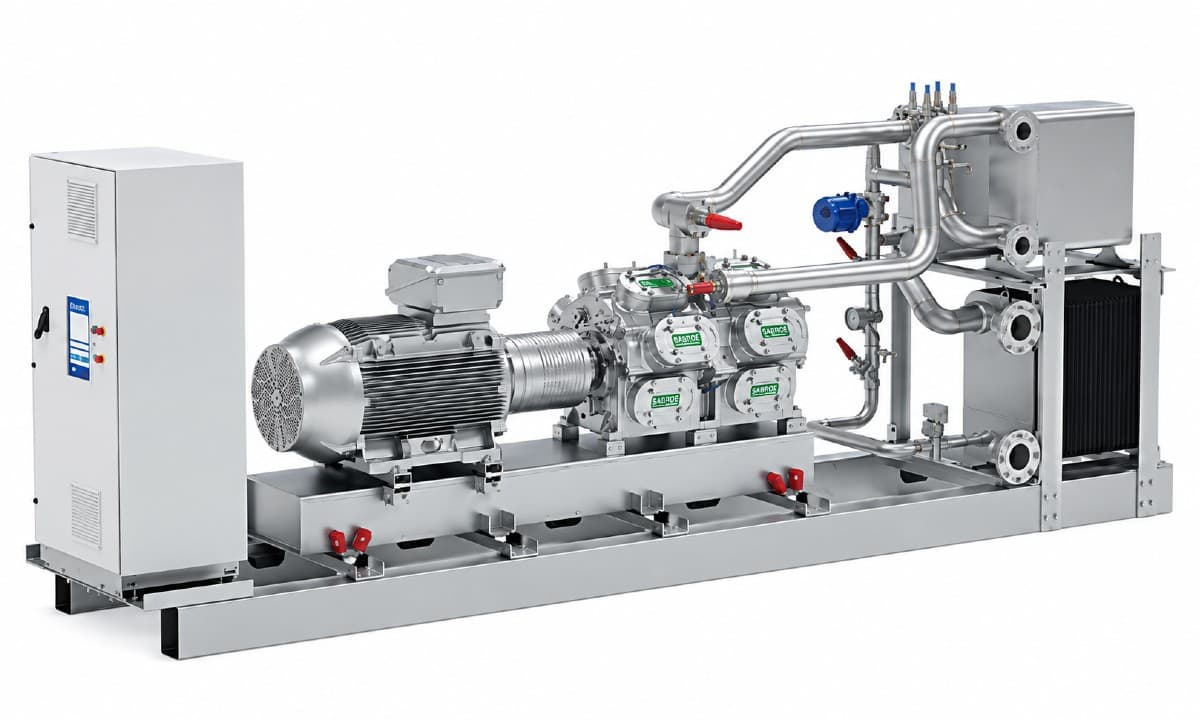
Lync by Watts showcased the flexibility of its CO2 domestic hot water heat pump for large-scale electrification at ATMOsphere America Summit 2026, highlighting its availability in air-source, water-source and hybrid configurations.
Andrew Macaluso, Senior Product Manager of System Solutions at Lync by Watts, outlined the technology in a presentation about commercial HVAC market trends. Zackery Fink, President of ZBF Geothermal, and Geoff Cullen, Mechanical Division Manager at G.A. Fleet, presented separate case studies. The event, organized by ATMOsphere, publisher of NaturalRefrigerants.com, took place June 2‒3 in Tarrytown, New York.
“We formed Lync about five years ago to bring cutting-edge CO2 solutions to market with an integrated design for the entire system, including the heat pump, storage tanks, electric tanks and mixing valves,” Macaluso said. He added that the company has already installed a “few hundred” units across North America, from Florida to British Columbia.
In air-source configuration, Lync’s Aegis unit can achieve up to 170°F (77°C) storage temperatures in ambient conditions as low as −4°F (−20°C). In water-source configuration, it reaches similar temperatures with glycol inlet temperature down to 18°F (−8°C).
In a hybrid configuration, the system automatically selects the most favorable heat source, according to Macaluso. For example, in locations requiring space cooling and heating, it uses the HVAC cooling return loop during summer when waste heat is available, and it switches to air-source in winter.

Proving the technology: In 2021‒2022 G.A. Fleet, Lync’s representative in New York City, installed its first air-source CO2 heat pump system in a retrofit of a 66-unit Bronx apartment building owned by the NYC Housing Authority (NYCHA).
- The contractor installed two 500MBH (41.7TR/147kW) CO2 heat pumps in a single parking space and a 1,000gal (3,785L) domestic hot water tank inside the building, with the systems connected via an intermediate glycol loop and heat exchanger.
- “With the heat pump operating the past three winters, NYCHA has yet to turn back on the gas boiler which it retained for backup,” Cullen said.
- As part of its sustainability agenda, NYCHA now requires heat pumps for all domestic hot water systems. The group is currently conducting energy monitoring of the Bronx apartment building to assess the CO2 system’s COP and its energy savings.
Southern application: At a Florida aerospace facility, a water-source unit uses the chiller plant’s return water as the heat source, reducing the building’s overall energy use.
- “We actually made the chiller load so low when we started the CO2 unit at this site that we had to increase the temperature on the chiller plant to keep it from running,” Macaluso said. He estimated the heat pump’s annual COP at 2.9.

Meeting specs: Lync’s CO2 water-source configuration allowed ZBF Geothermal to lift 35°F (1.7°C) ground water to 170°F storage tank temperature for a new 450-unit apartment building on Coney Island, according to Fink.
- Compared to synthetics, CO2 offers higher efficiency, higher storage temperatures and a smaller footprint to meet the building’s electrification requirements.
- “Modeling shows that CO2 increases the COP from R134a’s 1.9 to 3.5, delivering an annual energy savings of $229,000 [€199,000] for the Coney Island apartments,” said Fink.
Configuration options: Macaluso highlighted two additional projects that demonstrate solution flexibility.
- In a retrofit of a 700-unit apartment building in Washington, D.C., Lync installed five Aegis A 500 units with cool water recovery beneath the building’s chiller plant, along with five custom storage tanks and an electric circulation tank. “We can fit it in a very tight space, increase the performance of the mechanical cooling system and provide hot water to the apartment complex,” Macaluso said.
- He added that installing a CO2 heat pump alongside existing equipment nearing end of life can help customers bridge the gap to full electrification.
- As part of a study by the U.S. Department of Energy, Lync installed an Aegis A 250 unit in a 130-bed army barracks in Virginia, while retaining the gas-fired boiler for backup. “A piecemeal approach keeps first cost down and allows customers to gain confidence in a full-system solution,” Macaluso said.
“With the heat pump operating the past three winters, NYCHA has yet to turn back on the gas boiler which it retained for backup.”
Geoff Cullen, Mechanical Division Manager at G.A. Fleet